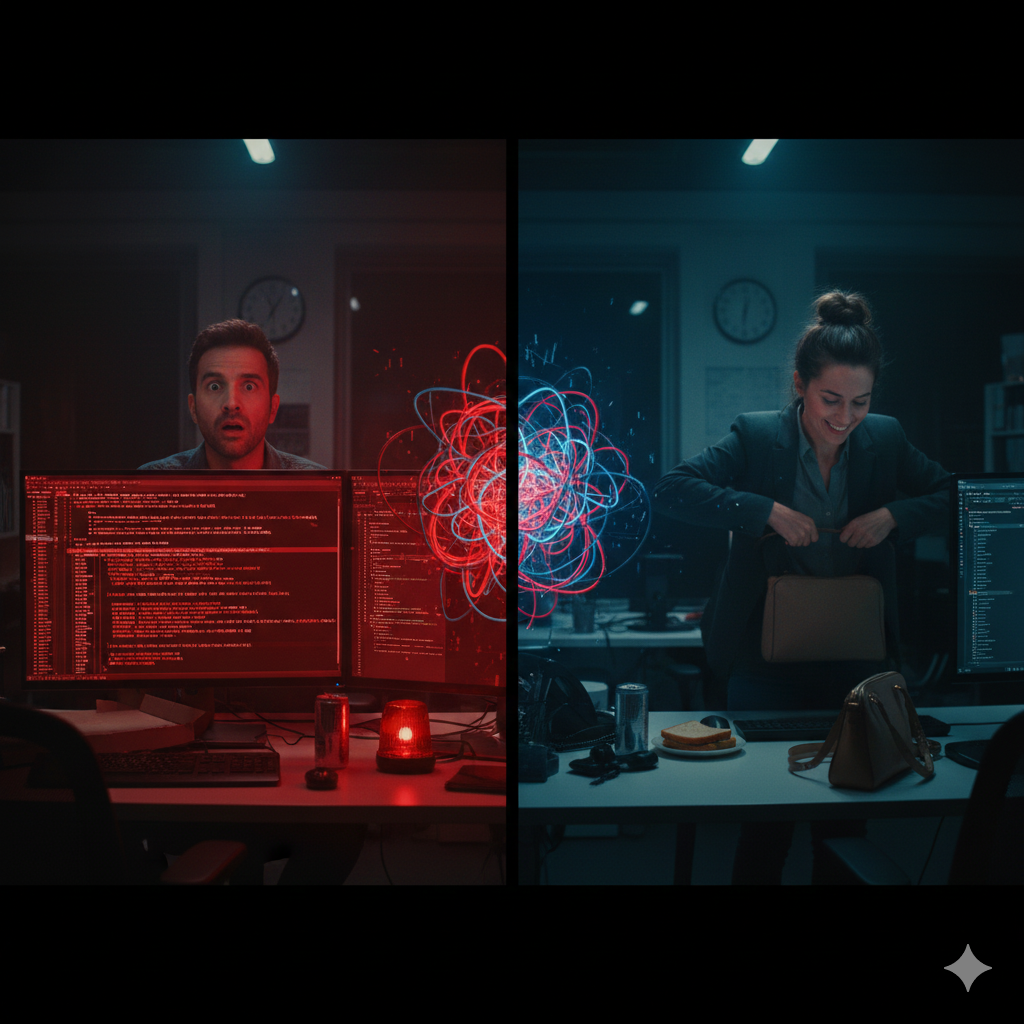
There is a specific kind of silence that falls over a development office when a Merge Conflict occurs. It usually happens at the worst possible moment: 5:30 PM on a Friday, right before a release.
Imagine the scene. Carlos has spent three days refactoring the authentication logic. He feels triumphant. He runs his tests, they pass. He types git push with the confidence of a winner. But instead of a success message, the terminal vomits a wall of angry red text. rejected.
Why? Because Ana, sitting three desks away, decided to “quickly clean up” the exact same file two hours ago. She pushed her changes and went to lunch. Now, Carlos is staring at a file full of <<<<<<< HEAD markers. His code is mixed with Ana’s code, creating a Frankenstein monster that doesn’t compile. The triumph vanishes. Now, they have to spend their Friday evening untangling the wires, debating whose logic survives and whose gets deleted.
Coding in the Dark
The tragedy of the Merge Conflict is that it is almost never a technical failure; it is a communication failure. It is the digital equivalent of two carpenters trying to build a doorframe at the same time, without looking at each other. One is sanding the left side, the other is hammering nails into the right, and when they meet in the middle, the door doesn’t close.
This happens because teams often work in “Stealth Mode.” Developers pull a ticket, bury their heads in the IDE, and disappear. If the task is vague—like “Improve User Interface”—it is entirely possible for two people to touch the same CSS file without knowing it. They are working in parallel universes that are destined to collide.
Human Version Control
We spend hours configuring tools like Git to manage our code versions, but we often forget to configure the “Human Version Control.”
Git can tell you that a conflict happened, but it cannot tell you why. To prevent the conflict, you need to move the timeline back. You need visibility before the first line of code is written. The project management board is your first line of defense.
If the board is messy, the code will be messy. A clear assignment strategy acts as a “lock” on a file.
- Granularity is Safety: If a task is too big (e.g., “Build Checkout”), it invites collision. Break it down. One person owns “Payment Gateway Integration,” another owns “Cart UI.” The more specific the task, the smaller the blast radius of the code.
- The “In Progress” Signal: Moving a card to “In Progress” is not just a status update; it is a warning shot to the rest of the team. It says, “I am operating on this organ. Do not touch it.”
Transparency is Efficiency
When a team aligns their tasks before they open their code editors, the repository stays clean. You stop wasting time resolving conflicts and start spending time shipping features. The goal is to make the “who is doing what” so obvious that stepping on someone else’s work becomes impossible.
Don’t let your developers code in the dark. Avoid duplicate work and integration conflicts by keeping your development team aligned and visible in GGyess WorkSuite.