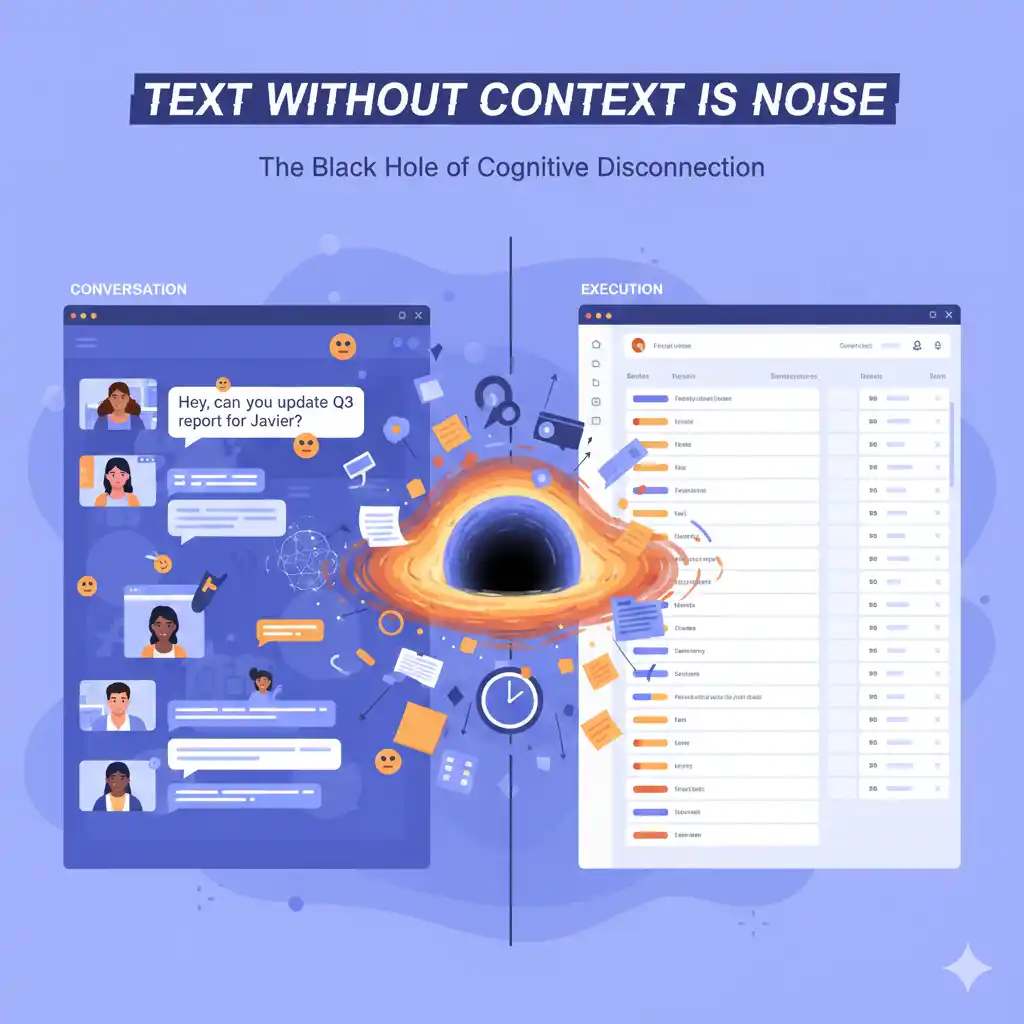
There is a fundamental principle in the theory of complex thinking that serves as a warning for the modern workplace: Text without context is noise.
When we strip a message of its environment—the time it was sent, the document it refers to, the specific task it addresses—we aren’t communicating. We are merely generating data. In the current landscape of project management, we are suffering from a plague of “Cognitive Disconnection.” We have separated the conversation about the work from the execution of the work.
We talk about tasks in one app (a chat tool), and we track the tasks in another (a project manager). This gap is not just an inconvenience; it is a black hole where time, logic, and motivation disappear.
The Phenomenon of the “Digital Archaeologist”
To understand the cost of this disconnection, we must look at the daily reality of a typical project manager—let’s call him David.
David is managing a website launch. Three weeks ago, a decision was made to change the landing page header from a video to a static image. Today, the client asks: “Why did we do that? The video was better.”
David freezes. He remembers the decision, but he doesn’t remember the why.
- He opens his chat app and searches for “video.” He gets 342 results across five different channels.
- He checks his email. Nothing.
- He looks at the task card in his project management tool. The card simply says “Update Header.” The status is “Done.”
David spends the next 45 minutes acting as a Digital Archaeologist. He is digging through strata of old messages, piecing together fragments of conversation, trying to reconstruct the logic of the past. He is not working; he is excavating.
Finally, he finds it: a single line in a group chat from a developer saying the video was slowing down load times by 4 seconds. That is the context. But because that context lived in a chat app, isolated from the task card, the “reasoning” was lost while the “action” remained.
The High Cost of Cognitive Switching
This scenario represents the greatest enemy of productivity: The Split Brain.
When your team discusses a file in a chat app but works on the file in a separate window, they are forced to hold two parallel realities in their minds.
- Reality A: The conversation stream (The “Why” and “How”).
- Reality B: The static task list (The “What”).
Every time an employee switches between these two apps to verify an instruction, they suffer a “context switch penalty.” It takes the brain time to refocus. When you multiply this by fifty messages and ten tasks a day, you aren’t just losing minutes; you are eroding the team’s ability to think deeply.
The Solution: The Integrated Narrative
The antidote to noise is not more communication; it is Integrated Communication.
We must move toward a model where the dialogue occurs on the object of work.
- If the discussion is about a design, the chat must happen on the design file.
- If the discussion is about a deadline, the comment thread must live inside the task card.
When communication is integrated, the history and sense of every decision are preserved naturally. You no longer have to search for the “why.” It is right there, attached to the “what.”
Preserving the Story of the Work In this model, the task card is no longer just a checklist; it becomes a historical record. If a new team member joins the project halfway through, they don’t need to read three months of chat logs. They simply open the relevant task and read the specific thread attached to it. They see the initial brief, the feedback, the pivot, and the final approval—all in one linear narrative.
This eliminates the “he said/she said” ambiguity. It turns the workflow into a single source of truth.
Closing the Gap
The era of the “isolated chat” is ending. It served its purpose for casual connection, but for high-performance execution, it is a liability. To build a system that respects complex thinking, we must glue the conversation to the action.
Stop forcing your team to be archaeologists. Give them the power to see the text and the context in a single glance.
Avoid misunderstandings, eliminate the noise, and keep your conversations glued to the action with the collaboration tools of GGyess WorkSuite.