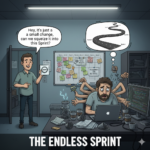
There is a pervasive myth in modern management that suggests a healthy team is a flat line. In this idealized version of the workplace, every member operates at 100% capacity, every single day. The workload is distributed evenly, like bricks in a wall, and stability is measured by how static everything remains.
But this industrial-era thinking is failing us. In the complex, fluid reality of knowledge work—particularly in hybrid and remote models—equilibrium is not static; it is dynamic.
A truly high-performance team isn’t one where everyone carries the exact same weight perpetually. It is a living system with the collective intelligence to fluctuate. It shifts pressure, redistributes weight, and adjusts to stress before the structure buckles. The ability to manage this dynamic reassignment is the true art of modern leadership.
The Invisible Crisis: A Tale of Two Employees
To understand why teams collapse even when they are full of talent, we have to look inside the “Invisible Information Gap” that plagues most managers. Consider the story of Sarah and Mark.
Sarah was the team’s anchor—a brilliant marketing coordinator known for her speed and reliability. Her manager, suffering from “Proximity Bias” and a lack of data, fell into a predictable trap: reliance on memory. Whenever a high-priority fire needed putting out, the manager instinctively handed the hose to Sarah. It wasn’t malice; it was habit.
Over a period of three weeks, Sarah’s reality became a nightmare.
- The Burden: Her task queue silently grew from a manageable stream into a crushing torrent.
- The Symptom: She began working late into the night, the glow of her monitor the only light in her room. Her communication in the team chat slowed to monosyllabic answers.
- The result: Her quality slipped. The typos she never used to make started appearing.
Meanwhile, just a few metaphorical desks away on the digital dashboard, sat Mark.
Mark was a skilled strategist on the same team. While Sarah was drowning, Mark was finishing his tasks by 2:00 PM. He felt underutilized, bored, and disconnected. However, he didn’t volunteer to help. Why? Because he lacked visibility. He couldn’t see the critical path of the project, and he certainly couldn’t see Sarah’s rising stress levels.
When Sarah finally burnt out and missed a mission-critical deadline, the team scrambled. The post-mortem meeting was tense. The manager blamed the deadline; the team blamed the workload. But the failure wasn’t Sarah’s lack of grit, nor was it Mark’s lack of initiative.
The failure belonged to the system. It was an information failure. The leader lacked the “systemic sight” to rebalance the weight before the collapse occurred.
Workload Management as Systemic Care
The lesson from Sarah and Mark is clear: The true challenge of team management is not surveillance; it is systemic care.
If a leader cannot see who is saturated and who has available capacity, the overload remains invisible. It operates in silence, deteriorating the foundation of the team until the day the resignation letter hits the inbox.
1. The Cost of the Information Silo
When a high-performer feels overwhelmed, they rarely complain immediately. They try to power through. They withdraw to focus, which ironically makes them less communicative. This individual saturation is, holographically, a symptom of a breakdown in collective distribution. If one cylinder in an engine is overheating while another is cold, the car doesn’t go faster—it breaks down.
2. Redistribution is Resilience
We often confuse resilience with endurance. We think resilience is about how much punishment an individual can take. Real resilience is the team’s elasticity.
Transparent visibility allows a leader to act as a “Manager of Resilience.” It gives you the power to see the disparity: The senior designer is at 95% capacity, red-lining, while the junior strategist is sitting at 40%. Seeing this data allows for proactive redistribution. You aren’t just assigning tasks; you are protecting your assets. You are preventing a bottleneck before it stops production.
3. The “Neuron” Approach
Effective assignment goes beyond just “who has time.” It requires understanding the ecology of the team. Think of your organization as a brain. You must identify the “neurons”—who is the Designer? Who is the Accountant? Who is the Developer?
You must combine that Role Description with Current Load to make an informed decision. This ensures the right task reaches the correct “neuron” of the organizational system. When you assign based on this data, you ensure that every unit of energy is spent where it generates the highest value.
Dynamic Visibility
For teams managing multiple projects, complex client portfolios, or remote staff, the ability to view and adjust the workload in real-time is no longer a luxury feature. It is a strategic imperative that directly impacts profitability and talent retention.
Your management tools must do more than just list tasks. They must offer immediate, objective transparency regarding task distribution. You need a cockpit that shows you the health of your system at a glance.
By providing dynamic views that instantly reveal which team members are overloaded with pending tasks and which have the bandwidth for new responsibilities, you transform from a reactive firefighter into a proactive architect. You maintain the team’s response capacity without sacrificing individual well-being. This capability transforms a team from a group of individuals struggling with misassigned workloads into a cohesive, highly efficient machine.
Don’t let your “Sarahs” burn out in silence while your “Marks” wait for instructions. The difference between a chaotic week and a productive one is often just a matter of seeing the full picture. Keep your team healthy, balance the weight intelligently, and prevent the silent overload before it happens with GGyess WorkSuite.