Imagine the silence.
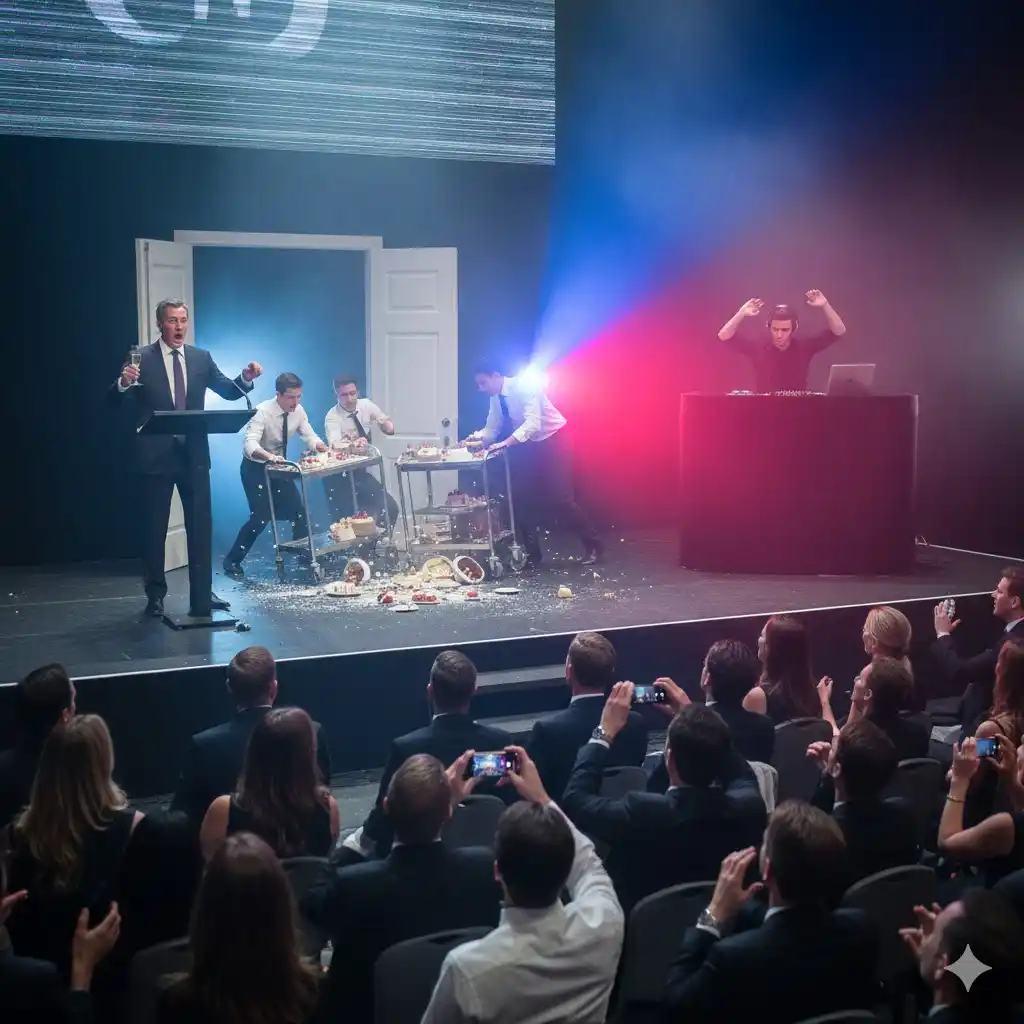
It is the most important night of the fiscal year. The CEO is on stage, raising a glass for the final toast. Five hundred investors are holding their breath. The tension is perfect. This is the climax. But instead of the dramatic spotlight hitting the podium, it accidentally illuminates the waiters crashing through the kitchen doors with dessert carts. Or worse, the DJ drops the bass of an EDM track three seconds before the CEO finishes the sentence, cutting off the emotional punchline of the entire evening.
In almost every other industry, an error is a draft. In graphic design, you have an eraser. In software development, you have a “rollback.” In accounting, you have an eraser. But in the high-stakes world of live event management, there is no “Ctrl+Z.” There is no backspace.
An error in a live event is not a “bug”; it is a memory. It is public, immediate, and indelible. If the microphone fails for ten seconds, you haven’t just lost time; you have lost the room. The difference between a legendary experience and a viral disaster often comes down to the only currency that matters: surgical timing.
The Great Illusion of the “To-Do List”
The most common mistake amateur planners make is confusing a “Project Plan” with a “Run of Show.”
A Project Plan (To-Do List) is static. It tells you what needs to exist: “Book the florist,” “Rent the speakers,” “Order the vegan meals.” This is useful for preparation, but on the day of the event, a To-Do list is useless paper.
A Rundown, or minute-by-minute schedule, is kinetic. It is a script for a play where the actors are the vendors. It doesn’t tell you that there are flowers; it tells you that at 19:04, the florist must move the centerpiece from the lobby to the head table because the guests are moving at 19:06. If the florist misses that two-minute window, the logic of the event collapses.
The Anatomy of the “Cue”: Absolute Synchronization
To achieve operational excellence, we must stop viewing an event as a series of tasks and start viewing it as a series of “Cues.” This is the military precision required to survive the chaos.
A “Cue” is a trigger that fires multiple actions across different departments simultaneously. Consider the complexity of a simple “Product Reveal” moment:
- The Trigger: The presenter says the phrase, “And today, everything changes.”
- The Lighting Tech: Must instantly cut the house lights and hit the stage with a strobe effect.
- The Audio Engineer: Must unmute the playback channel and hit “Go” on the reveal track at -10dB, swelling to 0dB.
- The Stage Manager: Must radio the backstage crew to pull the curtain.
- The Video Director: Must switch the LED wall from the logo loop to the demo video.
If these five people do not act in the exact same second, the magic is broken. If the video plays before the lights go down, the audience sees the awkward transition. The illusion of perfection is maintained only by the rigorous synchronization of the rundown.
Managing the “Human API”
The challenge is that your “team” for an event is often a disjointed collection of freelancers. The DJ doesn’t know the caterer. The lighting guy has never met the security guard.
If you rely on printed spreadsheets or static PDFs, you are courting disaster. Papers get lost, coffee gets spilled on them, and most importantly, they don’t update. If the keynote speech runs five minutes long (which it always does), a static paper rundown becomes obsolete instantly. The kitchen is still prepping to serve hot food at the original time, meaning the guests will receive cold steaks.
You need a dynamic, centralized system—a “Digital Conductor.” When the schedule shifts by five minutes, every vendor needs to see that shift on their screen instantly. The “Cue” must be universal. The rundown transforms the event from a chaotic gathering of vendors into a synchronized symphony of execution.
Stop hoping for the best and start commanding the timeline. Execute your events with military precision and coordinate every minute of the rundown with the detailed planning tools of GGyess WorkSuite.