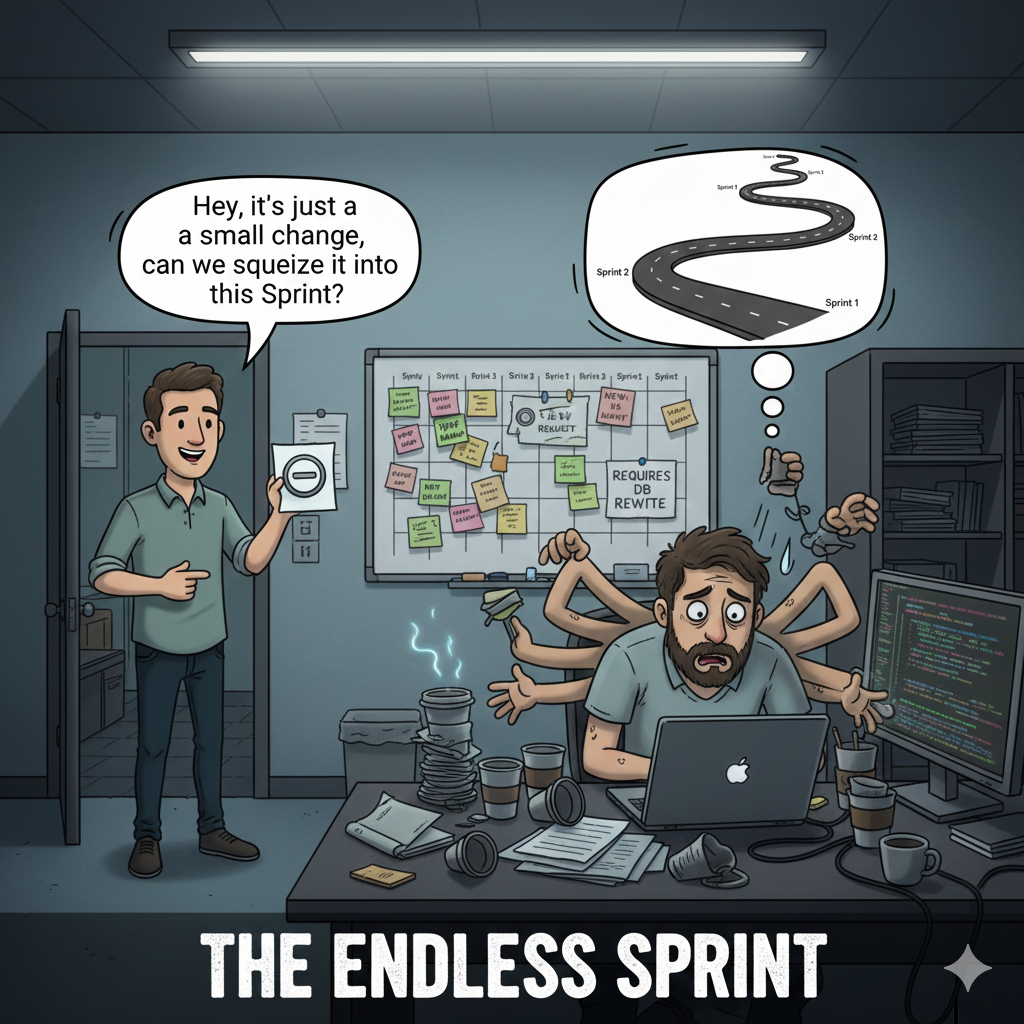
It all begins with an innocent Slack notification on a Tuesday morning. The team is focused, the Sprint Backlog is locked, and the goal is clear. Then, the Product Owner appears with the most dangerous phrase in software development: “Hey, it’s just a small change, can we squeeze it into this Sprint?”
That “small change” is usually a button that requires restructuring the entire database.
What follows is the tragic story of the “Endless Sprint.” The team, eager to please, accepts. Then comes another request. And another. By Friday, the Sprint is no longer a two-week dash; it is a death march with no finish line. The team collapses, code quality plummets, and ironically, the original features that were promised are not delivered. The desire to do “everything” results in finishing nothing.
The Physics of Software Development
The root problem is a fundamental disconnect in the perception of reality. To the business side, software often feels like magic: something flexible, ethereal, and infinitely malleable. To developers, software is logic and mathematics: a rigid structure with finite capacity.
A development team is not a rubber band that can be stretched infinitely without snapping. It is a container with a fixed volume. If you have a glass full of water and you pour more liquid into it, the glass doesn’t grow; the water simply spills. In project management, what “spills” is the quality, the team’s mental health, and the delivery date.
The Kanban Board as a Weapon of Negotiation
This is where the Scrum Master or Tech Leader’s most powerful tool comes into play: The Visual Board.
When work is abstract—a list in Excel or a verbal conversation—it is easy for the Product Owner to underestimate the effort. “It’s just one more thing.” But when work is visualized on a Kanban or Scrum board, the abstraction becomes physical. A full board visually screams that there is no space.
The survival strategy is not to say “No.” Saying “No” creates friction. The strategy is to say: “Yes, but…”
You must use the rule of Equivalent Exchange: “Of course we can add this urgent new feature, but the board is full. For this card to enter, which of these other cards of the same size are we going to take out?”
Visualizing Opportunity Cost
This move changes the power dynamic instantly. You are no longer the “negative” developer who doesn’t want to work. You are now the strategic partner managing finite resources. You are forcing the Product Owner to make a difficult executive decision.
By visualizing the opportunity cost, you transfer the pain of the decision back to the business, which is where it belongs. If the Product Owner has to personally kill feature “B” to give life to feature “A,” they will think twice before interrupting the team’s flow. They will understand that every request has a price.
Protect the integrity of your Sprints and negotiate with undeniable visual data using the dynamic boards of GGyess WorkSuite.