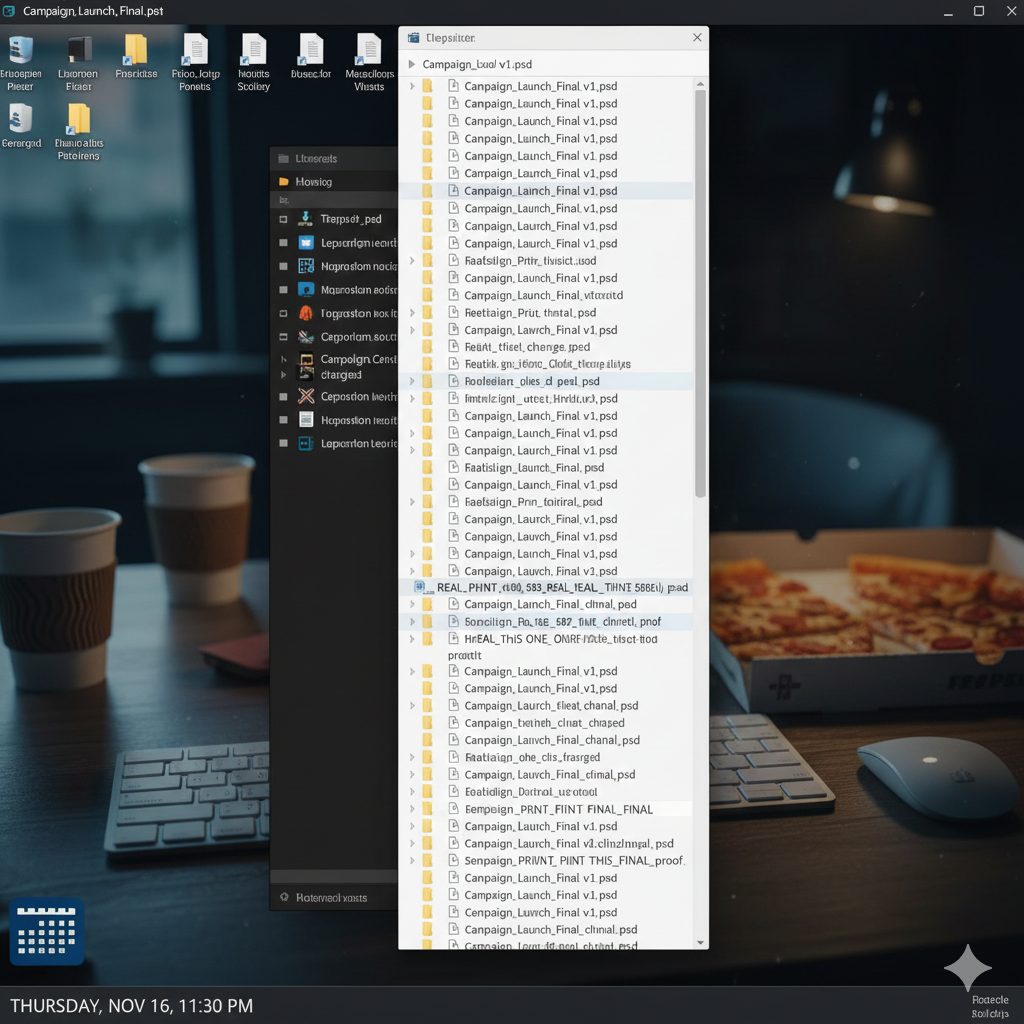
If you want to see the true definition of human optimism, you don’t need to look at space exploration or peace treaties. You just need to look at a graphic designer’s desktop folder at 11:30 PM on a Thursday.
There, sitting innocently among the clutter, is a file named “Campaign_Launch_Final_v1.psd”. It represents hope. It represents the belief that the client will be happy on the first try. But scroll down a bit, and you find the tragic reality of our industry: “Campaign_Launch_Final_v88_REAL_PRINT_THIS_ONE_seriously.psd”.
We have all lived through this recursive nightmare. It begins with a “small tweak” to the logo size and ends three days later with a completely different concept, three exhausted creatives, and an Account Manager who is afraid to open their email. This isn’t just bad luck; it is a structural failure of how agencies handle information.
The Brief is Not a Law, It’s a Rumor
In the theoretical world of business schools, the “Brief” is a constitution. It is a locked document that dictates the scope of work. In the real ecosystem of an agency, the Brief is merely a suggestion that mutates the moment it touches oxygen.
The problem starts with the “Broken Telephone” of approvals. The client tells the Account Manager over a casual coffee that the tone should be “more playful.” The Account Manager writes this down on a sticky note. Later, they mention it to the Copywriter in the hallway. The Copywriter changes the headline. But nobody tells the Art Director, who is still designing for “corporate and serious.”
By the time the assets merge, you have a Frankenstein campaign: a joke-filled headline pasted over a somber, brutalist design.
The Anatomy of the Collapse
Why does this happen? It is rarely a lack of talent. It is almost always a lack of a Single Source of Truth. When feedback lives in scattered silos, entropy takes over.
- The Inbox Trap: The client sent the color correction in an email chain from last Tuesday, which only the Account Manager can see.
- The Chat Black Hole: The Creative Director asked for a font change on Slack, but the message was buried under 50 GIFs of cats.
- The Meeting Void: The feedback was given verbally in a Zoom call that wasn’t recorded, and everyone remembers it differently.
This fragmentation creates a scenario where the Account Manager is promising deliverables that the Copywriter hasn’t written and the Designer hasn’t sketched, simply because they are all looking at different versions of reality.
Stop the Meeting, Fix the Flow
The solution to version control madness is not to have more “alignment meetings.” Meetings are where productivity goes to die. The solution is to centralize the assets and the feedback into a single, visible flow.
You need a system where the conversation happens on top of the work. If the client wants the logo bigger, they should click on the logo and leave a comment right there. If the copy needs to change, the edit should be tracked on the file itself.
When you move to a visual approval board, the ambiguity vanishes. There is no “v88” because the version history is stacked and clear. The “Final” version is no longer a guess; it is the one with the green checkmark that everyone can see.
Don’t let your team drown in a sea of conflicting filenames. Avoid the collapse of versioning and centralize your arts and approvals on the visual boards of GGyess WorkSuite.