In the dynamic world of digital marketing, where algorithms evolve and strategies are constantly being redefined, one fundamental concept has established itself as the cornerstone of search engine optimization (SEO) success: search intent. Understanding this principle isn’t just another tactic; it’s the foundation upon which all effective content and organic positioning strategies are built today.
Beyond Keywords: The “Why” Behind Every Search
Search intent, also known as user intent or keyword intent, is the ultimate goal or underlying reason that motivates a person to enter a query into a search engine like Google.1It goes beyond the literal words typed into the search bar to decipher the real intent: is the user looking to learn something, find a specific website, compare products, or make an immediate purchase?4
This concept represents a paradigm shift in SEO. It’s no longer about identifying and repeating keywords, but rather about understanding and satisfying the user’s fundamental need.5Search intent is, in essence, the foundation upon which all good content should be built, being the first and most crucial step in any optimization strategy.2
The Evolution of Google’s Algorithm: From Keyword Matching to User Satisfaction
To understand the paramount importance of search intent, it’s necessary to observe the evolution of search engines themselves. In the early stages of SEO, algorithms were relatively simple and relied heavily on keyword matching. This simplicity allowed for the proliferation of “black hat SEO” tactics such askeyword stuffing(keyword stuffing), where pages were filled with search terms to manipulate their rankings, often to the detriment of the user experience.2
Google, in its mission to deliver the most relevant and useful results, has spent decades refining its algorithms to make them think more humanly. Transformative updates likeHummingbirdand the implementation of machine learning algorithms such asRankBrainThey introduced natural language processing, allowing Google to interpret the meaning and context behind queries, rather than just matching words.1
Today, even more sophisticated systems like BERT and other artificial intelligence models analyze content for contextual relevance and natural language, prioritizing pages that best meet user intent.8Google’s primary goal is no longer simply to index the web, but to act as an intelligent intermediary that connects a user’s need with the most accurate and satisfactory answer available.9
This focus on user satisfaction is manifested in how Google evaluates content quality. When a user interacts positively with a page—staying on it for a considerable amount of time and not immediately returning to the results page (a behavior known aspogo-sticking)—, sends a powerful signal to the algorithm.11This positive interaction is a direct result of having found content that perfectly aligns with their search intent. In this way, satisfying user intent becomes tangible proof of a page’s quality and relevance, directly influencing its ranking. Google can infer that content that satisfies intent is useful, relevant, and authoritative, thus fulfilling the principles of Expertise, Knowledge, Authority, and Trustworthiness (E-E-A-T), which are crucial for ranking.8
Why ignoring search intent is the most costly mistake in SEO
In today’s competitive digital ecosystem, failing to align content with search intent is the equivalent of building a store with no front door. Resources are invested in creating content, but it never connects with the intended audience. The consequences of this mismatch are direct and detrimental to any SEO strategy and, ultimately, to the business.
First, the chances of achieving good rankings are minimal. Google’s algorithm overwhelmingly favors websites that match user intent; if your content doesn’t, it simply won’t be considered a relevant result, no matter how well-optimized other elements such as metadata or backlinks are.12
Second, even if you do manage to attract some traffic, it will be of low quality. Users who arrive at a page and discover it doesn’t address their needs will quickly abandon it. This translates into negative engagement metrics, such as a high bounce rate and low dwell time, which tell Google that the page isn’t a good result for that query.11
Ultimately, the impact is felt in business results. A mismatch with search intent leads to a low click-through rate (CTR) on search results, less engagement with content, and, consequently, fewer conversions and a poor return on investment (ROI).2Aligning content with search intent isn’t just a good SEO practice; it’s the foundation of a successful entire strategy.1
Decoding the User’s Mind: The Fundamental Types of Search Intent
To create content that resonates with your audience, it’s essential to first classify and understand the different motivations that drive searches. Although each query is unique, most can be grouped into four main categories that serve as pillars for your content strategy.
The Four Pillars of Intention
The SEO community has reached consensus on four fundamental types of search intent, each with distinct characteristics, keywords, and user goals:
- Informative Intention (Know/Saber):This is the most common intention.8The user is actively searching for information, wanting to learn something, resolve a question, or understand a concept. They don’t have immediate purchase intentions. Their queries are usually direct questions or broad ones.
- Keyword modifiers:“what is”, “how to”, “why”, “guide”, “tutorial”, “examples”.1
- Example:“How to do a keyword search?”17
- Navigation Intent (Go/Website/Ir):The user already knows which website or page they want to reach and uses the search engine as a shortcut to navigate. These searches are usually branded.
- Keyword modifiers:Brand names, specific products, or terms like “login,” “contact.”1
- Example:“Facebook Login.”2
- Commercial Research (Investigate/Investigar):The user intends to make a purchase in the near future and is in the research and comparison phase. They look for reviews, opinions, and comparisons to make the best decision.
- Keyword modifiers:“best”, “review”, “comparison”, “vs”, “top 10”, “alternatives”.1
- Example:“best keyword research tools”.17
- Transactional Intention (Do):The user is ready to take a specific, immediate action. This action is typically a purchase, but it can also be a download, a subscription, or filling out a form.
- Keyword modifiers:“buy”, “price”, “discount”, “offer”, “download”, “subscribe”.1
- Example: “Comprar Asus Zenbook”.17
Build a brand that impacts everyone Download the guide
Beyond the Four Types: Secondary and Mixed Intentions
Human behavior is rarely so definitive, and online searches are no exception. In addition to the four pillars, there are important nuances that a well-rounded strategy must consider:
- Local Intent (Visit-in-person):This intent is triggered when a user searches for a product, service, or establishment in a specific geographic location. Google uses the user’s geolocation to offer relevant results, such as nearby stores, restaurants, or offices.1A clear example would be “hairdressers in Madrid.”17
- Mixed or Fractured Intention:This occurs when a single keyword can satisfy multiple intents simultaneously. For example, the query “air fryer” is a classic case.17A user might be looking for information about what a website is and how it works (informational), comparing the best models (commercial research), or searching for where to buy one (transactional). In these cases, the Google search results page (SERP) typically displays a mix of content types—blogs, reviews, product pages—to cater to all possible user profiles.24
Mapping Intention with the Conversion Funnel
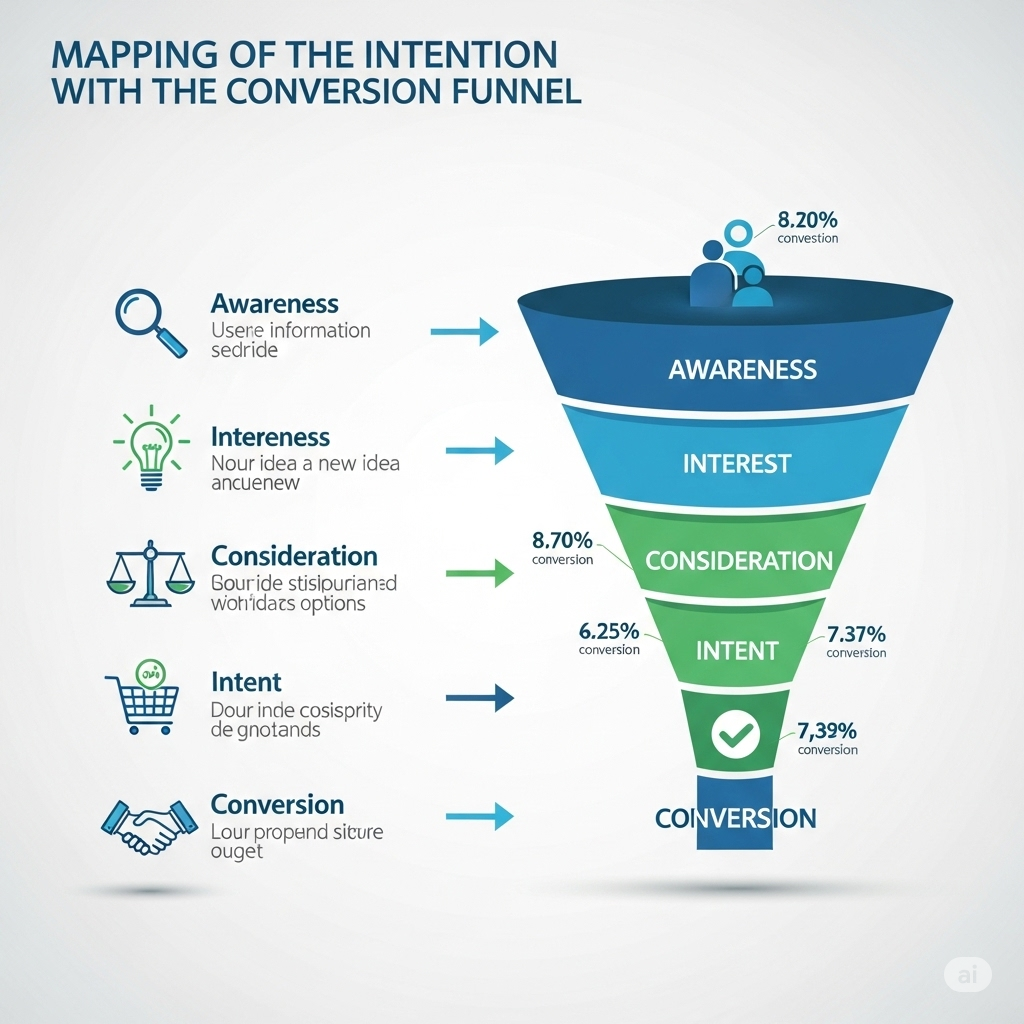
The true strategic power of search intent is revealed when aligned with the marketing and sales conversion funnel. This mapping allows you to create a coherent and effective customer journey, guiding users from the first contact to the final conversion.2
- Awareness Phase (Top of the Funnel – TOFU):It corresponds directly to theInformative IntentionAt this stage, users realize they have a need or problem and seek general information to better understand it.
- Consideration Phase (Middle of the Funnel – MOFU):It aligns with theCommercial ResearchThe user has already defined their problem and is now actively exploring and comparing the different solutions and providers available.
- Conversion Phase (Bottom of the Funnel – BOFU):It coincides with theTransactional IntentThe user has made a decision and is ready to act, whether by purchasing a product or contracting a service.
Understanding this connection is vital. Many companies make the mistake of focusing exclusively on transactional keywords because they seem to have a more direct return on investment.19However, transactional searches represent only a small fraction of total search volume; one study indicates they barely reach 0.69%, while informational searches exceed 52%.8Ignoring informational and commercial intentions means missing out on the vast majority of the potential market. By creating high-quality content for the awareness and consideration phases (blogs, guides, comparisons), a brand can engage users at the beginning of their journey, establish itself as a trusted authority, and build a relationship of trust long before the user is ready to purchase.11This holistic strategy creates a sustainable flow of potential customers, rather than competing solely for the small and highly contested pool of immediate buyers.
The Art of the SERP Detective: How to Identify Search Intent with Surgical Precision
Once you understand the types of intent, the next step is learning how to identify them in the real world. Fortunately, Google provides all the necessary clues. The search engine results page (SERP) is the ultimate source of truth, a direct reflection of what the algorithm considers the most satisfying answer to a given query.
SERP Analysis as a Source of Truth: A Step-by-Step Guide
The most reliable method for determining search intent for a keyword is to analyze the pages that already occupy the top positions.1If Google ranks a specific type of content, it’s because it has verified that it’s what users expect and want to find. To perform this analysis in a structured manner, you can use the “Three Cs” framework:
- Content Type:What types of pages dominate the results? Are they primarily blog posts, product pages, e-commerce category pages, videos, orlanding pagesof services?10The answer to this question defines the primary vehicle for delivering the information.
- Content Format:How is the information structured on these pages? Are they step-by-step guides (“how to”), lists (“top 10…”), product reviews, comparisons, opinion pieces, or news?17This format dictates the way in which the content should be presented so that it is easily digestible by the user.
- Content Angle:What is the focus or unique selling point of the top-ranked pages? Is the content aimed at beginners? Does it promise a “quick and easy” solution? Is it focused on the economic aspect (“cheap” or “affordable”)? Or is it positioned as the most comprehensive “definitive guide”?21The angle defines the tone and value proposition of the content.
Interpreting Google’s Clues: SERP Features
The analysis should not be limited to the ten blue links. Modern SERPs are enriched with a variety of modules orfeaturesthat offer direct clues about user intent23:
- Featured Excerpts (Featured Snippets) and “Other user questions” (People Also Ask – PAA):Its presence is a clear sign of a strong informational intent. Users look for quick and concise answers to specific questions. The PAA grid is a gold mine for identifying subtopics and related questions that should be covered in the content.30
- Local Packages (Local Pack) and Maps:They indicate a clear local or “in-person” intent. The user is looking for a physical business in their area.17
- Google Shopping and Product Ads Results:They are a clear indicator of transactional intent or commercial research. Users are in purchasing mode.1
- Knowledge Panels (Knowledge Panels) and Image/Video Carousels:They can indicate informational intentions (for a person or concept), navigational intentions (for a brand), or even a visual intention, where the user prefers to consume information in image or video format.23
The Language of Intent: Decoding Keyword Modifiers
The words users add to their main queries (known as modifiers) are explicit clues about their intent. Recognizing these patterns allows for a quick initial assessment during the keyword research phase.1:
- Information: what, how, why, when, who, guide, tutorial, ideas, examples, tips.
- Commercials: best, top, review, comparison, vs, versus, alternatives.
- Transactional: buy, price, cost, discount, offer, coupon, free shipping, cheap.
- Navigation: [brand name], [product name], log in, login, contact, official website.
Winning Content Architecture: How to Create and Optimize for Every Intent
Once search intent has been identified, the next step is execution: creating and optimizing content that perfectly aligns with that intent. It’s not about creating a single type of content for all situations, but rather building a diverse content architecture where each piece serves a specific purpose in the customer journey.
The Right Content for the Right Time
Each type of search intent requires a specific type and format of content. Providing the wrong asset is one of the quickest ways to frustrate a user and lose a conversion opportunity.11
- For Informational Purposes:The goal is to educate and provide value. The content should be comprehensive, well-structured, and easy to understand.
- Ideal content assets:In-depth blog posts (“ultimate guides”), step-by-step tutorials, practical guides (“how-tos”), infographics, explanatory videos, and glossaries of terms. The goal is to become the most comprehensive and useful resource on the topic.12
- For Commercial Research:The goal is to help the user make an informed decision, building confidence in the process.
- Ideal content assets:Detailed product reviews, side-by-side comparisons (with feature tables), “best of” lists, case studies, and customer testimonials. Credibility is key, so include social proof and expert opinions.9
- For Transactional Intent:The goal is to facilitate the conversion as smoothly and securely as possible. The page should eliminate any friction and guide the user directly to the action.
- Ideal content assets:Product pages, e-commerce category pages, service pages, and pricing pages. Optimization should focus on clear and visible calls to action (CTAs) (“Buy Now,” “Add to Cart”), high-quality product images, compelling descriptions, trust signals (customer reviews, security seals), and a streamlined checkout process.9
- For Navigation Intent:The goal is accessibility and efficiency. The user is already familiar with the brand and just needs to get to their destination quickly.
- Ideal content assets:The homepage, login pages, contact pages, or store locators. These pages should have clear branding, load quickly, and be easy to navigate on any device.9
Optimization for Mixed Intent
When SERP analysis reveals mixed intent, where different types of content coexist, the most effective strategy is to create a comprehensive page that addresses multiple user needs.25Instead of creating separate pages and competing against each other, a multi-faceted page can become the ultimate resource.
For example, for a query like “best bookstore near me” which has both commercial and local intent24, an optimized page could include:
- A top section with an interactive map and physical store information (address, hours) to meet local intent.
- A middle section with a list of “best-sellers” or “staff recommendations” for business research.
- A product catalog with the option to “buy online” or “reserve for in-store pickup” for transactional intent.
The key is to structure the page with clear headings and well-defined sections, allowing each type of user to easily find the information they are looking for.3
Master Table of Intent Optimization
To consolidate these concepts into a quick reference guide, the following table summarizes the optimization strategy for each type of search intent.
| Criterion | Informative Intention | Navigation Intent | Commercial Research | Transactional Intent |
| User Objective | Learn, resolve a doubt | Go to a specific site | Evaluate, compare, decide | Buy, subscribe, download |
| Typical Modifiers | what is it, how, guide, why | [brand name], login, web | best, review, vs, top 10 | buy, price, discount |
| Ideal Content Type | Blog article, guide, wiki | Home page, login page | Comparison, list, review | Product/Service Page |
| Recommended Format | Long text, video, infographic | Simple, clear, fast page | Tables, pros/cons, ratings | High-quality images, CTAs |
| Primary Success Metric | Time on page, interaction rate | Direct traffic, brand searches | CTR, assisted conversion | Conversion rate, sales |
The Future is Now: Search Intent in the Age of Generative AI
The SEO landscape is undergoing one of its most significant transformations with the integration of generative artificial intelligence directly into search results.AI OverviewsGoogle’s AI-generated summaries that appear at the top of the SERP are redefining how users interact with information and, therefore, how businesses should address search intent.
The Impact of Google’s AI Overviews: Threat or Opportunity?
The main concern in the industry is that by providing direct, synthesized answers, AI Overviews will reduce the need for users to click on organic links, which could lead to a significant decrease in web traffic.44Initial studies suggest a possible drop in CTR and organic traffic, especially for queries that can be answered concisely.44
However, the impact is not uniform across all intent types. Informational queries, especially simple questions, are the most likely to trigger an AI Overview. In contrast, transactional and navigational searches, which require the user to visit a specific site to complete an action, display these summaries much less frequently.47This presents a nuanced scenario: a threat to “rapid response” traffic but an opportunity to consolidate authority and capture more qualified traffic.
Content Strategies to be Cited by AI
In this new paradigm, the goal of SEO is evolving. It’s no longer just about “ranking number 1,” but rather becoming a source of information so authoritative and well-structured that Google’s AI chooses it to build its summaries. To achieve this, content strategies must intensify their focus on quality and clarity:
- Focus on E-E-A-T:More than ever, content must demonstrate expertise, knowledge, authority, and reliability. AI needs reliable sources to generate accurate answers.46
- Natural and Conversational Language:The content should be written clearly and directly, as if answering a question in a conversation. This makes it easier for AI models to extract relevant information.50
- Structure for Extraction:Use clear headings (H2, H3) to formulate questions and provide concise answers directly below. Lists and tables are easily interpretable formats for AI.32
- Using Structured Data (Schema Markup):Implementing Schema markup for FAQs, How-Tos, Articles, Products, etc., is like giving Google an “instruction manual” for your content, dramatically increasing the likelihood of being included in rich results and AI summaries.32
- Comprehensive Content:Create pieces that cover a topic from multiple angles and anticipate follow-up questions. This positions the page as a comprehensive resource and an ideal citable source.45
The arrival of AI Overviews does not invalidate the importance of search intent; on the contrary, it magnifies it. AI seeks to synthesize thebestavailable answers. Therefore, content must be the most accurate, authoritative, and direct answer to the user’s core need to have any chance of being used as a source. AI raises the bar for quality and relevance, forcing content creators to radically focus on satisfying user intent as efficiently as possible.
Adapting Success Measurement: Beyond the Click
In a world with potentially fewer clicks, SEO success metrics must evolve. Organic traffic will remain a crucial KPI, but it will no longer be the only one. The new approach must include measuring visibility and authority within Google’s AI ecosystem:
- Visibility in AI (AI Visibility):Measure the frequency with which a brand or its content appears in AI Overviews.
- Mentions in AI (AI Mentions):Track mentions of your brand, product, or service within AI-generated summaries.
- Citations in AI (AI Quotes):The ultimate goal is not just to be mentioned, but to be cited as a source with a link. These citations are the new currency of authority in the era of generative search.46
The strategic objective shifts from simply acquiring traffic to building a brand presence so strong and authoritative that it dominates the conversation in its niche, both in traditional organic results and in AI-generated responses.46
From Theory to Results: Success Stories Driven by Search Intent
Search intent optimization isn’t a theoretical exercise; it’s a business strategy with a measurable and transformative impact. Analyzing real-life success stories demonstrates how a user-centric approach can generate exponential growth in visibility, traffic, and revenue.
Analysis of Real Case Studies
- Ahrefs (SEO Tools):The SEO software company itself applied this methodology to its own blog. They identified older articles whose traffic was declining and updated them to better align with users’ current search intent. This “content refresh” strategy, which included adding new data and restructuring to better answer user questions, resulted in a traffic increase of up to 468% on some of the updated pages.53
- Zara and Airbnb (Retail and Travel):Both global brands used in-depth keyword research to understand their customers’ intent. Zara focused on terms like “sustainable fashion” and “spring trends,” revamping its product descriptions and creating style guides to meet both commercial and informational intent. Airbnb identified the intent behind searches like “vacation rental in Paris” to optimize its listings and travel guides. The results were spectacular: Zara saw a 120% increase in organic traffic and doubled its online sales, while Airbnb consolidated its dominance in key markets.54
- Flyhomes (Real Estate):This real estate platform achieved 10,737% traffic growth in just three months. Its strategy focused on the mass creation of “cost of living guides” for different cities. This content aligned perfectly with the informational and commercial intent of people researching a potential move, positioning Flyhomes as an indispensable authority in the early stages of the homebuyer’s journey.55
- Weight Loss Supplements Site (E-commerce):A site in a highly competitive niche went from 2,732 to 38,420 monthly visitors in eight months. The key change was abandoning “thin,” unstructured content and adopting an intent-based approach. They conducted a full audit, grouped keywords by topic and intent, and created relevant, useful content that directly addressed their audience’s informational and marketing needs, resulting in massive growth in traffic and rankings.56
These examples, among many others, share a common thread: success did not come from algorithmic tricks, but from a fundamental commitment to understanding and meeting user needs.
Practical Lessons and Conclusion: Your Immediate Action Plan
Mastering search intent is a continuous process of listening, analyzing, and adapting. It’s the core of modern SEO and the surest path to sustainable organic growth. To transform theory into action, you can follow a clear and methodical plan:
- Always start with the SERP:Before typing a single word, you should research your target keyword and thoroughly analyze the first-page results. The SERP is the definitive guide to the type, format, and angle of content that Google and users expect.
- Mapping content to the funnel:Keywords and content ideas should be categorized according to their intent and aligned with the stages of the conversion funnel. This ensures the creation of a complete customer journey, from awareness to purchase.
- Create the right asset:You should produce the type of content that Google already rewards. If the SERP is full of video tutorials, a 5,000-word blog post probably won’t be successful. The key is to adapt to the audience’s preferred format.
- Structuring for humans and machines:Content should be easy for users to read and scan, utilizing headings, lists, and visual elements. At the same time, it should be technically optimized with structured data so that search engines and AI can interpret it unambiguously.
- Measure, learn, and adapt:SEO isn’t a “set it and forget it” task. It’s crucial to continuously monitor content performance, analyze engagement metrics, and be aware of changes in the SERPs. Search intent can evolve, and your content strategy must evolve with it.11
By embracing search intent not as a simple SEO tactic, but as the core philosophy of content strategy, brands can stop simply competing for keywords and start building genuine connections with their audiences, offering the exact value they’re looking for, at the precise moment they need it. That’s the true power of user-centric SEO and the key to dominating the search landscape of today and tomorrow.
Turn your intent strategy into an immediate action list. Stop wasting hours breaking down workloads manually. Describe your goal to the GGyess AI Assistant (e.g., “Create a TOFU, MOFU, and BOFU content funnel for ‘sustainable running shoes'”), and the AI will automatically generate and assign writing, design, and SEO tasks to your team in Planily. Automate your workflow at GGyess.com
Sources cited
- Search Intent and SEO – WooRank, accessed: August 25, 2025,https://www.woorank.com/es/edu/seo-guides/intencion-de-busqueda-y-seo
- What Is Search Intent? + and How to Determine It – SEO.com, accessed August 25, 2025https://www.seo.com/es/basics/glossary/search-intent/
- What is Search Intent in SEO? The Ultimate Guide, acceso: agosto 25, 2025, https://searchengineland.com/guide/search-intent-seo
- What is search intent? • SEO for beginners – Yoast, acceso: agosto 25, 2025, https://yoast.com/search-intent/
- www.seo.com, accessed: August 25, 2025,https://www.seo.com/es/basics/glossary/search-intent/#:~:text=La%20intenci%C3%B3n%20de%20b%C3%BAsqueda%20es,en%20un%20motor%20de%20b%C3%BAsqueda.&text=La%20intenci%C3%B3n%20de%20b%C3%BAsqueda%20es%20la%20base%20del%20contenido.,motores%20de%20b%C3%BAsqueda%20(SEO).
- esden.es, accessed: August 25, 2025,https://esden.es/intencion-de-busqueda-que-es-por-que-importante/#:~:text=La%20intenci%C3%B3n%20de%20b%C3%BAsqueda%20es%20concepto%20%C3%BAtil%20tanto%20para%20los,responda%20directamente%20a%20sus%20consultas.
- How Does Google Determine Ranking Results – Google Search, acceso: agosto 25, 2025, https://www.google.com/intl/en_us/search/howsearchworks/how-search-works/ranking-results
- What is SEO Marketing? [A Comprehensive Overview], acceso: agosto 25, 2025, https://www.ama.org/marketing-news/what-is-seo-marketing/
- What is Search Intent in SEO? A Comprehensive Guide – Go Fish Digital, acceso: agosto 25, 2025, https://gofishdigital.com/blog/what-is-search-intent-seo-guide/
- What Is Search Intent? How to Identify It & Optimize for It – Semrush, acceso: agosto 25, 2025, https://www.semrush.com/blog/search-intent/
- ᐅ Search Intent: What It Is, Types, and Its Importance for SEO – InboundCycle, accessed August 25, 2025,https://www.inboundcycle.com/blog-de-inbound-marketing/intencion-de-busqueda-que-es
- How Search Intent Impacts Google SEO Rankings – Leadraft Marketing, acceso: agosto 25, 2025, https://www.leadraftmarketing.com/post/how-google-uses-search-intent-to-rank-your-website
- What is bounce rate and why is it important in SEO? – Seology Agency, accessed August 25, 2025https://agenciaseology.com/blog/que-es-la-tasa-de-rebote/
- What Is Search Intent: How to Identify & Optimize for It [2025] – Writesonic, acceso: agosto 25, 2025, https://writesonic.com/blog/what-is-search-intent
- SEO Search Intent: What Is It and How Does It Change?, accessed: August 25, 2025,https://chesusrodrigo.es/intencion-busqueda-seo/
- What is Search Intent? – WooRank, acceso: agosto 25, 2025, https://www.woorank.com/en/edu/seo-guides/search-intent
- What is search intent in SEO and what types exist on the internet? – SE Ranking, accessed August 25, 2025https://seranking.com/es/blog/intencion-de-busqueda/
- How to Effectively Structure Your Content Around Search Intent?, accessed: August 25, 2025,https://www.seoquantum.com/es/blog/como-estructurar-eficazmente-contenido-torno-intencion-busqueda
- Types of Search Intents in SEO – Digital Agency, accessed: August 25, 2025,https://www.marketerosagencia.com/blog/seo/tipos-intenciones-busqueda-seo/
- Search Intent in SEO: The Complete Guide – SEOTesting, acceso: agosto 25, 2025, https://seotesting.com/blog/search-intent/
- Search Intent in SEO: What It Is and How to Optimize It – Ahrefs, accessed August 25, 2025https://ahrefs.com/blog/es/intencion-de-busqueda/
- Search Intent: What It Is and How to Identify It – Semrush, accessed: August 25, 2025,https://es.semrush.com/blog/intencion-de-busqueda/
- What is a SERP analysis and how can you do it? – Semrush, accessed August 25, 2025https://es.semrush.com/blog/analisis-de-serp/
- landingi.com, accessed: August 25, 2025,https://landingi.com/es/seo/intencion-de-busqueda/#:~:text=Considerar%20la%20intenci%C3%B3n%20mixta%20o%20dividida&text=Comprueba%20qu%C3%A9%20tipos%20de%20contenido,es%20tanto%20transaccional%20como%20local.
- What is search intent and how to use it in SEO? – José Facchin, accessed August 25, 2025https://josefacchin.com/intencion-de-busqueda/
- Search Intent: Definition, Types, and Optimization – Landingi, accessed: August 25, 2025,https://landingi.com/es/seo/intencion-de-busqueda/
- luciayelseo.com, accessed: August 25, 2025,https://luciayelseo.com/blog/intencion-de-busqueda-seo/#:~:text=Para%20la%20identificaci%C3%B3n%20de%20la,llevar%20a%20cabo%20el%20usuario.
- Everything You Need to Know About Search Intent Optimization – BigSeo, accessed August 25, 2025https://www.bigseo.top/todo-lo-que-necesitas-saber-sobre-la-optimizacion-de-la-intencion-de-busqueda/
- The Importance of Understanding Search Intent – Adogy, accessed August 25, 2025,https://www.adogy.com/es/La-importancia-de-comprender-la-intenci%C3%B3n-de-b%C3%BAsqueda/
- People Also Ask (PAA): Everything You Need to Know – Hello Mr Lead, accessed: August 25, 2025,https://www.hellomrlead.com/people-also-ask-paa-todo-lo-que-necesitas-saber/
- People Also Ask: How to Maximize SEO Opportunities – YouTube, accessed: August 25, 2025,https://www.youtube.com/watch?v=zAC55pmT8J0
- Google PAA: How to Optimize for “People Also Ask” Questions, accessed August 25, 2025,https://www.seoptimer.com/es/blog/google-la-gente-tambien-pregunta/
- People also ask — Semrush study on “Other user questions”, accessed: August 25, 2025,https://es.semrush.com/blog/people-also-ask/
- Search Intent in SEO: How to Detect and Use It Well, accessed: August 25, 2025,https://luciayelseo.com/blog/intencion-de-busqueda-seo/
- Search Intent: How to Satisfy Users and Increase…, accessed: August 25, 2025,https://pencilspeech.com/intencion-de-busqueda/
- Free Keyword Research Tool – Semrush, accessed: August 25, 2025,https://es.semrush.com/analytics/keywordmagic/
- MOZ vs SEMRush vs Ahrefs: Which is Better? – Posted in SEO Marketing, accessed August 25, 2025https://www.postedin.com/blog/moz-semrush-ahrefs-cual-mejor/
- A Step-by-Step Guide to Keyword Research (2025 Edition) – Kinsta, accessed: August 25, 2025,https://kinsta.com/es/blog/palabras-clave/
- Semrush vs. Ahrefs vs. Moz – Which is Better? (Pros and Cons) – WPBeginner, accessed August 25, 2025https://www.wpbeginner.com/es/opinion/semrush-vs-ahrefs-vs-moz-which-one-is-better-pros-and-cons/
- 11 Best Keyword Research Tools for SEO in 2025, accessed: August 25, 2025,https://www.seo.com/es/tools/keyword-research/
- How to Check Competitor Rankings in SERP – SEOptimer, accessed: August 25, 2025,https://www.seoptimer.com/es/blog/clasificacion-de-competidores-serp/
- The 4 Types of Keywords Based on Search Intent – jdigital.mx, accessed August 25, 2025,https://jdigital.mx/agencia-seo/posicionamiento-web-seo/los-4-tipos-de-palabras-clave-segun-su-intencion-de-busqueda/
- SEO Search Intent: [What it is, types, and how to apply it] – Jamil Mansilla, accessed: August 25, 2025,https://jamilmansilla.com/intencion-busqueda/
- Impact of Google’s AI Overviews on SEO and PPC – dobleO, accessed August 25, 2025,https://dobleo.com/blog/pago-por-click/impacto-de-las-ai-overviews-de-google-en-el-seo-y-el-ppc/
- What are Google AI Overviews and how do they affect SEO? – Unlimited Growth, accessed August 25, 2025https://unlimitedgrowth.online/blog/google-ai-overviews/
- Does SEO Still Work? How AI Impacts Your Online Visibility – Nonica Studio, accessed August 25, 2025https://nonicastudio.com/es/estrategias-y-tendencias-marketing-digital/impacto-ia-seo
- Search Intent Types and Their Impact on Google’s AI Overviews – Opinly, acceso: agosto 25, 2025, https://blog.opinly.ai/search-intent-types-and-their-impact-on-googles-ai-overviews/
- AI Overviews in Spain: Analysis of 100,000 SEO searches – SE Ranking, accessed: August 25, 2025,https://seranking.com/es/blog/ai-overviews-en-espana/
- How to Optimize Content for Google AI Overview – SEO Agency Querétaro, accessed: August 25, 2025,https://agenciaseoqueretaro.com/como-optimizar-contenido-para-ai-overview/
- Do AI Overviews Affect Google’s SEO? – Andres Macario, accessed August 25, 2025https://andresmacario.com/afectan-las-ai-overviews-al-seo-de-google/
- Artificial Intelligence and Search: How to Optimize Your Law Firm’s Website for the Age of AI Search – Justia Advances, accessed August 25, 2025https://avanza.justia.com/la-inteligencia-artificial-y-la-busqueda-como-optimizar-el-sitio-web-de-tu-firma-de-abogados-para-la-era-de-la-busqueda-con-ia/
- Generative AI for SEO: Everything You Need to Know – Marketinet, accessed August 25, 2025,https://www.marketinet.com/blog/ia-generativa-para-seo/
- Top SEO Success Stories & Case Studies 2025 | Wix, Canva, Airbnb & More – Glorywebs, acceso: agosto 25, 2025, https://www.glorywebs.com/blog/seo-success-stories-and-case-studies
- SEO and SEM Success Stories with Zara and Airbnb | KLOROFiLA Marketing Agency, accessed August 25, 2025https://klorofila.es/blog/casos-exito-seo-sem-estrategias
- 19 SEO Case Studies to Improve Your Strategy in 2025 – AIOSEO, acceso: agosto 25, 2025, https://aioseo.com/seo-case-studies/
- SEO Case Study: How To 14x Search Traffic In 8x Months – Search Logistics, acceso: agosto 25, 2025, https://www.searchlogistics.com/case-studies/14x-search-traffic/