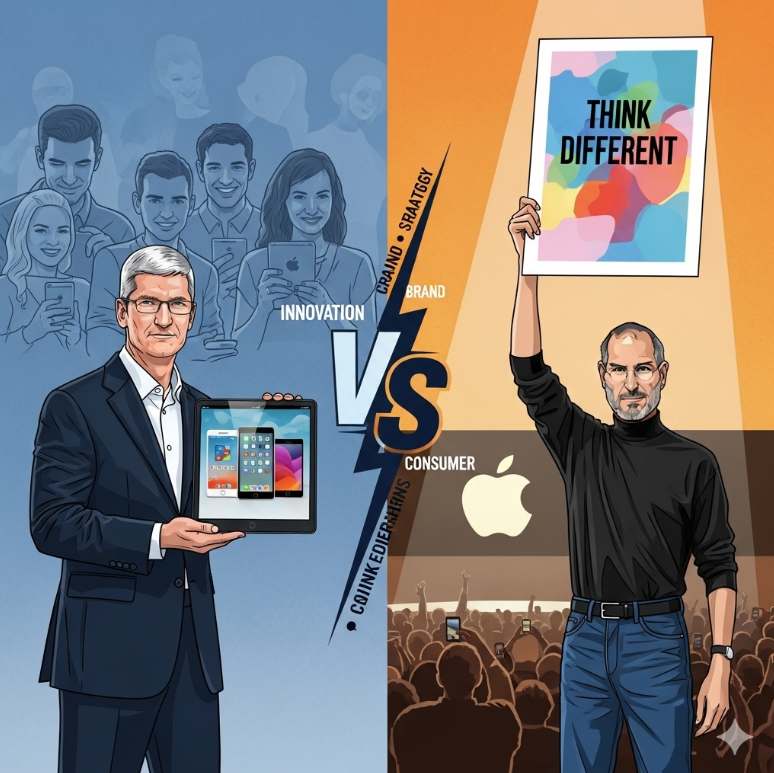
Apple’s marketing genius isn’t a monolithic entity, but rather a tapestry woven from two distinct but equally brilliant threads: the Steve Jobs era and the Tim Cook era. Analyzing the evolution of the brand’s communications is like witnessing a masterclass in strategic adaptation. The Jobs era was a period of rebellious marketing, driven by bold narratives that not only rescued a company from the brink, but also created a cultural movement.1It was defined by audacity, confrontation and the creation of a myth.
After his passing, many predicted the end of Apple’s magic. However, what followed wasn’t a decline, but a calculated transformation. The Tim Cook era is characterized by a marketing that has matured, moving from insurgency to empire-building. The focus shifted toward a global communications machine centered on ecosystem, scale, corporate responsibility, and values.3
This report deconstructs this fundamental transition. The central question is not whether Apple’s marketing has worsened, but rather how a brand that defined itself as “rebel” and “different” was able to maintain its dominance once it became the undisputed market leader.5The answer lies in a necessary strategic evolution, a change of voice that reflects the transition from a company struggling to survive to the world’s largest $3 trillion corporation.7This analysis will examine Jobs’ core philosophy, his iconic campaigns, the strategic pivot under Cook’s leadership, and the pillars of modern Apple marketing, culminating in a head-to-head comparison that reveals the DNA of two of the most successful marketing strategies in history.
Jobs’ Philosophy: Selling Dreams, Not Products
To understand the marketing of Apple’s first golden age, it’s crucial to understand that Steve Jobs wasn’t selling computers; he was selling an ideology. His genius lay not in traditional advertising, but in his profound understanding that consumers don’t buy products, but rather better versions of themselves. His marketing doctrine was based on a set of fundamental principles that transformed Apple from a mere technology manufacturer to a cultural icon.
Simplicity as the Ultimate Sophistication
Jobs’s obsession with simplicity was a core value that permeated every facet of Apple, from the industrial design of its products to the clarity of its marketing messages.2Apple’s first marketing brochure declared, “Simplicity is the ultimate sophistication.”8This belief was evident in his legendary presentations, which eschewed the clutter of traditional corporate slides in favor of powerful images and minimal text, often a single word or number.9Jobs believed that making something simple was much more difficult, but infinitely more valuable, than making it complex, a lesson he instilled in the company’s entire culture.10Their ads communicated a single, powerful idea, stripping away all the unnecessary to get to the essence of the message.
Create an Enemy, Lead a Movement
Jobs instinctively understood that every great story needs a conflict, an antagonist. To galvanize his customer base and give them a cause to fight for, he consistently positioned Apple against a larger, more monolithic “enemy.” In the 1980s, it was IBM, portrayed as “Big Brother” in the iconic “1984” ad.11Later, in the 2000s, the adversary was Microsoft, personified as a clumsy, outdated “PC” in the “Get a Mac” campaign.5This strategy was brilliant because it framed the purchase of an Apple product not as a simple consumer choice, but as an act of rebellion, a declaration of individuality. In doing so, it wasn’t just selling a product, it was inviting customers to join a movement of creative, rebellious thinkers who saw the world differently.5
Sell the Experience, Not the Specs
Jobs revolutionized technology marketing by inverting the traditional process. Instead of starting with technical specifications and working toward the customer, he started with the customer experience and worked backward toward the technology.2Their marketing never led with gigahertz or megabytes of RAM. Instead, it focused on what technology
allowed: Unleash creativity, simplify life, and empower the individual.11The purest example of this philosophy is the “1984” commercial, which aired to millions of people without ever once showing the product it was advertising, the Macintosh.5The message was clear: technical details don’t matter, what matters is the revolution this product is about to start.
Turning Launches into Cultural Events
Jobs was a consummate showman who transformed product launches from boring press conferences into highly anticipated cultural events.5He was a master of suspense, cultivating mystery for months. The tech ecosystem teemed with rumors, leaks, and speculation, generating a level of excitement no paid advertising campaign could match. His presentations were a masterclass in communication, often culminating with his famous line, “One more thing…”—a moment that guaranteed worldwide attention and revealed a surprising innovation.5This approach turned customers into fans and launches into headline news, generating invaluable earned media value.
Jobs’s famous “reality distortion field” wasn’t just an internal management tool; it was the engine of his external marketing. It was the ability to imbue a product with a narrative so powerful that it transcended its technical reality to become a symbol of a future ideal. Observers describe Jobs as a “showman” and a “storyteller” who sold “dreams,” not products.2This approach connects directly to the marketing principle of prioritizing emotion over features. The “dream” was a distorted reality: a better, more creative, and liberated world thanks to a new piece of technology. Marketing didn’t simply describe the product; it painted a vivid picture of the world the product would create. This explains why Apple’s early marketing was so effective in building a cult following.15Customers weren’t simply buying a computer; they were buying a stake in Steve Jobs’s vision of the future. This emotional investment is much stronger and more lasting than a transactional relationship based on features and price, creating evangelists rather than mere customers.5
Build a brand that impacts everyone Download the guide
Iconic Campaigns That Defined a Generation
Steve Jobs’s marketing philosophy wasn’t theoretical; it translated into some of the most memorable and impactful advertising campaigns in history. These campaigns not only sold products, but defined Apple’s identity and changed the rules of the advertising game. Each was a manifestation of his core strategy, executed with a precision and audacity that resonated across generations.
“1984”: The Declaration of Advertising War
Context:In 1984, Apple was preparing to launch the Macintosh in a personal computing market dominated by IBM’s imposing presence. Apple didn’t need a simple announcement; it needed a declaration, an event that would shake the industry to its foundations.12
Strategy:The strategy was bold and high-risk: positioning the Macintosh not as a product, but as a tool of liberation from the conformist, dystopian world that the ad claimed IBM represented. Inspired by George Orwell’s novel, the ad presented IBM as “Big Brother” and Apple as the only force of individuality and innovation capable of breaking the chains.11It was a huge gamble, costing $1.7 million at the time to produce and airing only during the Super Bowl, a decision that Apple’s own board of directors hated.5
Execution:Directed by acclaimed filmmaker Ridley Scott, the ad was a piece of cinema. With a dark and dramatic aesthetic, it focused entirely on narrative and emotion, building tension that culminated in a liberating climax. Crucially, the product itself, the Macintosh, never appeared on screen.13
Impact:The result was seismic. The ad became a cultural phenomenon and global news, generating massive amounts of free media coverage that far eclipsed the initial investment.11Not only did he successfully launch the Macintosh, but he established the Super Bowl as the prime stage for epic brand advertising and cemented Apple’s identity as the maverick innovator of the tech industry.17
“Think Different”: Resurrecting an Icon Through Values
Context:When Steve Jobs returned to Apple in 1997, he found a company on the brink of bankruptcy. The brand was diluted, with a confusing product line and no clear direction.1Jobs knew that before he could sell a single product, he needed to remind the world, and his own employees, what Apple stood for at its core.2
Strategy:The “Think Different” campaign was a masterpiece of emotional branding. The strategy consisted of realigning the Apple brand with its core values, associating it with “the crazy ones, the misfits, the rebels”: iconic historical figures like Albert Einstein, Mahatma Gandhi, Martin Luther King Jr., and Pablo Picasso, who changed the world precisely because they thought differently.1The campaign wasn’t about technology; it was a tribute to the creative human spirit and a direct appeal to Apple’s core audience: creatives, educators, and nonconformists.20
Execution:The campaign featured powerful black-and-white images of these geniuses, accompanied by poignant narration and the slogan “Think Different.” The slogan itself, grammatically controversial (it should have been “Think Differently”), was a deliberate choice to be disruptive, memorable, and consistent with the message of breaking the rules.1
Impact:“Think Different” was much more than an advertising campaign; it was the resurrection of Apple’s soul.19He shifted the conversation from the company’s financial woes to its enduring philosophy. He reaffirmed the brand’s identity and created a deep emotional connection with consumers, laying the groundwork for the most spectacular comeback in corporate history.20
“Get a Mac”: The Personification of Competitive Advantage

Context:By the mid-2000s, Apple had recovered, but it remained a niche player in the personal computer market, dominated by Microsoft’s Windows ecosystem. The goal was to directly attack this dominance, simply and directly communicating the advantages of using a Mac: ease of use, security, and superior design.22
Strategy:The genius of the “Get a Mac” (also known as “Mac vs. PC”) campaign lay in the personification. Instead of boring the audience with technical jargon, the campaign brought the two platforms to life. “Mac” was portrayed by a young, laid-back, and creative actor (Justin Long), while “PC” was portrayed by a comedian (John Hodgman) as an older, formal man prone to problems and viruses.22This simple analogy made complex technical differences instantly understandable and entertaining.25
Execution:The campaign consisted of a series of short, humorous ads filmed against a minimalist white background. This stripped-down setting, a hallmark of Apple’s aesthetic, eliminated all distractions and focused the viewer’s attention on the witty dialogue and interaction between the two characters.22
Impact:The campaign was a resounding success. It ran for several years, spawning hundreds of variations and becoming a cultural icon. It significantly boosted Mac sales and reinforced the brand’s perception as a modern, secure, and easy-to-use alternative to the complicated and vulnerable world of PCs.23
These three campaigns, though creatively distinct, are united by a common narrative thread: the story of a resourceful and creative underdog who faces off against a domineering and soulless giant. “1984” presents a lone heroine against a totalitarian regime.11“Think Different” celebrates rebels who challenge the status quo.19“Get a Mac” positions the fresh, niche Mac against the ubiquitous but flawed PC.22This narrative consistency over decades forged an incredibly powerful brand identity. It allowed consumers to easily understand who Apple was and what it stood for. This strategy appealed to a universal archetype that resonates deeply with those who see themselves as independent and creative thinkers. This almost tribal brand loyalty was based on a sense of belonging to an exclusive club or a rebellion.5Ironically, this same success created the biggest marketing challenge for the Cook era: how do you evolve the narrative when you’re no longer the underdog, but the new establishment?
The Changing of the Guard: From Visionary to Operator
The transition from Steve Jobs to Tim Cook in 2011 marked more than just a change in CEO; it was a fundamental shift in Apple’s soul and strategy. This internal transformation was directly reflected in the evolution of its marketing. To understand why Apple’s marketing changed, we must first understand how its leaders changed, and with them, the company’s priorities.
Jobs the Visionary vs. Cook the Operator
Steve Jobs was the epitome of a visionary leader. Charismatic, intense, and practical, often autocratic, his genius lay in his ability to create markets where none existed before.4He didn’t respond to market demands; he created them. His leadership was centered on his singular vision of the perfect product.
Tim Cook, on the other hand, is the archetype of the strategic operator. With a calm temperament and collaborative style, his experience was forged in optimizing Apple’s operations and supply chain, a task of astonishing complexity.4His genius wasn’t inventing the iPhone, but building the incredibly efficient global machine that could make and sell billions of them profitably and predictably.14
From Revolution to Evolution
The Jobs era was defined by a series of disruptive innovations that reinvented entire product categories: the iMac, the iPod, the iPhone, and the iPad.7Each was a revolution in itself. The Cook era, by contrast, has been defined by evolution and expansion. The focus has been on refining these existing product categories (with new iPhone models every year) and, crucially, building a vast ecosystem around them. This includes new products that complement the core, such as the Apple Watch and AirPods, and a massive expansion into services like Apple Music, Apple TV+, iCloud, and Apple Pay.7This strategic difference is reflected in the company’s innovation data, which shows a lower rate of “disruptive technology” patents under Cook, who favors “continuous technologies” that improve and refine existing technologies.34
The Financial Transformation
Jobs resurrected Apple from near-bankruptcy and laid the foundation for its success. Cook took that foundation and built a financial colossus. Under his leadership, Apple’s revenue soared from approximately $108 billion in 2011 to more than $394 billion in 2022, and the company became the first in history to reach a market capitalization of $3 trillion.7This unprecedented scale and financial stability provided the context and resources for a new kind of marketing, one less focused on survival and more on consolidating dominance.
The marketing of each era is a direct reflection of the core competency and strategic priority of its CEO. Jobs, the product visionary, created a marketing approach centered on narratives of revolutionary products that would change the world. Cook, the operational and social strategist, forged a marketing approach focused on the seamless integration of the ecosystem and corporate values. Jobs’s marketing was about the “next big thing.”11Cook’s marketing is about how all the devices work together seamlessly and about the values of the company that makes them: privacy and sustainability.14Jobs’ focus was product innovation4Cook’s is operational excellence, long-term growth, and social responsibility.4This shows that a company’s marketing is not an isolated function. It is the outward expression of the CEO’s fundamental vision for the company. Jobs marketed a series of revolutions because that’s what he was building. Cook markets a stable, ethical, and interconnected empire because that’s what he
hehas built. Marketing didn’t just change; it was driven to change by the new corporate reality.
Marketing in the Cook Era: Ecosystem, Values, and Global Scale
Under Tim Cook’s leadership, Apple’s marketing adapted to its new reality as a global market leader. The strategy shifted from that of a bold challenger to that of a consolidated empire. This new approach is based on three fundamental pillars that define the brand’s communication today: the ecosystem as the core product, the community as the creative engine, and corporate values as a key differentiator.
The Ecosystem as a Main Product
The Cook-era marketing strategy has shifted the focus from selling a single “hero” product to selling the seamless, integrated experience of the entire Apple ecosystem.3The real product is no longer just the iPhone, but how the iPhone works seamlessly with the Apple Watch, AirPods, Mac, and iCloud services. Features like iMessage’s “blue bubbles” or cross-device continuity create a powerful “lock-in” effect that makes switching to a competing platform inconvenient and costly in terms of user experience.37Marketing, from ads to product launches, consistently demonstrates this synergy. The value proposition is no longer simply “the best phone,” but “the best all-around technological experience.” This strategy is reinforced by the massive expansion into services, which has transformed Apple into a recurring revenue machine, less dependent on hardware sales cycles.7
“Shot on iPhone”: Community as a Creative Engine
Perhaps the most iconic campaign of the Cook era is “Shot on iPhone.” This initiative is a masterclass in how to leverage user-generated content (UGC) to demonstrate a product’s quality in an authentic and credible way.38The strategy involves inviting millions of iPhone users around the world to share their best photos and videos, turning them into brand evangelists and content creators.38
The execution is brilliant in its simplicity and scale. The campaign combines massive social media engagement, through the hashtag #ShotOniPhone, with high-profile outdoor advertising, such as billboards in major cities around the world.38This validates user content by elevating it to the level of official Apple advertising. The company has even gone so far as to record portions of its launch events with iPhones, a definitive meta-demonstration of the product’s capabilities.41With over 29 million tagged posts on Instagram alone, it’s one of the most successful UGC campaigns in history.38Build a community, showcase the product’s core benefit (an exceptional camera) without resorting to technical jargon, and generate a massive volume of authentic marketing materials at a relatively low cost.42
Privacy and Sustainability as Selling Points
The most sophisticated marketing move of the Cook era has been to transform corporate responsibilities into key brand differentiators and direct selling points.4In an era of growing distrust of Big Tech, Apple has strategically positioned itself as the ethical and trustworthy choice.36
- Privacy:Apple actively markets privacy as a core feature of its products, not merely a regulatory requirement. Features like App Tracking Transparency and end-to-end encryption are presented as direct user benefits, framing privacy as a fundamental human right.36This stance is a direct and calculated attack on the business models of competitors like Google and Meta, which rely on collecting user data.
- Sustainability:Similarly, Apple aggressively promotes its environmental commitments. Its goal of being carbon neutral by 2030, its use of recycled materials in its devices, and its investments in clean energy are prominently communicated in its reports, website, and presentations.36This values-based marketing appeals directly to its target audience, largely affluent and socially conscious consumers who are willing to pay a premium for a brand that aligns with their own values.42This approach not only builds a deeper emotional connection, but also justifies the brand’s price positioning.35
While Jobs’s Apple battled tangible corporate enemies like IBM and Microsoft, Cook’s Apple has subtly redefined the adversary. The new “enemy” is now a set of abstract concepts that plague the modern technological world: complexity, insecurity, and irresponsibility. The pillars of Cook-era marketing—the ecosystem, privacy, and sustainability—are designed to combat precisely these villains. The ecosystem fights complexity, offering simplicity and fluidity. Privacy fights insecurity and surveillance. Sustainability fights environmental irresponsibility. This is a brilliant evolution of Jobs’s “find an enemy” strategy.5As the market leader, Apple can no longer credibly attack a larger competitor. Instead, it positions itself as the solution to the problems created by the very industry it now leads. This allows Apple to maintain a principled, almost rebellious stance without attacking a specific company, which could attract antitrust scrutiny or appear petty. It elevates the brand from being a simple product manufacturer to being a purveyor of a better, safer, and more responsible digital life. It’s a far more sophisticated and defensible marketing position for a mature global power.
Comparative Analysis: The DNA of Apple’s Marketing
The transition from the Steve Jobs era to that of Tim Cook represents one of the most fascinating brand evolutions in the corporate world. It’s not about one strategy overtaking the other, but rather two distinct marketing approaches, each perfectly suited to the circumstances and strategic needs of its time. The central narrative shifted from “Revolution” to “Evolution.” Jobs focused on creating entirely new markets; Cook has focused on scaling and refining those markets.14Jobs was selling a revolutionary product; Cook is selling an impeccable ecosystem.37Jobs sold rebellion; Cook sells responsibility.4
Although Apple’s target audience has always been consumers willing to pay a premium price for quality and design42, the emotional appeal has mutated. Jobs appealed to the “misfit,” the “dreamer,” and the “rebel” in each of us.14Cook, on the other hand, appeals to the pragmatic desire for seamless technological integration and the ethical yearning for a brand that reflects modern values of privacy and sustainability.35
The results of each approach are undeniable. Jobs’s marketing rescued the company from extinction and turned it into a cultural phenomenon. Cook’s marketing took that phenomenon and transformed it into the most valuable and stable company on the planet.31The debate, therefore, is not about which era was “better,” but rather about how each was the right strategy at the right time for the company’s needs.3
The following table summarizes the key strategic differences between the two eras, providing a clear view of the evolution of Apple’s marketing DNA.
Table 1: Marketing Strategies Comparison: Jobs vs. Cook
| Metric | Era Steve Jobs (1997-2011) | Tim Cook Era (2011-Present) |
| Leadership Style | Visionary, Charismatic, Autocratic4 | Strategic, Collaborative, Operational4 |
| Strategic Approach | Disruptive Product Innovation7 | Operational Efficiency, Services, Ecosystem3 |
| Positioning | Rebel, “Underdog”, Challenger1 | Market Leader, Luxury, Aspirational6 |
| Key Message | “Think Different”, Revolution, Individual Empowerment11 | Integration, Privacy, Sustainability, Responsibility14 |
| Campaign Tone | Emotional, Bold, Confrontational17 | Inclusive, Authentic (UGC), Values-Based38 |
| The “Enemy” | A corporate competitor (IBM, Microsoft)5 | Abstract concepts (Complexity, Insecurity, Irresponsibility) |
| Success Metric | Cultural Impact, Creation of New Markets11 | Financial Growth, Ecosystem Loyalty, Brand Value31 |
Conclusion: The Future of a Marketing Powerhouse
Analyzing Apple’s two major marketing eras reveals a fundamental truth: the brand hasn’t lost its spark.31; has cleverly transformed it. The rebellious, disruptive energy of the Jobs era didn’t fade away, but was channeled into mature, principled market leadership under Tim Cook. Apple has successfully navigated the difficult transition from being the market disruptor to becoming the market leader, evolving its narrative from “us versus them” to proposing “a better way for everyone.”
Crucial lessons for any brand strategist or marketing director emerge from this evolution:
- From the Jobs era:You learn the immutable power of a simple, emotional story; the strategic value of defining an antagonist to unite a community; and the transcendental importance of making a brand represent an ideal, not just a product.
- From the Cook era:The lessons learned include how to market from a position of leadership; the power of turning corporate values and ethics into a tangible competitive advantage; and the immense potential of leveraging one’s own customer community as the most authentic and powerful marketing voice.
Looking ahead, Apple faces new challenges. As it delves into emerging and potentially revolutionary categories like artificial intelligence and spatial computing with products like the Vision Pro7, the question arises: will he need to rediscover some of the magic of Jobs’s category-creating marketing? The most likely conclusion is that the future of Apple’s marketing will be a strategic hybrid. It will require combining the operational, global, and values-based marketing machine built by Cook to launch the next generation of disruptive products. It will demonstrate that the two legacies—that of visionary and that of operator—are not mutually exclusive, but are essential and complementary components for the company’s continued success in the decades to come.
Transform Your Vision into Flawless Execution
Apple’s history proves that moving from “rebel challenger” to “market leader” requires strategic maturity and operational discipline. Don’t let the complexity of your growth—managing campaigns, product launches, and multiple teams—fragment your focus.
GGyess WorkSuite is the operational backbone you need to manage your empire:
- Simplicity: Centralize all projects, tasks, and team communications in one elegant platform (Jobs’ principle of simplicity).
- Ecosystem: Connect your marketing planning, product roadmaps, and content creation (Cook’s ecosystem approach).
- Execution: Assign roles, track deadlines, and ensure every team member is aligned with your overarching vision.
Register to Build Your Empire with Operational Excellence Today.
Start Executing Your Strategy with GGyess WorkSuite
Sources cited
- “Think Different”: The slogan that resurrected Apple in 1997 – Leonardo Network, accessed: September 11, 2025,https://leonardonetwork.es/think-different-el-eslogan-que-resucito-a-apple-en-1997/
- Steve Jobs Marketing Strategy (Is Pure Genius) – Business & Leadership, acceso: septiembre 11, 2025, https://www.businessandleadership.com/marketing/item/steve-jobs-genius-marketing-strategy/
- Study on the evolution of apple’s business strategy: how it became a global leader. – ijrpr, acceso: septiembre 11, 2025, https://ijrpr.com/uploads/V6ISSUE4/IJRPR43857.pdf
- Apple’s Astonishing Evolution: How Steve Jobs and Tim Cook Forged a Tech Empire, acceso: septiembre 11, 2025, https://danielduwa.medium.com/apples-astonishing-evolution-how-steve-jobs-and-tim-cook-forged-a-tech-empire-96c9cd5f7002
- 10 Lessons From Steve Jobs That Every Marketer Must Learn, acceso: septiembre 11, 2025, https://blog.hubspot.com/marketing/10-steve-jobs-marketing-lessons
- 5-1 Blog: Top Dog Versus Underdog/ Microsoft vs Apple, acceso: septiembre 11, 2025, https://elisesblog416668364.wordpress.com/2019/02/07/5-1-blog-top-dog-versus-underdog-microsoft-vs-apple/
- Steve Jobs vs Tim Cook Apple leadership: Tim Cook just beat Steve …, acceso: septiembre 11, 2025, https://m.economictimes.com/news/international/us/tim-cook-longest-serving-apple-ceo-2025-tim-cook-just-beat-steve-jobs-in-one-major-way-heres-what-it-means-for-apples-future/articleshow/123050517.cms
- The Real Leadership Lessons of Steve Jobs – Harvard Business Review – Nicholas School WordPress Network, acceso: septiembre 11, 2025, https://sites.nicholas.duke.edu/delmeminfo/files/2012/07/The-Real-Leadership-Lessons-of-Steve-Jobs-HBR-l-Apr-2012.pdf
- 7 Ways Tim Cook Gave a Steve Jobs-Like Presentation – Forbes, acceso: septiembre 11, 2025, https://www.forbes.com/sites/carminegallo/2012/03/08/7-ways-tim-cook-gave-a-steve-jobs-like-presentation/
- Why Tim Cook joined a nearly bankrupt Apple and one thing Steve Jobs did differently, acceso: septiembre 11, 2025, https://m.economictimes.com/magazines/panache/why-tim-cook-joined-a-nearly-bankrupt-apple-and-one-thing-steve-jobs-did-differently/articleshow/114488999.cms
- The 1984 Apple commercial that changed marketing for…, accessed: September 11, 2025,https://vanelopdigital.com/el-comercial-de-apple-de-1984-que-cambio-el-marketing-para-siempre/
- You don’t need a lot of ads, you need the right one – Plus Marketing, accessed: September 11, 2025,https://www.plusmarketing.mx/publicidad-estrategica/no-necesitas-muchos-anuncios-necesitas-el-anuncio-correcto/
- The Apple Revolution | Adlatina, accessed September 11, 2025http://www.adlatina.com/publicidad/la-revoluci%C3%B3n-de-apple
- Jobs vs Cook. Apple’s Evolution: From Jobs’ Vision to… | by Aditya …, acceso: septiembre 11, 2025, https://medium.com/@adityapratapgoswami07/jobs-vs-cook-0da6b162a26a
- Apple Strategic Analysis for a Post-Jobs Era – Shadow Nate Lives, acceso: septiembre 11, 2025, https://shadownatelives.com/portfolio/apple-strategic-analysis-for-a-post-jobs-era/
- How the Macintosh Launch Revolutionized Super Bowl Ads | SAE Institute Mexico, accessed September 11, 2025https://mexico.sae.edu/noticias-y-eventos/como-el-lanzamiento-de-la-macintosh-revoluciono-los-anuncios-del-super-bowl/
- Apple’s 1984 Super Bowl Ad: Revolutionizing Advertising, accessed September 11, 2025,https://marketingbyali.com/es/El-anuncio-de-la-Super-Bowl-de-1984-revolucion%C3%B3-la-publicidad/
- Think Different Apple – FasterCapital, accessed: September 11, 2025,https://fastercapital.com/es/palabra-clave/think-different-apple.html/1
- Analysis of the Think Different | Marketing with Values presentation, accessed September 11, 2025.https://marketingconvalores.es/news/analisis-sobre-la-presentacion-think-different/
- The Story Behind Apple’s “Think Different” Campaign: Changing the Conversation, accessed September 11, 2025,https://marketingbyali.com/es/La-historia-detr%C3%A1s-de-la-campa%C3%B1a-Think-Different-de-Apple-que-cambia-la-conversaci%C3%B3n/
- The mistake no one noticed in Apple and Steve Jobs’ iconic phrase: Think Different – Infobae, accessed: September 11, 2025,https://www.infobae.com/tecno/2025/08/18/el-error-que-nadie-noto-de-la-iconica-frase-de-apple-y-steve-jobs-think-different/
- Media Campaigns | PDF | Advertising | Macintosh – Scribd, accessed September 11, 2025https://es.scribd.com/document/518712113/Campanasmedios
- Famous Marketing Agencies: Iconic Campaigns & Epic Flops – Moving Minds, acceso: septiembre 11, 2025, https://movingminds.io/famous-marketing-agencies/
- Mastering Undifferentiated Targeting Strategy: A Beginner’s Guide | Copy.ai, acceso: septiembre 11, 2025, https://www.copy.ai/blog/undifferentiated-targeting-strategy
- Product Marketing: Everything You Need to Know – Bastida Farina, accessed: September 11, 2025,https://www.bastidafarina.com/post/product-marketing-todo-lo-que-necesitas-saber
- Top 32 Best Marketing Campaigns of All Time – Simplilearn.com, acceso: septiembre 11, 2025, https://www.simplilearn.com/best-marketing-campaigns-article
- Advertising Effectiveness + 6 Ways to Measure/Optimize – Criterion Global, accessed September 11, 2025,https://criterionglobal.com/es/faq/eficacia-publicitaria/
- Competitor Ads That Flopped and What We Can Learn From Them | Kaya, acceso: septiembre 11, 2025, https://www.usekaya.com/blog/competitive-ads-that-flopped
- Apple Leadership: a brief overview – Research-Methodology.net, acceso: septiembre 11, 2025, https://research-methodology.net/apple-leadership-and-apple-organizational-structure/
- medium.com, accessed: September 11, 2025,https://medium.com/@adityapratapgoswami07/jobs-vs-cook-0da6b162a26a#:~:text=Cook%2C%20a%20supply%20chain%20wizard,past%20%242.5%20trillion%20by%202025.
- Tim Cook breaks Steve Jobs’ this record at Apple, what it says about Apple’s evolution, acceso: septiembre 11, 2025, https://timesofindia.indiatimes.com/technology/tech-news/tim-cook-breaks-steve-jobs-this-record-at-apple-what-it-says-about-apples-evolution/articleshow/123060520.cms
- August 1 marks a symbolic moment: Tim Cook’s tenure as CEO has now equaled Steve Jobs’s at 5,090 days. : r/apple – Reddit, acceso: septiembre 11, 2025, https://www.reddit.com/r/apple/comments/1met32n/august_1_marks_a_symbolic_moment_tim_cooks_tenure/
- How apple has changed under Tim Cook. – Reddit, acceso: septiembre 11, 2025, https://www.reddit.com/r/apple/comments/71hi5d/how_apple_has_changed_under_tim_cook/
- Analysis of Apple Inc.’s Innovation Dilemma From the Perspective of Leadership, acceso: septiembre 11, 2025, https://www.researchgate.net/publication/348838161_Analysis_of_Apple_Inc’s_Innovation_Dilemma_From_the_Perspective_of_Leadership
- What Makes Apple’s Marketing Strategy Unique – Sulema, accessed: September 11, 2025,https://www.sulema.es/noticias/que-hace-unica-estrategia-marketing-apple/
- Apple’s Corporate Social Responsibility (CSR), accessed September 11, 2025,https://businessmodelanalyst.com/es/Responsabilidad-social-corporativa-de-Apple/
- Steve Jobs vs Tim Cook – Does Apple still innovate? – YouTube, acceso: septiembre 11, 2025, https://www.youtube.com/watch?v=fmsalmx5hQ0
- 8 Best Social Media Campaigns to Inspire You in 2024, accessed: September 11, 2025,https://es.semrush.com/blog/mejores-campanas-en-redes-sociales/
- Digital Marketing Examples: 10 Iconic Campaigns, accessed: September 11, 2025,https://www.pulsiondigital.com/blog/ejemplos-de-marketing-digital-10-campanas-iconicas/
- How to Create a Field Marketing Strategy (+ Examples) – ClickUp, accessed September 11, 2025,https://clickup.com/es-ES/blog/225982/estrategia-de-marketing-de-campo
- Apple Reveals: Its Final Event Recorded Entirely with iPhone 15 Pro – 17pin.net, accessed: September 11, 2025,https://17pin.net/blog/apple-revela-su-ultimo-evento-grabado-integramente-con-iphone-15-pro/
- Apple Target Market Analysis (2025) – Business Model Analyst, accessed: September 11, 2025,https://businessmodelanalyst.com/es/Mercado-objetivo-de-la-manzana/
- Apple strengthens its commitment to privacy and unveils new initiatives on Data Privacy Day, accessed September 11, 2025,https://www.apple.com/us-es/newsroom/2023/01/apple-builds-on-privacy-commitment-by-unveiling-new-efforts-on-data-privacy-day/
- About Apple Product Privacy and Security for Education, accessed September 11, 2025,https://support.apple.com/es-la/102123
- Environment – Apple, accessed: September 11, 2025,https://www.apple.com/la/environment/
- Sustainability Marketing Example: Apple and Mother Nature Content, accessed: September 11, 2025,https://www.luismaram.com/ejemplo-de-marketing-de-sostenibilidad/
- Environment – Apple (ES), accessed: September 11, 2025,https://www.apple.com/es/environment/
- Apple Marketing Strategy (2025) – Business Model Analyst, accessed: September 11, 2025,https://businessmodelanalyst.com/es/estrategia-de-marketing-de-manzana/
- Apple Marketing Strategy (2025) – Business Model Analyst, acceso: septiembre 11, 2025, https://businessmodelanalyst.com/apple-marketing-strategy/