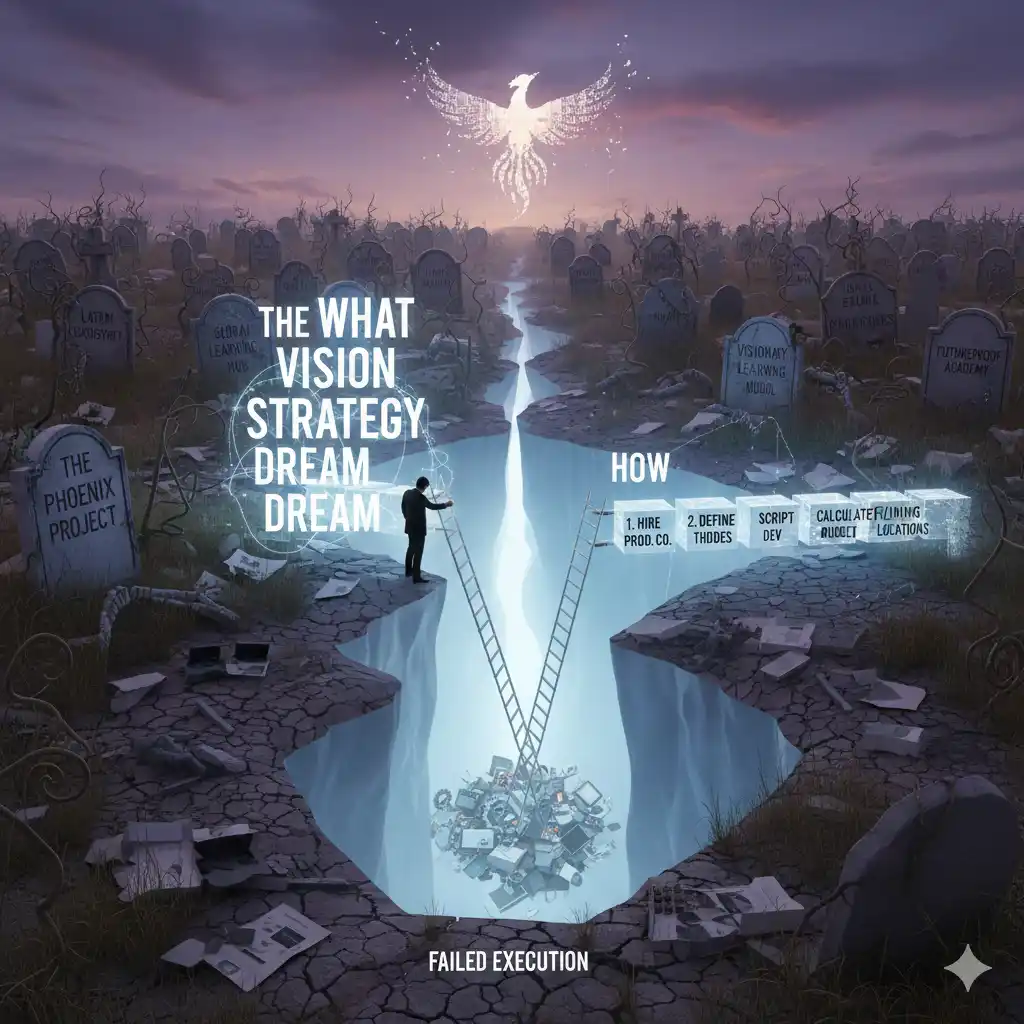
The graveyard of great business ideas is vast. The cause of death is rarely a lack of vision; it is, more often, the inability to translate that vision into executable steps. There exists a paralyzing chasm between the “what”—the abstract dream or high-level strategic goal—and the “how”—the sequence of practical, manageable tasks.
The story of “The Phoenix Project” is familiar in many offices. An entrepreneur or a leadership team has a brilliant idea: “We are going to create an educational content ecosystem in Latin America that will double our subscriber base in six months.” It’s a grand vision, with million-dollar potential. However, the enthusiasm only lasts until the next question: What is the first executable step? Should we hire a production company? Define the themes for the first month? Calculate the budget for the pre-production phase? The idea is abstract, holistic, and non-linear; execution, however, demands a sequential, methodical, and concrete task list.
It is at this point that most great ideas die. The brain, excellent at strategy and long-term vision, succumbs to analysis paralysis when required to manually translate a vague concept into hundreds of steps, roles, and dependencies. The consequence is that The Phoenix Project remains a static file in the cloud, untouched by action.
The Cognitive Fatigue of Manual Fragmentation
The problem of the gap is not a lack of capability within the team, but a cognitive fatigue imposed by manual fragmentation. For years, the only way to launch a project was to dedicate days or hours to meetings for task decomposition: breaking the idea down into its logical components.
The High Cost of Slow Operations
For a marketing agency launching a multi-platform campaign or a software team starting a new development, the manual process of translation carries enormous costs:
- Loss of Creative Momentum: The initial excitement and momentum of the idea are lost while the team struggles with logistics and formatting. Energy is invested in the project’s carpentry, not its essence.
- Errors by Omission: When manually breaking down a complex idea (such as “launch an optimized landing page”), it is easy to forget critical tasks: the legal check, the SEO metadata optimization, or the event tracking setup. A single omitted step becomes a recursive error that compromises the quality of the final deliverable.
- Inefficient Distribution: The leader ends up assigning tasks based on intuition (“I think John has time”), rather than based on actual capacity and role. This leads to the overload of some and the underutilization of others, a problem that is invisible until the project collapses.
The Human Soul Elevates the Strategy
The human must not be the generator of the logical structure, but its architect. The mind must elevate itself towards strategy and innovation. We need a tool that understands project logic and frees us from the burden of constantly translating between abstraction and action.
Materializing Vision in Seconds
This is where technology, acting as a complex translator, closes the gap. The algorithmic bridge takes a vague description or a business imperative and instantly fragments it into a complete roadmap, eliminating analysis paralysis and the need for endless logistical brainstorming.
From a Paragraph to a Complete Project
The great difference in this approach is structural delegation. You introduce a high-level idea in natural language—for example, “We need a complete plan for introducing our new executive coaching service on LinkedIn for the next quarter”—and the system does the rest:
- Instant Detailed Task Breakdown: The system takes a conceptual requirement and generates a detailed task list, complete with deadlines, priorities, and owners. You go from “Launch a new product landing page” to a list including “Draft Initial Landing Page Design,” “Review and Feedback on Initial Design,” and “Publish Final Landing Page”.
- Role and Deliverable Mapping: The algorithm doesn’t just create tasks; it understands roles. It automatically assigns the fragmented steps to the appropriate team members based on their designated expertise, ensuring that the right person gets the right deliverable.
- Eliminating Analysis Paralysis: This automatic fragmentation eliminates the mental block that prevents launch. The mind is instantly provided with a clear sequence, allowing the team to transition immediately from the abstract “what” to the concrete “start now”.
The Liberating Effect for the Entrepreneur
This approach creates a productive symbiosis. By delegating the logical and procedural structure to the Artificial Intelligence, the human team recovers its most valuable capital: cognitive capacity. The mind is no longer stuck on the logistics of how the work gets done, but free to concentrate on the strategic why and the creative what if. The entrepreneur recovers time for strategy, innovation, and client interaction—the only activities that truly drive growth. The idea, previously paralyzed in abstraction, materializes into a concrete, executable plan in seconds.
Materialize your abstract dreams into concrete plans in seconds with the AI assistant of GGyess WorkSuite.