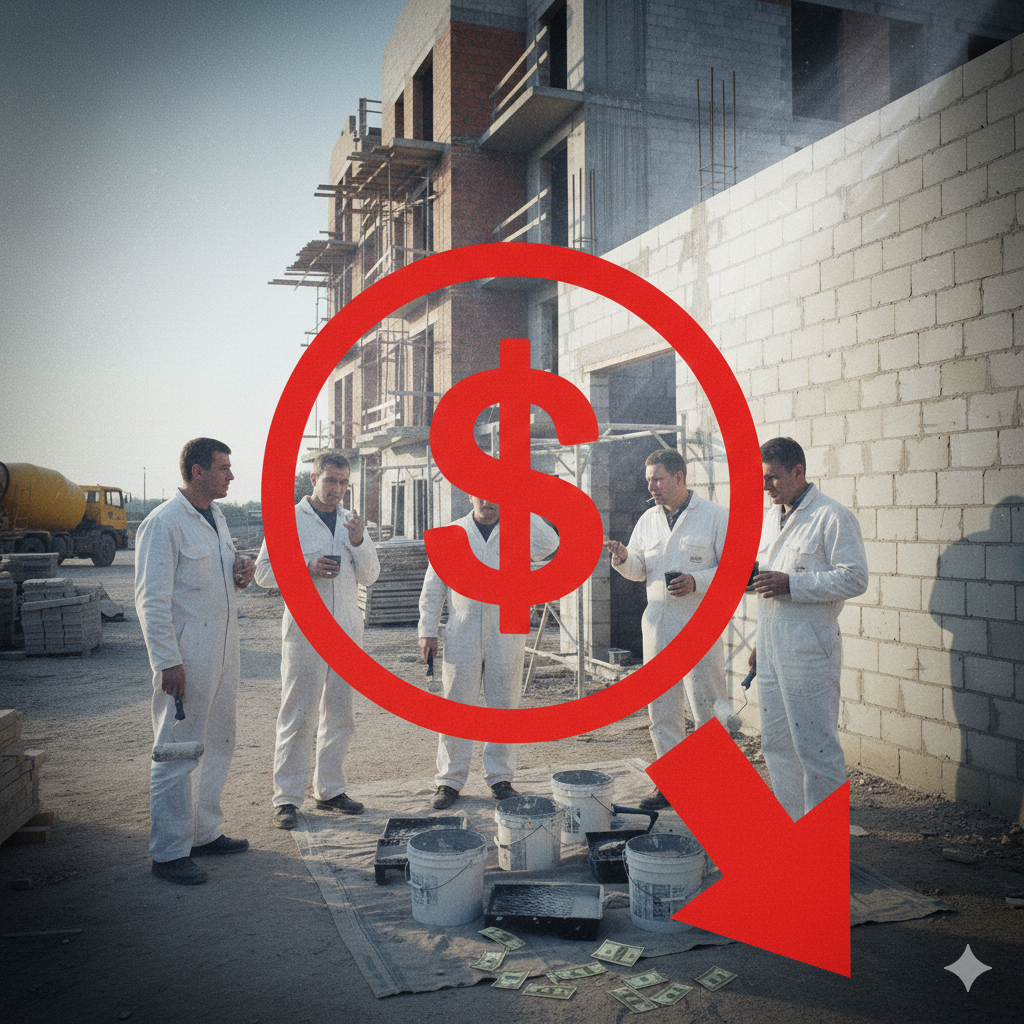
In the logical world of a child, construction is simple: first you build the wall, then you paint the wall. It is a linear, obvious sequence. But in the chaotic reality of a multi-story development project, this logic frequently dissolves into expensive confusion.
Imagine a construction site on a Tuesday morning. The painting crew arrives at 7:00 AM, sharp. They are professionals; their rollers are clean, their buckets are mixed, and the meter is running. There is just one problem: the wall they are supposed to paint is still naked brick. The plastering crew, who was supposed to finish yesterday, is missing. Maybe their truck broke down, or maybe they are stuck on another job.
The result? You have five painters standing around, smoking cigarettes and drinking coffee, while you pay them full hourly rates to watch cement dry. This is not just a scheduling error; it is a financial hemorrhage. In the construction business, you don’t lose money on materials; you lose money on idle time.
The Domino Effect of the “Missing Tile”
To understand why projects go over budget, we have to talk about the Critical Path.
In a small renovation, you can keep everything in your head. In a commercial build, dependencies are a complex web. Let’s look at the “Flooring Scenario.”
You have a supplier who is delivering the porcelain tiles. He calls and says he is 48 hours late. On a spreadsheet, this looks like a minor delay of two days. But in reality, it triggers a catastrophic chain reaction:
- The Floor Layer cannot work, so he goes to another site and can’t return for a week.
- The Carpenter cannot install the baseboards because the floor isn’t finished.
- The Painter cannot do the final touch-ups because the baseboards aren’t installed.
- The Electrician cannot install the floor outlets.
A single delay of 48 hours in logistics has just halted four different crews and pushed the project delivery date back by two weeks. This is the Domino Effect. If you cannot see these connections before they happen, you are not managing a construction site; you are just hosting a very expensive gathering of confused tradesmen.
The Gantt Chart: Not a Luxury, But a Map
There is a misconception among old-school contractors that Gantt charts are bureaucratic paperwork for corporate offices. This is dangerous thinking. A Gantt chart is the only way to visualize the future of the build.
It allows the Site Manager to see the “cliff” before the project falls off it. It changes the conversation from reactive to proactive. Instead of finding out on Tuesday that the painters have nothing to do, the Gantt view alerts you on Friday: “Warning: Plastering is 80% complete. Impact on Painting start date is imminent.”
This visibility allows you to pick up the phone and reschedule the painters before they show up. It allows you to move the electrician to a different floor instead of sending him home. It turns “crisis management” into “logistics.”
Stop Paying for Silence
Construction is a war against entropy. Every day, the natural state of the site is to fall into disorder. Your job is to impose structure.
You cannot afford to have skilled laborers waiting for materials, and you cannot afford to have materials ruining in the rain waiting for laborers. The only way to bridge the gap between “Grey Work” (structural) and “Finishes” (aesthetic) is to visualize the invisible lines that connect them.
Synchronize your providers and crews by visualizing the critical path of your construction site with the Gantt chart of GGyess WorkSuite.