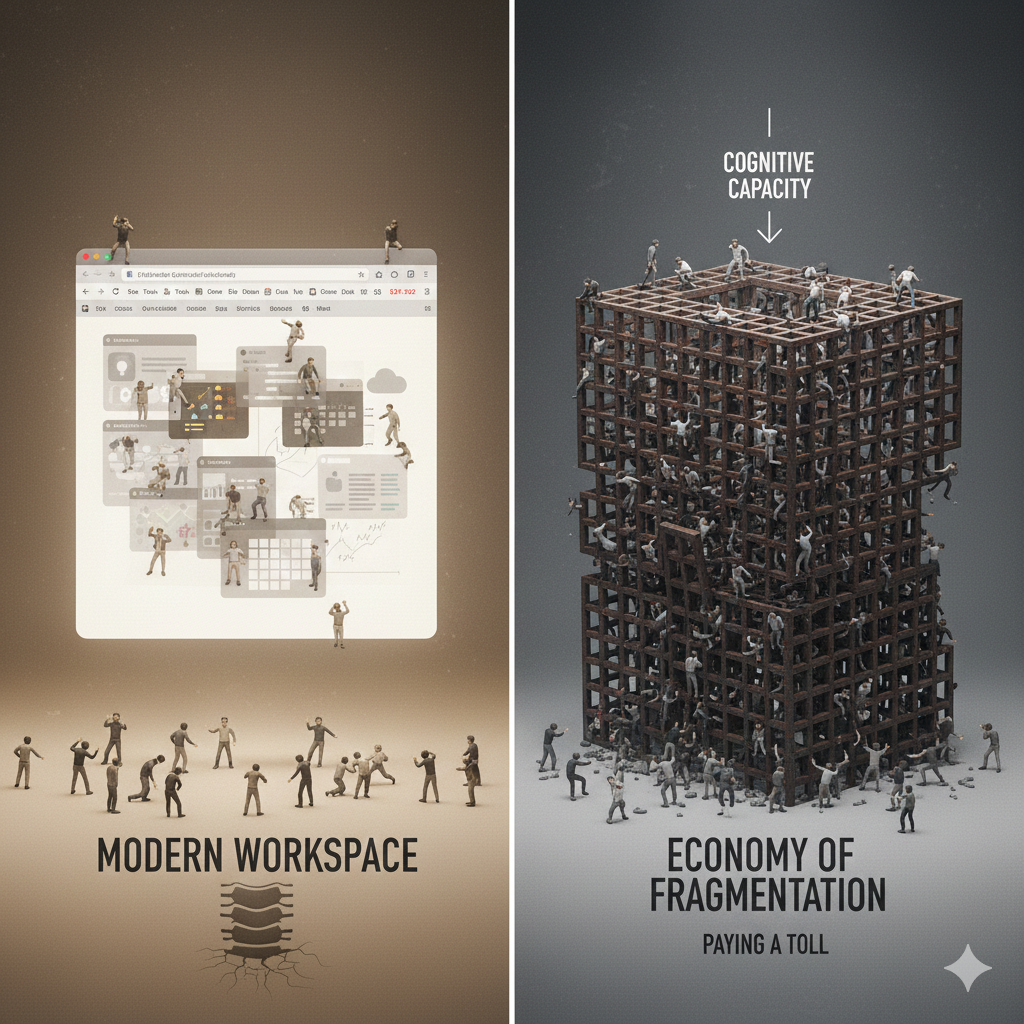
The modern workspace is a browser window with 47 tabs open.
In the last decade, we fell into a trap. We bought into the idea that there is “an app for that.” A chat app for talking. A board app for tasks. A cloud app for files. A calendar app for time. A whiteboard app for brainstorming.
Individually, these tools are brilliant. But collectively, they have created a monster.
We didn’t build an ecosystem; we built a labyrinth. And every day, your team is paying a toll to navigate it. This is the Economy of Fragmentation, and the currency isn’t just dollars—it’s cognitive capacity.
The Story of the “Alt-Tab” fatigue
Meet Julian, a Product Manager at a mid-sized tech firm. Julian is hardworking, but he is exhausted by 11:00 AM. Why?
Let’s look at 15 minutes of his morning:
- He gets a notification on Slack: “Did we approve the design?”
- He switches to Figma to check the design. He sees a comment referring to a “new requirement.”
- He switches to Jira to find the requirement. It’s not there.
- He remembers it was in an Email. He opens Outlook.
- He finds the email, copies the text, goes back to Slack, and pastes it.
In 15 minutes, Julian didn’t do any work. He didn’t create value. He acted as a human router, copying and pasting data between incompatible silos. He performed five “context switches.”
By the end of the day, Julian feels like he ran a marathon, but his to-do list is barely touched. He is suffering from App Fatigue.
The “Context Switching Tax”
The cost of this fragmentation is backed by neuroscience. It’s called the Context Switching Tax.
Every time you switch from one application to another, your brain doesn’t switch instantly. There is a “residue” of attention left behind. Sophie Leroy, a business professor, calls this Attention Residue.
When Julian switches from Email to Trello, a part of his processing power is still stuck on the email.
- Research suggests it takes an average of 23 minutes and 15 seconds to get back into deep focus after an interruption.
- If your team uses 10 different apps, they are interrupting themselves dozens of times an hour.
The Math of Inefficiency: You aren’t just paying the subscription fee for 10 SaaS products. You are paying for the 20% to 40% of your employees’ mental energy that is wasted on simply managing the tools.
The Financial Illusion: The “Stack” vs. The “Suite”
There is also a hard financial reality.
The “Best of Breed” Trap: Companies often think, “I want the best chat app, the best task app, and the best file app.” The result is “SaaS Sprawl.” You end up with 10 invoices, 10 admin panels, 10 sets of permissions to manage, and 10 security vulnerabilities.
- The Visible Cost: $150 per user/month across 10 apps.
- The Hidden Cost: The IT hours spent managing integrations that break. The lost data when an employee leaves and their specialized account is deleted.
Integration as a Cognitive Strategy
The solution isn’t just to “save money.” It is to save your team’s brains.
Integration is an efficiency strategy. When you move to a unified environment, you remove the friction.
- Unified Context: The chat happens on the task card. You don’t have to explain the context; it is visibly attached.
- Single Source of Truth: You don’t have to ask “Is the file in Dropbox or Drive?” There is only one place it can be.
- Flow State Protection: The user stays in one interface. They move from planning to execution to reporting without ever pressing Alt-Tab.
Stop Paying the Tax
We are entering the era of consolidation. The novelty of having 50 colorful icons in your dock has worn off. We want to work.
We need to move from a “Fragmented Stack” to a “Unified Operating System.”
Stop paying for ten disconnected tools that fight for your attention. Stop forcing your team to be human routers. Centralize your investment, protect your cognitive capacity, and unify your experience with GGyess WorkSuite.