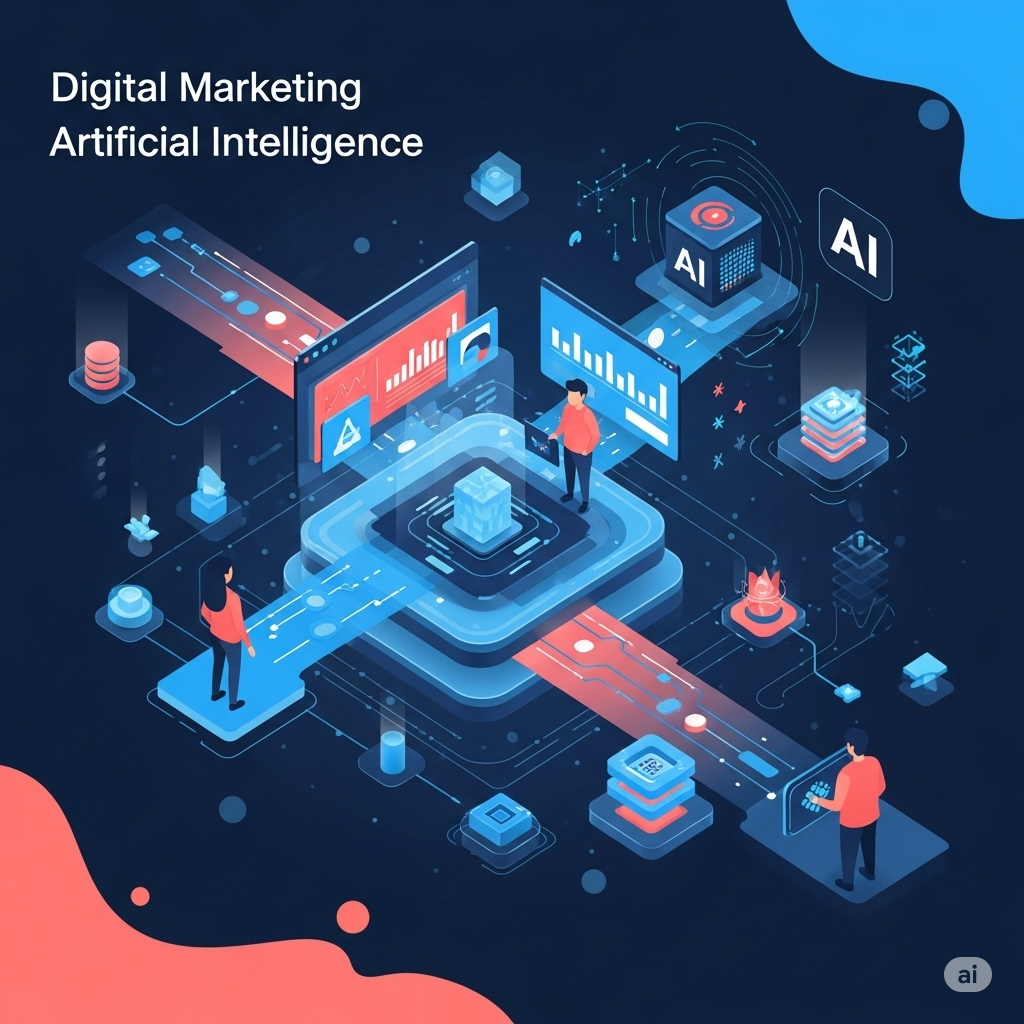
The rapid and “dizzying emergence of AI within the reach of the masses”1has raised fundamental questions about its ability to transform or even replace human roles in various industries. In this context, the central question of this analysis emerges with particular relevance: Will digital marketing be one of these areas where artificial intelligence becomes a substitute, or will its “exponential growth”2predicts a more complex relationship?
From the outset, a central perspective is established: artificial intelligence is not positioned as a substitute, but as a catalyst for change and an amplification tool. Experts in the field already affirm that “The future of marketing is human: AI will not replace brand identity.”3AI is reshaping digital marketing and going beyond automation to empower professionals.4, enabling strategic evolution and a redefinition of human value in the industry. This analysis will delve into how this technology is reshaping the digital marketing landscape, highlighting the areas where AI excels and those where human intervention remains indispensable.
I. The Digital Marketing Ecosystem: Fundamentals and Scope
Digital marketing is defined as “the application of marketing strategies carried out in digital media,” translating and adapting techniques from the offline world to a new environment.1It is a comprehensive set of strategies and techniques designed to promote products or services through digital channels such as social media, search engines, emails, and websites.1The discipline has evolved significantly, with the “vertiginous emergence of AI” marking a “third stage” in its development, driven by the way users interact with the web.1
The “5 Pillars of Digital Marketing” are essential elements that provide structure and direction for any business with an online presence, helping it sustain, grow, and achieve its goals.6These pillars are fundamental to understanding the strategic basis of digital marketing. The first is the
Self-knowledge, which involves understanding the brand’s identity, purpose, and unique value proposition, answering the key question: “Why do you do it?”6The second pillar is the
Customer, which requires a deep understanding of the target audience, their needs, and how to interact with them, including the use of tools such as CRM to manage the relationship from the first contact.6 He
Purchase CycleIt is the third pillar, which underlines the importance of being present and relevant at every stage of the consumer journey, from discovery to post-purchase.6 He
Content, considered the “fuel of a successful digital presence,” constitutes the fourth pillar; it must be useful, timely, relevant, and in the right format to solve consumer problems and build trust.6Finally, the
StrategyIt is the fifth pillar, the roadmap that connects all the elements, defining the starting point, the objectives (qualitative and quantitative), the specific actions and how performance will be measured.6
Digital marketing encompasses several core functions that are crucial to your operation.Content generationIts importance is undeniable, involving the creation of texts for blogs, social media posts, web content, and advertisements, always focused on a specific audience, their interests, and engaging language. This role requires a deep understanding of buyer personas, the conversion funnel, and the buyer’s journey to tailor the message to each stage and audience, in addition to collaborating with graphic designers to create engaging pieces.7 The
Ad Management (PPC)It goes beyond simple publishing; it’s crucial to generate and manage them efficiently, which involves evaluating the target audience, defining keywords, directing them to relevant pages, setting optimal budgets, and monitoring performance to make constant corrections. Good command of Google AdWords and social media advertising platforms is essential.7
The SEO (Search Engine Optimization) ImplementationIt is a key methodology for increasing organic traffic, commonly referred to as “an art and a science.”8The “science” lies in the research of factors such as content quality and uniqueness, optimization of key elements (URL, title tag, H1), user experience (time on page, bounce rate), and backlinks. It’s a medium- to long-term process that requires tools like Google Search Console.7The “art” part comes from the unpredictability of Google’s algorithms, which change “almost constantly,” requiring endless evolution and constant performance monitoring.8Other functions include the
Social media management, which allows companies to build brand recognition and interact directly with customers1, and the
Email marketing strategy, which helps nurture leads and generate conversions through personalized content.1 He
Web design, although not detailed in detail, is essential to creating visually appealing pieces and maintaining brand image consistency.7
Digital marketing offers inherent advantages that distinguish it from traditional marketing. The main and most obvious is the ability to obtainMeasurable results, allowing for accurate tracking of Return on Investment (ROI) through multiple analytical tools.1In addition, it provides a
Global reach, allowing companies to reach audiences anywhere in the world via the Internet.1 The
ImmediacyThis is another crucial advantage, as digital media allows you to see the results of a campaign in real time, facilitating quick adjustments and optimizations.1Finally, the
Target accuracyIt is superior because, unlike a traditional advertisement aimed at an undifferentiated audience, digital marketing allows you to direct ads to a specific audience, achieving much more efficient campaigns.1
The evolution of digital marketing is intrinsically linked to the evolution of the web itself and user interaction with it. Online marketing was made possible by the progression from Web 1.0 to Web 3.0, and the AI era represents a “third instance” of this evolution.1This indicates that digital marketing is not a static field vulnerable to technological disruption, but one that continually adapts and leverages advancements. The current wave of AI is, therefore, the most recent and powerful iteration of this technological integration, suggesting a transformation and enhancement rather than a replacement.
The pillars and components of digital marketing demonstrate that while tactical execution can be automated, fundamental strategic objectives—such as understanding one’s identity, the customer, their journey, content, and overall strategy—remain constant and are inherently human-driven. AI, in this sense, primarily enhances the execution and analysis of these pillars, rather than rendering them obsolete. This implies a shift in the marketer’s focus from repetitive tasks to strategic direction and high-level oversight.
What makes a brand unforgettable? Find out here Download the guide
II. Artificial Intelligence as a Catalyst: Current Applications in Digital Marketing
Artificial intelligence has established itself as a “superstar”9In digital marketing, not to replace, but to enhance existing strategies and open up new avenues for efficiency and personalization. Its ability to “analyze large amounts of data”5with “unprecedented precision”5is the engine of its transformative impact.
A. Automation of Repetitive Tasks
AI frees marketers from monotonous and resource-intensive tasks, allowing them to focus on strategic and creative activities.4This translates into “massive time savings” and “increased productivity.”9 The
campaign optimizationis a clear example, since AI can analyze data in real time and adjust offers and messages to maximize Return on Investment (ROI).10Tools like Google Ads and Facebook Ads use AI algorithms to automatically optimize advertising campaigns in real time, achieving “greater precision in audience segmentation and advertising budget allocation.”10
The email managementEmail marketing automation has also been revolutionized. Although email marketing automation isn’t new, AI has taken it to the next level. Tools like Mailchimp and HubSpot use AI algorithms to personalize each email based on a user’s behavior, preferences, and history, and to optimize sending times, increasing open and conversion rates.11Similarly, AI facilitates the
scheduling and publishing content on social networks, freeing teams from “manual programming.”10In addition, AI can generate
detailed reports and data visualizationseffortlessly, allowing professionals to focus on strategy.11
B. Hyper-Segmented Personalization
AI is the key to “delivering personalized and relevant experiences to consumers with surgical precision.”9, which translates into increased loyalty and conversions.9AI algorithms perform a deep
data analysis for personalization, examining “online shopping habits, preferences, and behaviors”9, as well as demographics, location, and website interaction12, to anticipate needs and offer tailored products or services. This enables “precise customer segmentation.”16and “hyper-personalization.”17
The dynamic customer experiencesThey benefit greatly, as AI-driven personalization has a positive impact on customer satisfaction and loyalty, providing a contextually appropriate digital experience that fosters positive brand relationships.14By creating a relationship of closeness and trust, you encourage the customer to return.15AI is also critical for
product/service recommendations, suggesting items based on the customer’s purchase history and preferences, increasing the likelihood of a purchase.2Finally, AI can show
adapted contentand offers that are more appropriate for each person, improving the user experience.12
C. Predictive Analytics and Data-Driven Decision Making
AI “predicts consumer behavior with surgical precision”9and analyzes “large amounts of data in record time”9to gain valuable insights, identify trends, and measure campaign performance, enabling “more accurate and faster data-driven decisions.”2This ability to process massive volumes of data in real time is the foundation that enables the precise segmentation, hyper-personalization, predictive analytics, and campaign optimization that AI offers. Data acts as the fuel, and AI as the engine, of this transformation in digital marketing.
He predictive analyticsIt is a form of statistical analysis that uses data, algorithms, and machine learning techniques to identify the probability of certain events occurring in the future.12In marketing, it is used to analyze what users like and offer suggestions.12, anticipate customer needs and behaviors16, and forecast future market trends.4This ability also translates into a
ROI optimization, as AI platforms allow you to extract valuable data in real time to improve campaigns, make quicker decisions, and create more effective ads, achieving “maximum value for your investment.”4In addition, AI facilitates the
accurate measurement of KPIs, helping marketers link the success of their efforts to specific tactics, better understanding what works and what could be improved.12
D. AI-Assisted Content Generation

AI can “significantly scale content production”4by automating processes and accelerating the creation of texts, images and videos.2For the
text creation, tools like ChatGPT16, Jasper y Copy.ai 11can generate “persuasive and creative texts”16for blog posts, social media posts, product descriptions, emails, and subject lines.11News agencies are already using AI to automatically create news stories based on data and information.12However, it’s important to note that artificial intelligence “can’t yet write political opinions or an article about the best tips for a specific industry.”12, suggesting a limitation in creating nuanced, opinion-based content or deep experience that requires human judgment.
For thecreation of images and visual elements, tools like MidJourney16generate images from textual descriptions. Others, like AutoDraw, help you draw and refine graphics, and Remove.bg automatically removes backgrounds from photos.22AI also contributes to the
creative optimization, testing different ad variants and adjusting creative elements to improve performance.11In addition, AI tools such as
Brand Voices 16They focus on creating consistent brand voices and tones for advertising communications, ensuring “greater coherence in brand communication.”16
E. Improving Customer Interaction
The AI-powered chatbotsThey provide assistance and answer customer questions in real time, simulating human conversations to offer a faster and more effective customer service experience.4 The
CRM automation(Customer Relationship Management) is another benefit, as AI can automate routine tasks such as customer data preparation, reduce the likelihood of human error, send more personalized messages, and identify at-risk customers.11Tools like Salesforce Einstein and Zoho CRM use AI to suggest products and predict future sales, significantly improving the efficiency of customer relationship management.11
Below is a table summarizing the digital marketing tasks that can be automated or augmented by AI, in contrast to those that inherently require human judgment and skills. This dichotomy visualizes how AI complements, rather than replaces, the capabilities of marketers.
Table 1: Comparison: Digital Marketing Tasks: Automatable by AI vs. Requiring Human Judgment
| Automatable/AI-Powered Tasks | Tasks Requiring Human Judgment/Soft Skills |
| Big data analysis2 | Developing brand strategy and purpose3 |
| Audience segmentation9 | Creativity and creation of original concepts4 |
| Personalization of content and offers2 | Brand narrative and emotional storytelling3 |
| Optimization of advertising campaigns4 | Interpretation of emotional nuances and cultural context24 |
| Email marketing automation11 | Ethical judgment and dilemma management14 |
| Scheduling social media posts10 | Building deep relationships and loyalty14 |
| Reporting and metrics generation2 | Supervision and validation of AI-generated content26 |
| Customer service via chatbots4 | Definition of high-level strategic objectives6 |
| Generation of factual/repetitive content (data-driven news, product descriptions, summaries)11 | Crisis management and sensitive communication23 |
| Predictive analysis of trends and behaviors4 | Adapting to unexpected market changes10 |
III. The Irreplaceable Value of the Human Factor in Digital Marketing
Despite the impressive capabilities of AI, there are fundamental domains in digital marketing where the “human touch”24remains, and likely will continue to be, irreplaceable. These aspects focus on the essence of what it means to connect with people and build meaningful brands.
A. Creativity, Strategy and Brand Narrative
Creativity is the driving force behind success in digital marketing, enabling the generation of “new and original ideas.”22that capture attention and differentiate a brand in a saturated market.21While AI can generate content and optimize creative elements11, the “essence of the brand’s identity and purpose” and the ability to “deliver impactful narratives that resonate deeply with its audience”4require a human touch. AI is proficient at producing content based on existing data or patterns, such as business reports or news summaries.12However, it lacks the cognitive and emotional capacity to generate truly novel ideas, conceive a brand’s fundamental purpose, or infuse content with emotional resonance and cultural relevance. For example, artificial intelligence “cannot yet write political opinions or an article about the best tips for a specific industry.”12, which makes a clear distinction between content generation and strategic creativity.
He development of the content strategyIt’s an inherently human responsibility. A content marketer is responsible for “planning, creating, distributing, and promoting relevant, high-quality, and informative content.”23This involves defining a strategy that aligns with the company’s objectives, researching and understanding the target audience, identifying the types of content that will resonate, establishing a schedule, and defining the ideal distribution channels.23This holistic and strategic vision goes beyond mere text generation.
He branding and purposeA brand’s capabilities are exclusively human domains. As experts say, “Branding isn’t just what you do, how you do it, or where you do it. It’s above all why you do it and who you are.”3The identity, coherence and culture of a brand are aspects that AI, by “not feeling [or having] consciousness”3, cannot conceive. A brand’s ability to connect with people and avoid “irrelevance” lies in its ability to answer the essential question: “Why does it exist?”3This profound reflection on purpose and identity is a uniquely human domain, where a brand’s value is built on authenticity and emotional connection, something machines cannot replicate.
B. Empathy, Ethical Judgment and Cultural Understanding
AI can detect behavioral patterns and respond to emotions, which is called “artificial empathy.” However, this capability “still requires human input and interpretation to function most effectively.”24The “human touch” is crucial to interpreting emotional nuances and cultural context, bridging the gap between data-driven insights and human empathy.25Since AI “does not feel, it has no consciousness”3The ability to understand and respond to human complexities, cultural sensitivity, humor, irony, and ethical judgment in delicate situations remains the exclusive domain of human beings. This is vital in brand communication and reputation management, where a mistake can have significant consequences.
The ethics and privacyare paramount considerations in the age of AI. AI integration is not a “plug and play” tool.26It is crucial that those who use it understand its logic, its limits, and its ethical implications to avoid legal and reputational risks.26“Transparency in the use of algorithms” and “maintaining consumer trust” are key ethical challenges that require human oversight.14Organizations should establish clear “ethics oversight and control” mechanisms, such as internal committees or interdisciplinary teams, to evaluate the use of AI before content is released, especially in sensitive cases such as healthcare, education, politics, or testimonials.26Understanding AI ethics and privacy is an essential skill for marketers.27The importance of this aspect underscores that the role of the marketing professional goes beyond performance metrics, encompassing moral and social considerations that only human judgment can address.
C. Relationship Building and Strategic Leadership
While AI handles analytical tasks and content generation, humans must focus on the aspects of marketing that remain “uniquely human: building relationships, navigating ethical dilemmas, and infusing campaigns with human creativity and emotion.”25Improved user experience, driven by AI personalization, helps strengthen the relationship between brand and consumer, generating greater trust and loyalty.16However, the
deep relationship building, managing long-term loyalty and resolving complex conflicts require human interaction and genuine empathy.
He strategic leadershipIt’s a function that AI can support, but not replace. AI can help define goals and propose strategies.28, but the ability to set “high-level goals and ethical guidelines,” to “direct AI systems toward optimal outcomes,” and to “maintain brand integrity and customer trust.”25It’s a human leadership function. This includes defining the strategic path to achieving business objectives and measuring long-term performance.6AI is a tool for execution and analysis, but the vision, direction, and final decision-making that define a brand’s direction in the market rests with the human professional.
IV. The Digital Marketer of the Future: An Orchestrator of Human-AI Synergy
The integration of AI does not eliminate the digital marketing professional, but rather redefines their role, transforming them into “conductors” of a “grand symphony of human and artificial intelligence.”25This new profile focuses on strategy, interpretation, and oversight, leveraging the vast capabilities of AI while bringing uniquely human qualities to the table. There is a clear and consistent trend transforming the marketer from an “executor” of repetitive tasks to an “orchestrator” or “curator” of AI-driven processes and information. AI handles execution and data processing, freeing marketers to focus on high-level strategic thinking, nuanced interpretation, ethical oversight, and authentic relationship building.4This implies a significant improvement in the skills required for marketing professionals, moving them up the value chain.
Emerging roles
AI is redefining existing roles and giving rise to new specialized functions, requiring a combination of technical and soft skills. Michael Yaziji identifies six new roles for marketing managers using AI.25:
- Insight Curator:The role shifts from information gatherer to curator. The marketing professional focuses on contextualizing AI findings within the company’s broader strategic vision, discerning whether a trend is a passing trend or a fundamental shift in consumer values.25
- Omnichannel Orchestrator:AI can generate numerous campaign ideas for different audiences and platforms. Marketers must orchestrate these diverse elements (text, images, videos, augmented reality experiences) into cohesive and immersive brand narratives, acting as the “arbiter of brand authenticity.”25
- Digital architect:As marketing technology evolves into a complex ecosystem of AI-powered tools, the marketer becomes a digital architect, designing and managing this ecosystem. Their task is to ensure that data and information flow seamlessly between systems to create a unified and adaptable marketing strategy.25
- Emotional interpreter:With AI analyzing and predicting consumer sentiment, the human touch becomes crucial to interpreting emotional nuances and cultural context. Marketers act as a bridge between data and human empathy.25
- Decision Guide:As AI systems take on more complex decision-making tasks, the marketer’s focus shifts toward establishing high-level goals and ethical guidelines, directing AI systems toward optimal outcomes while maintaining brand integrity and customer trust.25
- Relationship Builder:With AI performing more creative and repetitive tasks, marketers need to focus on the aspects of marketing that remain uniquely human: building relationships, navigating ethical dilemmas, and infusing campaigns with human creativity and emotion.25
Essential skills for digital marketers in the AI era

The integration of AI into digital marketing demands an evolution in professional skills. The future marketer must be not only technologically competent, but also a responsible and discerning guardian of brand integrity and consumer trust. This implies a new and critical layer of responsibility, where human intervention is essential to ensure that AI outputs align with brand values, legal regulations, and societal expectations, thus preventing potential crises.
- Critical thinking and evaluation of results:AI is not a plug and play tool.26Professionals must understand how each model works, its limits, biases, and ethical implications. It’s crucial to know when AI is a good support and when it’s better to rely on human judgment.26The ability to assess the quality, consistency, and alignment of AI output with brand objectives is critical.27
- General understanding of AI and practical use of tools:You don’t need to be a data scientist, but you do need to understand the fundamentals of AI and machine learning, and know how to use AI-based tools efficiently.2This includes the ability to give clear instructions (prompts) to generative AI.27
- Knowledge of ethics and privacy in AI:It’s a crucial skill. Using AI ethically protects both the company and its users and demonstrates technological maturity and commitment, as privacy is a core value for businesses today.26
- Communication skills:The ability to convey clear and persuasive messages across different channels is crucial to achieving marketing goals and building strong relationships with your audience.21
- Data analysis capacity:Marketing experts must be able to understand and use web analytics tools to interpret campaign results, conduct market research, and make informed decisions. AI helps to deeply understand user behavior, detecting patterns and trends that can go unnoticed in large volumes of data.2
- Adaptability and continuous learning:Digital marketing is a constantly evolving discipline. Professionals must be motivated to learn and experiment with new strategies, tools, and trends to stay competitive.2
- Project organization and management:The ability to manage multiple projects, deadlines, and tasks simultaneously is essential to ensuring efficient campaign execution.21
- Teamwork:Collaborating with other marketing professionals, designers, web developers, and SEO experts is critical to achieving successful results and fostering creativity.21
Below is a table summarizing the key skills that digital marketers must develop to thrive in the AI era.
Table 2: Key Skills for the Digital Marketing Professional in the Age of AI
| Strategic and Leadership Skills | Analytical and Technical Skills (with a focus on AI) | Human and Soft Skills |
| Critical Thinking and Strategic Judgment25 | Understanding AI and Machine Learning Fundamentals2 | Creativity and Innovation21 |
| Definition of High-Level Objectives and Strategies6 | Practical Use of AI Tools2 | Empathy and Cultural Understanding24 |
| AI Insights Curation and Interpretation25 | Analysis and Interpretation of AI-Generated Data2 | Ethical Judgment and Privacy Awareness in AI14 |
| Omnichannel Orchestration and Digital Architecture25 | Ability to give effective prompts to generative AIs27 | Effective Communication and Storytelling21 |
| Relationship Building and Leadership25 | ||
| Collaboration and Teamwork21 | ||
| Adaptability and Continuous Learning2 |
V. Conclusion: Towards a Future of Intelligent Collaboration
Artificial intelligence is a powerful tool that amplifies human capabilities, not a substitute. Throughout this analysis, we’ve demonstrated how AI excels at automating repetitive tasks, hyper-targeted personalization, and predictive data analysis, transforming the efficiency and reach of digital marketing.4However, it has been shown that humans maintain a monopoly on strategic creativity, empathy, ethical judgment, and a deep understanding of brand purpose—aspects that AI cannot replicate.3AI is “reshaping” digital marketing, but its role is that of an ally, “giving marketers the ability to analyze vast amounts of data, personalize customer experiences, and predict future trends with unprecedented accuracy.”4
The key to success in the AI era lies not in choosing between artificial intelligence or human intelligence, but in the synergy between the two. As experts state, “the challenge is not automation or human intelligence, but AI with humans.” He summarized it as the human revolution with artificial intelligence.3Marketing professionals must acquire new skills to work
withAI, not against it, and to “take advantage of everything AI has to offer.”2Investing in training and developing critical thinking about AI are non-negotiable.26
The end result of integrating AI into digital marketing is not just increased efficiency or ROI, but more human-centric marketing.3By automating monotonous tasks and analyzing the complexity of data, AI frees humans to focus on the truly human aspects: understanding, connecting, empathizing, and strategizing at a deeper, more qualitative level. This creates a paradox in which greater technology leads to a more humanized approach to marketing.
Looking to the future, digital marketing will not only be more efficient and precise thanks to AI, but paradoxically, also more “human-centric.” By delegating mechanical tasks and data analysis to AI, marketers will be able to dedicate more time and energy to what truly matters: understanding consumers’ deep motivations, building authentic relationships, and creating brand narratives that resonate on an emotional and cultural level. The “future marketing manager… will be the conductor of a grand symphony of human and artificial intelligence, harnessing the vast capabilities of AI while providing uniquely human qualities.”25This transition toward a synergy between humans and AI is not automatic; it requires a proactive and ongoing effort from both individual professionals, through improving their skills and adapting their mindsets, and from organizations, through strategic integration, the development of ethical frameworks, and ongoing training. Failure to adapt to this evolving landscape will lead to “irrelevance.”3, which underscores the urgency of embracing this collaborative future. This future promises a marketing that is more strategic, ethical, and ultimately more connected to the essence of the human experience.
Be the “Architect” of your digital ecosystem. AI can generate ideas, but only humans can define the “Why.” Use the Planily module within GGyess to map out your brand’s purpose and long-term strategy. Organize your “sprints” and campaigns in a collaborative Kanban board to ensure every AI-driven task aligns with your high-level goals. Architect your strategy at GGyess.com
Sources cited
- What is it, what is it for, and how to leverage it? – Digital Marketing in 2024, accessed July 11, 2025,https://www.mdmarketingdigital.com/blog/que-es-el-marketing-digital/
- AI for Digital Marketers in 2025 – Ironhack, accessed July 11, 2025,https://www.ironhack.com/es/blog/ia-para-los-especialistas-en-marketing-digital-en-2024
- The future of marketing is human: AI won’t replace brand identity, experts say – Infobae, accessed July 11, 2025,https://www.infobae.com/tecno/2025/05/14/el-futuro-del-marketing-es-humano-la-ia-no-reemplazara-la-identidad-de-marca-segun-expertos/
- Leveraging AI in Digital Marketing – ON24, accessed July 11, 2025,https://www.on24.com/es/blog/how-to-leverage-ai-in-digital-marketing-the-complete-guide/
- www.on24.com, access: July 11, 2025,https://www.on24.com/es/blog/how-to-leverage-ai-in-digital-marketing-the-complete-guide/#:~:text=El%20papel%20de%20la%20IA,con%20una%20precisi%C3%B3n%20sin%20precedentes.
- What are the 5 pillars of digital marketing?, accessed: July 11, 2025,https://milcapeguero.com/blog/los-5-pilares-del-marketing-digital
- The 6 Essential Roles in Your Digital Marketing Team, accessed: July 11, 2025,https://www.titular.com/blog/los-6-roles-fundamentales-en-tu-equipo-de-marketing-digital
- What is Digital Marketing? Concepts and Complete Guide – Mailchimp, accessed July 11, 2025https://mailchimp.com/es/marketing-glossary/digital-marketing/
- AI Applications in Digital Marketing – Learning Heroes, accessed July 11, 2025,https://www.learningheroes.com/blog/aprende-ia/aplicaciones-de-ia-en-marketing-digital
- AI in Digital Marketing – Isabel I University, access: July 11, 2025,https://www.ui1.es/blog-ui1/la-ia-en-el-marketing-digital
- How to Automate Marketing with Artificial Intelligence – SEO Agency – Irudigital, accessed July 11, 2025https://www.irudigital.com/como-automatizar-el-marketing-con-inteligencia-artificial/
- Application of Artificial Intelligence in Digital Marketing | Upgrade Developers Group, accessed July 11, 2025https://upgrade.com.do/insights/aplicacin-de-inteligencia-artificial-en-marketing-digital/
- brand24.com, accessed: July 11, 2025,https://brand24.com/blog/es/que-es-la-automatizacion-del-marketing/#:~:text=Mediante%20el%20uso%20de%20tecnolog%C3%ADa,clientes%20potenciales%20y%20la%20segmentaci%C3%B3n.
- Personalization with AI – IBM, accessed: July 11, 2025,https://www.ibm.com/mx-es/think/topics/ai-personalization
- How to Personalize Your Marketing Strategies Using Generative AI – Salesforce, accessed July 11, 2025,https://www.salesforce.com/mx/blog/como-personalizar-marketing-ia-generativa/
- The AI revolution in advertising – NCA The Smart agency, accessed: July 11, 2025,https://www.ncasmart.com/la-revolucion-de-la-ia-en-publicidad/
- What is AI Marketing? – Cognizant, accessed July 11, 2025https://www.cognizant.com/es/es/glossary/ai-marketing
- How to Use AI to Analyze Marketing Data – SEO Agency – Irudigital, accessed July 11, 2025https://www.irudigital.com/como-utilizar-ia-para-analizar-datos-de-marketing/
- AI in Marketing | IBM, accessed July 11, 2025https://www.ibm.com/es-es/think/topics/ai-in-marketing
- thevalley.es, accessed: July 11, 2025,https://thevalley.es/formacion/master-digital-marketing/#:~:text=%C2%BFC%C3%B3mo%20la%20IA%20ayuda%20al,de%20la%20experiencia%20del%20cliente.
- What skills should a digital marketing expert have?, access: July 11, 2025,https://budamarketing.es/habilidades-de-un-experto-en-marketing-digital/
- The Importance of Creativity in Digital Marketing – WindUp, accessed July 11, 2025,https://windup.es/blog/la-importancia-de-la-creatividad-en-el-marketing-digital/
- 17 digital marketing positions | UniPiloto Blog, accessed July 11, 2025https://estudiarvirtual.unipiloto.edu.co/blog/puestos-en-markeitng-digital
- Artificial Empathy: The Development AI Needs to Talk to Consumers, accessed: July 11, 2025,https://es.weforum.org/stories/2022/04/empatia-artificial-la-actualizacion-que-necesita-la-ia-para-hablar-con-los-consumidores/
- 6 new roles for marketing managers utilizing AI – IbyIMD – IMD Business School, acceso: julio 11, 2025, https://www.imd.org/ibyimd/uncategorized/6-new-roles-for-marketing-managers-utilizing-ai/
- AI in Marketing: Creativity, Ethics, and Strategy to Stay on Track – Expansion, accessed July 11, 2025,https://expansion.mx/opinion/2025/06/26/ia-en-marketing-creatividad-etica-y-estrategia-para-no-perder-el-rumbo
- What skills do you need to master AI and apply it in your work?, accessed: July 11, 2025,https://www.societicbusinessonline.com/2025/06/30/habilidades-de-la-ia-profesionales/
- AI in Marketing: How to Use It to Improve Your Digital Strategy – GoDaddy, accessed July 11, 2025,https://www.godaddy.com/resources/latam/inteligencia-artificial/prompts-estrategia-marketing-digital