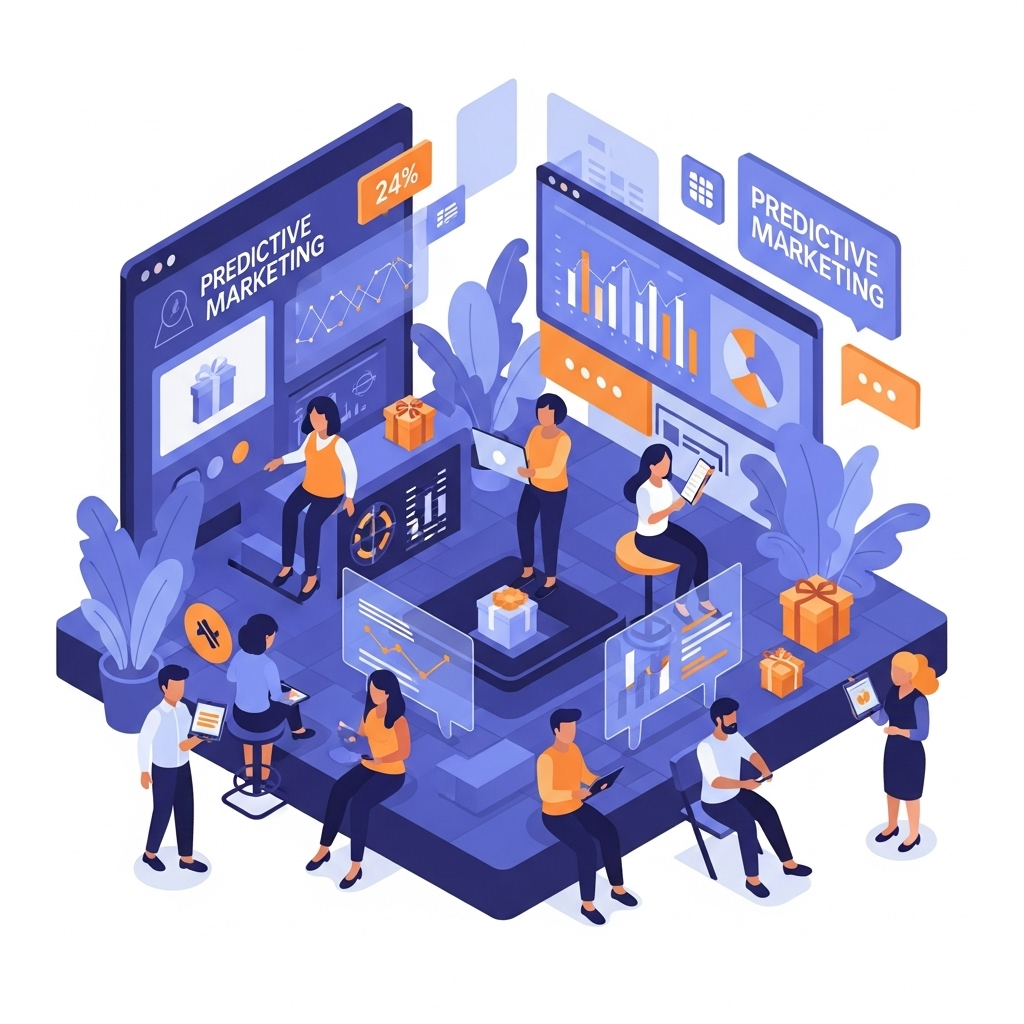
In an increasingly saturated and digitalized global market, a company’s ability to understand and, more importantly, anticipate its customers’ needs has become the key differentiator. It’s no longer enough to react to trends; success lies in anticipating them and acting proactively. This is where predictive marketing based on behavioral data emerges as a revolutionary discipline, transforming the way brands interact with their audiences.
Predictive marketing is a discipline that uses historical data, machine learning algorithms, and statistical models to predict future consumer actions.1Its main objective is to detect audience behavior patterns in real time to offer a personalized consumer experience and anticipate their needs.1This evolution marks a fundamental shift from a reactive to a proactive approach, where customer behavior insights become the strategic compass.
The ability to anticipate customer behavior goes beyond simply optimizing marketing campaigns. It allows organizations to fine-tune not only their advertising messages, but also product development, inventory management, and customer service quality.4This transformation elevates marketing from a departmental function to a core strategic capability that drives overall business agility and provides a sustainable competitive advantage. Forecasting needs thus becomes a strategic imperative, not just a tactical one.
I. Unraveling Predictive Marketing Based on Behavioral Data
Predictive marketing goes beyond retrospective analysis, using data intelligence to project the future. Its essence lies in a deep understanding of consumer behavior to deliver personalized and relevant experiences before the customer even requests them.
What is it and why is it crucial?
Predictive marketing encompasses a set of advanced techniques designed to predict customers’ future actions.1Its foundation lies in the detection of behavioral patterns in real time, allowing companies to offer highly personalized consumer experiences.1It’s not just about guessing, but about deeply understanding the underlying patterns in the data to act with a decisive advantage.2
The primary objectives of this discipline are diverse and strategic. They include recommending specific products to individual customers, predicting purchasing and consumption patterns, reactivating inactive customers, and accurately assessing a potential customer’s interest or affinity.3In essence, predictive marketing seeks to anticipate customer needs, proactively identify customers with the highest potential, and foster their loyalty through highly personalized service.3
Personalization, powered by predictive analytics, represents much more than simple market segmentation. It creates a genuine perception of individual customer understanding, fostering a deep sense of value. This emotional connection builds trust and loyalty, directly impacting customer lifetime value (LTV) and reducing churn. The focus shifts from the question “what can I sell?” to “how can I serve better?”, redefining the relationship between brand and consumer.
The Power of Behavioral Data
Behavioral data is the cornerstone of predictive marketing, acting as a detailed map of the customer journey. It reveals what captures their attention, what deters them, and ultimately, what motivates them to take action.7This data provides deep insight into how customers interact with a brand across various digital touchpoints, capturing their actions, interests, and preferences.7
There are three main categories of behavioral data, each with its own value and source:
- First Part Data:Considered the most valuable and reliable, this data is collected directly from customers through the company’s own platforms.7They offer a precise view of individual preferences, pain points, and overall brand experience. Online examples include website visits, click-through rates (CTR) on specific elements, time spent on each page, bounce rates, form submissions (such as newsletter subscriptions), product searches and filters used, shopping cart activity (additions, deletions, abandonments), checkout behavior, purchase history (frequency, age, amount), clickstream data (sequence of pages visited), engagement with newsletters or emails (open rate, click-through rate), video views, and social media interactions.7Offline, these include the frequency and duration of visits to physical stores, in-store purchase history, loyalty program use, and customer service interactions.7
- Second Part Data:These refer to first-party data from another company, obtained through strategic partnerships or data-sharing agreements.7Typically, this data is presented in an anonymized and aggregated form. Examples include customer interactions with a partner’s website or app, product preferences or browsing behaviors shared across platforms, clicks on referral or affiliate links, and behavior on co-branded landing pages.7
- Third Party Data:They are collected by third-party providers or data brokers, often through the use of cookies, pixels, and other tracking mechanisms across a variety of sites and platforms.7This data is typically aggregated and anonymized, providing a broader view of audience behavior rather than specific individual actions. Common examples include website visits and behaviors tracked by third-party ad networks, third-party cookie-based behavioral profiles (browsing habits, interests), demographic and psychographic data inferred from browsing history, and cross-site tracking (multi-site behavioral analytics).7
The supremacy of first-party data is a fundamental principle in predictive marketing. Its superior value and reliability, explicitly highlighted in research,7, represent a strategic imperative for companies. With increasing privacy regulation (such as the GDPR)8and the phasing out of third-party cookies, reliance on external data becomes unsustainable. Therefore, investing in robust first-party data collection mechanisms (such as advanced CRM systems, loyalty programs, and direct engagement platforms) is crucial for ethical and sustainable predictive marketing. This not only fosters direct relationships with customers but also generates richer and more accurate insights, transforming data management into a competitive advantage.
Table 1: Behavioral Data Types and Examples

| Data Type | Brief Definition | Online Examples | Offline Examples |
| Part One | Collected directly from the company’s platforms. | Website views, clicks, time on page, shopping cart activity, purchase history, email interactions, mobile app usage. | Frequency of visits to physical stores, in-store purchases, use of loyalty programs, interactions with customer service. |
| Second Part | First-party data from another company, obtained through agreements. | Interactions with a partner’s site/app, shared product preferences, clicks on affiliate links, behavior on co-branded pages. | Behaviors observed in partner stores, participation in joint events, interactions with physical partner touchpoints. |
| Third | Collected by third-party providers through tracking mechanisms. | Website views by advertising networks, behavioral profiling by third-party cookies, inferred demographics, cross-site tracking. | In-store shopping habits (e.g., supermarket loyalty cards), geolocation data, purchasing patterns from external surveys. |
The Science Behind the Prediction
Building predictive analytics models is a meticulous process that involves several key elements: collecting relevant historical data, thoroughly preprocessing that data, engineering features to extract meaningful variables, carefully selecting algorithms, training the model on specific datasets, and finally, evaluating it using performance metrics.9These models employ various statistical and machine learning techniques to uncover hidden patterns and trends in large volumes of data.9
Predictive analytics models fall into several categories, each designed for a specific type of prediction:
- Classification Models:Their purpose is to categorize data, usually to answer binary or “yes/no” questions. For example, they can predict whether a customer is about to cancel a service or whether a financial transaction is fraudulent.9
- Clustering Models:These models group similar data into “smart groups” based on shared attributes. They are essential for customer segmentation, enabling highly targeted marketing campaigns.9
- Forecasting Models:Widely used, they predict future numerical metrics, such as expected sales or call volume in a call center, based on historical data.9
- Time Series Models:They analyze sequences of data points captured over time, using time as an input parameter. They are crucial for more accurately identifying patterns, trends, and potential future events, such as seasonal demand.9
- Anomaly Detection Models (Outlier):They identify atypical or anomalous data entries within a data set, either in isolation or in combination with other variables. They are very useful for detecting fraud, product failures, or operational irregularities.9
The intelligence behind these models lies in machine learning and deep learning algorithms. Predictive analytics algorithms are primarily divided into these two groups.9Machine learning is commonly applied to structured data presented in tables, using linear and nonlinear algorithms. On the other hand, deep learning, a subset of machine learning, is better suited for processing complex data such as audio, video, text, and images.9
Some of the most common machine learning algorithms that power predictive analytics models include:
- Regression (Linear and Logistic):They analyze the relationships between variables to predict continuous (linear regression) or categorical (logistic regression) outcomes, such as purchase probability.9
- Decision Trees and Random Forests:Decision trees segment customers based on behavioral factors. Random forests improve accuracy by combining multiple decision trees, reducing errors and handling large volumes of data.9
- Neural Networks and Deep Learning:They mimic the human brain’s ability to recognize complex patterns, making them especially useful for highly dynamic predictions, such as real-time personalized recommendations on e-commerce platforms.9
- Clustering Algorithms (K-Means, DBSCAN):They group customers based on similar behaviors, enabling targeted marketing strategies and personalized experiences.9
- Natural Language Processing (NLP):It helps analyze text-based data, such as customer reviews, social media comments, and chat logs, to understand customer sentiment and preferences.11
- Prophet:An open-source algorithm developed by Facebook, valued for its speed and robustness in handling messy data. It’s very useful for capacity planning and setting sales targets in time-series models.9
Simply possessing data and algorithms does not guarantee success in predictive marketing. The effectiveness of this discipline depends fundamentally on the selection, training, validation, and continuous adjustment of models, always based on the specific business question and the characteristics of the data.12This requires specialized analytical talent and a deep understanding of both data science and marketing objectives, transcending a “plug and play” mentality.
Table 2: Key Models and Algorithms in Predictive Marketing

| Predictive Model Type | Brief Description | Common Algorithms | Application in Marketing |
| Classification | Categorize data for binary (yes/no) questions. | Logistic Regression, Decision Trees, Random Forests. | Customer churn prediction, fraud detection, potential customer identification. |
| Clustering | Groups similar data into “smart groups.” | K-Means, DBSCAN, Hierarchical Clustering. | Market segmentation, campaign customization, identification of customer niches. |
| Forecasting | Predicts future numerical values based on historical data. | Linear Regression, Time Series Models (ARIMA, Prophet). | Sales forecasting, demand estimation, inventory planning, call volume prediction. |
| Time Series | Analyze data captured over time to identify patterns and trends. | ARIMA, SARIMA, Prophet. | Predicting consumer trends, sales seasonality, and optimizing campaigns over time. |
| Anomaly Detection | Identify atypical or unusual data entries. | Density-based models, isolation trees. | Detecting fraudulent transactions, identifying unusual customer behavior, and alerting you to product issues. |
II. Tangible Benefits: Transforming the Customer Experience and the Business
The adoption of predictive marketing is not just a trend, but a strategic investment that generates significant returns. Its benefits range from improved customer experience to operational optimization and the achievement of a decisive competitive advantage.
Hyper-relevant Personalization
Data analytics allows companies to take a proactive approach, anticipating common problems or specific customer needs even before they express them.5This translates into the ability to offer highly personalized product recommendations, as demonstrated by success stories such as Amazon and Netflix.5It also enables the sending of tailored offers and messages through channels such as email.5, and creating unique content that resonates deeply with specific customer segments.5
A prime example of this personalization is Spotify, whose artificial intelligence algorithm analyzes users’ listening habits to generate personalized playlists, such as the popular “Weekly Discovery.” This strategy has resulted in an impressive 70% user engagement rate with AI recommendations and a notable increase in user retention.15
Beyond simple content adaptation, personalization driven by predictive analytics has a profound psychological impact. It builds trust, significantly improves the customer experience, and actively encourages brand recommendations.5When customers perceive that a brand genuinely understands and serves them proactively, strong emotional connections are established and brand loyalty grows that transcend purely transactional relationships. This, in turn, leads to increased customer lifetime value and a reduced churn rate, transforming customers into loyal brand advocates.
Campaign and Resource Optimization
Predictive marketing allows organizations to fine-tune their marketing strategies in real time, identifying the most effective strategies and adjusting campaigns to maximize performance.7This capability translates directly into marketing budget optimization and a substantial increase in return on investment (ROI).2
Furthermore, this discipline facilitates accurate forecasting of future demand, which is crucial for optimizing inventory levels, improving product logistics and distribution, and reducing response times to unexpected market changes.6The case of Unilever is illustrative: the company has managed to significantly reduce the costs of its advertising campaigns and increase the effectiveness of new product launches thanks to the application of predictive analytics.15
Predictive marketing transforms marketing spending from an operational cost to a measurable investment with a clear ROI. The ability to predict demand and optimize inventory extends this efficiency beyond the marketing department, encompassing the entire supply chain. This not only makes the business more efficient and agile, but also minimizes wasted resources, consolidating more strategic and profitable business management.
Do you know how to make your brand stand out? Download it now
Increased Conversions and Retention
By accurately identifying the behaviors that lead to conversions, businesses can optimize their sales funnels and maximize their return on investment.7Funnel analysis, a key technique, allows you to identify the exact points where users abandon the conversion process, making it easier to implement necessary adjustments, such as simplifying a complicated checkout process.7
One critical area where predictive marketing demonstrates immense value is in reducing customer churn. Predictive models are able to identify early signs that a customer may be at risk of leaving the service, allowing companies to take proactive measures to retain them.2It is a well-established fact that retaining an existing customer is considerably more profitable than acquiring a new one.2To achieve this, you can activate personalized and automated retention campaigns, such as sending an email with a discount or special offer when a customer’s engagement decreases.7
While conversion is often the immediate goal, retention and loyalty are key pillars for sustainable growth.2Predictive marketing enables businesses to shift their focus from a single transaction to customer lifetime value (LTV).7By proactively addressing churn and fostering loyalty, companies build a stable, recurring revenue base, which is inherently more sustainable and profitable than continually acquiring new customers. This creates a virtuous cycle of satisfaction, loyalty, and brand advocacy.
Strategic Decision Making
Predictive analytics empowers businesses to make more informed and strategic decisions, minimizing the risk of failure and maximizing the likelihood of success.6By processing large volumes of data, this analytical capability allows for the identification of new market opportunities, including emerging trends or untapped market segments.6
Furthermore, more accurate sales forecasts are essential for optimized inventory planning, production, and marketing strategies. This ensures that there are always enough products to meet market demand without incurring excess stock, which improves operational efficiency and reduces costs.6
Predictive analytics provides real-time answers4and enables businesses to quickly adapt to changing environments.18This reveals that the true strategic benefit is greater organizational agility. By having a clearer view of market changes, customer needs, and potential risks, companies can pivot more quickly, allocate resources more effectively, and maintain a competitive advantage in dynamic market conditions. It’s about building an adaptable, future-proof business model.
Table 3: Key Benefits of Predictive Marketing
| Key Benefit | Detailed Description | Business Impact |
| Hyper-relevant Personalization | It offers content, products, and offers tailored to each user, anticipating their needs and preferences. | Increase customer satisfaction and loyalty, boost sales, and increase customer lifetime value (LTV). |
| Campaign Optimization | Refine marketing strategies in real time, identifying effective tactics and adjusting campaigns. | Improve return on investment (ROI), reduce advertising costs, and maximize budget efficiency. |
| Increased Conversions | Identify behaviors that lead to purchases, optimizing sales funnels and processes. | Increase conversion rates, improve the profitability of marketing actions, and streamline the sales cycle. |
| Improved Retention | Predicts the risk of customer churn and enables proactive actions to retain customers. | Reduce churn, foster long-term loyalty, and ensure recurring revenue. |
| Strategic Decision Making | Provides accurate forecasts for planning inventories, production, and marketing strategies. | Minimize risks, identify new market opportunities, and improve business agility and competitiveness. |
Inspiring Success Stories
The implementation of predictive marketing has proven to be a catalyst for value across a variety of industries, with notable examples of companies that have transformed their operations and customer experience:
- Netflix:This streaming platform uses artificial intelligence algorithms to analyze viewing data and user preferences. The result is highly personalized content recommendations that have led to an 80% increase in user viewing time and a significant reduction in unsubscribes.5
- Amazon:The e-commerce giant uses a sophisticated machine learning-based recommendation engine that analyzes customers’ previous purchases and browsing habits. Thanks to this, 35% of its sales come directly from these personalized recommendations, which also contributes to an increase in the average purchase price.5
- Spotify:Spotify’s artificial intelligence algorithm analyzes listening habits to generate personalized playlists, such as the acclaimed “Weekly Discovery.” This strategy has led to 70% of users engaging with AI recommendations, resulting in a significant increase in user retention.5
- Starbucks:The Starbucks mobile app collects customer purchase data to offer personalized discounts and promotions. This initiative has resulted in an impressive 400% increase in engagement with personalized promotions, strengthening customer loyalty.15
- Unilever:This multinational consumer goods company analyzes consumer data and trends to predict product demand and adjust its marketing strategy accordingly. The impact has been reflected in reduced advertising campaign costs and greater effectiveness in launching new products.15
Beyond marketing, predictive analytics is actively applied across a wide range of industries to guide real-time and future decision-making.4:
- Finance:It is used for credit risk assessment, fraud and suspicious activity detection, and financial performance forecasting.4
- Retail:It allows you to forecast customer demand, optimize inventory management, and send predictive recommendations to increase cross-selling and upselling opportunities.4
- Manufacturing:Manufacturers use it to monitor production line equipment, optimize performance, and predict maintenance requirements.4
- Health:It is used in equipment monitoring to detect real-time changes in patient status, predict the course of diseases, and support medical diagnosis.4
The wide range of examples across various industries (streaming, e-commerce, music, retail, consumer goods, finance, manufacturing, healthcare)4It demonstrates that predictive marketing isn’t limited to tech giants or specific niches. The underlying principle—harnessing behavioral data to anticipate needs—is universally applicable. This means that any business, regardless of its sector, can derive significant value by identifying its unique behavioral data points and applying predictive models, turning it into a powerful, cross-cutting tool for competitive differentiation and operational excellence.
Table 4: Predictive Marketing Success Stories
| Enterprise | Predictive Marketing Application | Key Impact |
| Netflix | Personalized content recommendations. | 80% increase in viewing time, reduction in subscription cancellations. |
| Amazon | Product recommendation engine. | 35% of sales come from referrals, increasing the average ticket price. |
| Spotify | Personalized playlists and weekly discoveries. | 70% of users interact with AI recommendations, increasing retention. |
| Starbucks | Loyalty programs with personalized offers. | 400% increase in interactions with personalized promotions. |
| Unilever | Demand prediction and marketing strategy adjustment. | Reduced advertising costs, increased effectiveness in product launches. |
III. Challenges and Ethical Considerations: Navigating the Future Responsibly
Despite its immense benefits, predictive marketing is not without its challenges, especially in the ethical realm. Responsible data management and algorithmic transparency are essential to maintaining consumer trust and ensuring the sustainable development of this discipline.
Privacy and Data Protection
Predictive marketing’s ability to analyze large volumes of data raises significant questions about individual privacy.24The possibility of disclosing user identification without consent is a critical ethical issue.25Ensuring the security and privacy of consumer data is crucial to maintaining customer trust and complying with strict legal regulations, such as the General Data Protection Regulation (GDPR) in Europe.8
Companies have a responsibility to be transparent about how data is collected and used.12In addition, they must implement data minimization and anonymization practices to protect user identities and reduce the potential for misappropriation.25Investing in robust security technology is essential to protecting consumer data from unauthorized access and security breaches.8
In a data-driven world, consumer trust is not only an ethical obligation, but a critical business asset. Privacy breaches or data misuse can lead to severe reputational damage, loss of customer loyalty, and serious legal repercussions. Therefore, prioritizing ethical data handling, transparency, and robust security measures becomes a strategic imperative for long-term success, transforming a potential liability into a trust-based competitive advantage.
Algorithmic Bias and Transparency
One of the most complex challenges is algorithmic bias. Artificial intelligence algorithms learn from the data they are trained on. If this historical data contains biases or reflects discrimination toward certain user groups, predictive models can replicate and even amplify these inequalities, leading to unfair automated decisions.2For example, an algorithm trained predominantly on data from younger users could unintentionally discriminate against older adults when personalizing messages or content.25
Addressing this challenge requires a thorough review of the datasets used to train AI models. Data diversification and the implementation of bias-correcting algorithms are key strategies to minimize disparities and promote fairer and more equitable artificial intelligence.24
Furthermore, decisions made by AI can often be complex and difficult for humans to interpret, making it difficult to assess their transparency and balance.24It is essential that algorithms be clear and that AI decisions can be explained and justified.14Implementing regular audits of algorithms helps identify and correct any biases, ensuring more ethical use of artificial intelligence.25
The issue of algorithmic bias is a direct consequence of the data used to train the models. AI models are not inherently neutral; they reflect the biases present in the real-world data from which they learn. This requires a proactive and multifaceted approach: first,data diversification, actively seeking diverse and representative data sets to avoid amplifying inherent biases; second,algorithmic auditsregular and independent to identify and correct biases25; and third, the
human supervision and interpretability, recognizing that predictions are guides, not certainties, and that ethical judgment and human interpretation remain essential.2This requires interdisciplinary teams (data scientists, ethicists, marketers) to ensure responsible AI implementation.
Data Quality and Model Complexity
The effectiveness of both hyperpersonalization and predictive marketing depends largely on the quality of the data collected.12Incorrect, incomplete, or inconsistent data can lead to irrelevant recommendations or erroneous predictions, which could negatively impact customer experience and business decision-making.16Obtaining sufficient, high-quality data can be a considerable challenge for many organizations.12
Furthermore, human behavior is inherently dynamic and can change over time due to external or internal factors. This changing nature makes predictions less accurate if predictive models are not continually updated and recalibrated.12The inherent complexity of some machine learning models can also make them difficult to interpret and explain, making it difficult to fully understand and trust their results.12
The premise that “predictive analytics is only as good as the data used”14and the constant emphasis on “data quality”12They underline a fundamental principle: “garbage in, garbage out.” This implies that a significant investment in data governance, data cleansing, and validation processes is not an optional extra, but a fundamental requirement for any successful predictive marketing strategy. Without relevant, high-quality data, even the most sophisticated algorithms will produce inaccurate or misleading predictions, resulting in wasted resources and missed opportunities.
Table 5: Ethical Challenges and Proposed Solutions in Predictive Marketing
| Ethical Challenge | Challenge Description | Proposed Solutions |
| Privacy and Data Protection | Risk of disclosure of personal information without consent, indiscriminate use of data. | Investment in security technology, rigorous regulatory compliance (e.g., GDPR), data minimization and anonymization, privacy-focused system design from the outset, and transparency in data collection and use. |
| Algorithmic Bias | Algorithms can replicate or amplify biases present in training data, leading to discrimination. | Thorough review and diversification of training data sets, implementation of bias-correcting algorithms, and regular algorithm audits to identify and correct biases. |
| Transparency and Explainability | AI decisions can be complex and difficult to interpret, making justification and trust difficult. | Developing AI models with explanatory capabilities, implementing interpretability techniques (e.g., model attention visualization), and ensuring that algorithmic decisions can be clearly explained and justified to humans. |
| Data Quality | Incorrect, incomplete, or outdated data leads to irrelevant or inaccurate predictions. | Investing in tools and processes to ensure data quality and accuracy, implementing data governance, continuously validating information, and regularly updating predictive models to reflect changes in human behavior. |
IV. The Horizon of Predictive Marketing: Trends and Future
Predictive marketing is not a static goal, but a constantly evolving field, driven by advances in artificial intelligence and the integration of new technologies. The future promises even deeper personalization and immersive customer experiences that will redefine the interaction between brands and consumers.
The Evolution of AI and Automation
Artificial intelligence (AI) has transcended its novelty status to become a central pillar of digital marketing.20AI is anticipated to play a pivotal role in most marketing strategies by 2025 and beyond, taking an “AI-first approach.”26Companies are integrating AI to analyze large volumes of data, enabling more precise and efficient personalization in real time.20
Key applications of AI in predictive marketing include predictive analytics to anticipate future market trends and behaviors.14In addition, intelligent chatbots offer personalized customer service 24 hours a day.14, and dynamic segmentation allows you to tailor messages and offers based on the user’s previous interactions.20AI-powered automation also optimizes advertising campaigns, adjusting variables in real time to maximize ROI.14
The constant mention of AI as a “central pillar”20and the adoption of an “AI-first approach”26suggest that AI is no longer just a tool, but the fundamental intelligence that powers predictive marketing. This implies a future where AI will be seamlessly integrated into every aspect of marketing, from content creation to campaign optimization and customer service. Marketers will need to evolve from simply using AI tools to thinking with an “AI-first” mindset, understanding how to leverage these advanced capabilities for strategic advantage.
New Technological Frontiers
The convergence of various emerging technologies is opening up new dimensions for predictive marketing and customer experience:
- Internet of Things (IoT):Integrating the vast ecosystem of interconnected IoT devices enables businesses to collect accurate, real-time data, gain deep insights into customer behavior, and deliver hyper-personalized marketing messages.27This enables marketing based on moment (triggered by specific behaviors or situations), environment (temperature, weather), and product usage patterns.28A notable example is the IoT-enabled Oral-B toothbrush, which offers personalized oral care advice through a companion app based on actual brushing habits, increasing user engagement with the brand by 300% and retention rates by 28%.28
- Augmented Reality (AR) and Virtual Reality (VR) and the Metaverse:These technologies offer immersive experiences that allow consumers to interact with products and services in innovative ways.20The Metaverse is emerging as a highly immersive virtual environment where users interact through avatars, creating personalized, dynamic, and exciting experiences.29Brands can set up virtual stores (like Gucci on Roblox), offer virtual product try-ons (e.g., trying on clothes on avatars), and generate deep emotional connections through immersive experiences that complement traditional channels.30
- Voice Search and Optimization for Virtual Assistants:With the increasing use of devices like Alexa, Siri, and Google Assistant, voice search has experienced significant growth. It is estimated that by 2025, 50% of searches will be conducted by voice.20This requires SEO optimization for voice, which involves incorporating conversational phrases and frequently asked questions into your content, as well as using structured data to facilitate interpretation by search engines and virtual assistants.20
The integration of IoT, AR/VR and the Metaverse20It represents a breakthrough beyond traditional digital channels. These technologies aren’t just new platforms; they’re new dimensions for collecting behavioral data and delivering personalized experiences. This implies a future in which marketing will become truly “ambient” and “invisible.”28, seamlessly integrated into daily life. Brands will be able to anticipate needs based on the physical context in real time and offer immersive, personalized interactions that blur the lines between the physical and digital worlds, creating unprecedented levels of engagement and loyalty.
Real-Time Hyperpersonalization
Predictive personalization has become an organizational priority, with the goal of providing customers with exactly what they need, at the right time.18Predictive marketing algorithms have the ability to continuously adjust their predictions as they receive new data, improving their accuracy over time and adapting to changes in consumer behavior.19
In the age of immediacy, instant contact between companies and customers is an expectation, facilitated by the proliferation of channels such as social media.18Hyperpersonalization will become increasingly important for companies looking to differentiate themselves from the competition and establish a deeper connection with their customers.31
The concept of “real-time hyperpersonalization”16, combined with the idea of “ambient intelligence” and “invisible marketing” from the IoT28, points to a future where personalization will be so fluid and anticipatory that it will feel intuitive rather than intrusive. This means customers will expect this level of understanding and proactive service as the norm. Brands that fail to achieve this will be perceived as irrelevant or outdated, making hyper-personalized, real-time interaction a fundamental requirement for competitive survival.
Conclusion: Anticipating Tomorrow, Building Success Today
Predictive marketing based on behavioral data is not a futuristic tool, but a present reality and the engine of business success in the digital age. By harnessing the power of data and artificial intelligence, companies can transcend reaction to embrace anticipation, transforming the way they understand and serve their customers.
From hyper-relevant personalization that builds deep, lasting relationships to resource optimization that boosts profitability and operational efficiency, the benefits of predictive marketing are undeniable and multifaceted. This discipline enables organizations not only to identify market opportunities and optimize their campaigns, but also to reduce the risk of customer churn and make more informed strategic decisions, leading to greater agility and competitiveness in a dynamic business environment.
However, this path to anticipation requires an unwavering commitment to ethics, data privacy, and the active mitigation of algorithmic bias. Consumer trust is an invaluable asset that must be protected through transparency, robust security, and the constant pursuit of fair and explainable artificial intelligence. Data quality, as an indispensable foundation, requires ongoing investment in governance and validation to ensure the accuracy of predictions.
Looking to the future, integration with emerging technologies such as the Internet of Things (IoT), Augmented Reality (AR), Virtual Reality (VR), and the Metaverse promises to take anticipation of needs to unprecedented levels. These innovations will enable the creation of even more immersive and visible experiences that will redefine brand-consumer interaction, making personalization increasingly intuitive and an integral part of daily life. In a world where customer behavior is the currency of exchange, predictive marketing is the key not only to predicting tomorrow, but to building success today.
Sources cited
- www.il3.ub.edu, access: June 25, 2025,https://www.il3.ub.edu/blog/que-es-el-marketing-predictivo/#:~:text=El%20marketing%20predictivo%20es%20aqu%C3%A9l,una%20experiencia%20de%20consumo%20personalizada.
- Predictive Marketing: The Evolution of Data-Driven Strategy – Bonner MX, accessed June 25, 2025,https://bonner.mx/marketing-predictivo-la-evolucion-de-la-estrategia-basada-en-datos/
- What is predictive marketing? – IL3 Blog – UB, accessed June 25, 2025https://www.il3.ub.edu/blog/que-es-el-marketing-predictivo/amp/
- What is Predictive Analytics? – AWS, accessed June 25, 2025https://aws.amazon.com/es/what-is/predictive-analytics/
- How data personalizes and improves customer experience in companies – ISDI, accessed: June 25, 2025,https://www.isdi.education/es/blog/datos-y-experiencia-del-cliente
- Predictive Models in Marketing: What They Are, Applications, and Benefits – APD, accessed June 25, 2025,https://www.apd.es/modelos-predictivos-marketing/
- Understand the Importance and Types of Behavioral Data, acceso: junio 25, 2025, https://www.customerlabs.com/blog/what-is-behavioral-data-in-marketing-importance/
- How AI-Based Predictive Marketing Transforms the…, accessed: June 25, 2025,https://byoptimos.com/como-el-marketing-predictivo-basado-en-ai-transforma-el-comportamiento-del-consumidor-2/
- Top 5 Analytics Models and Algorithms… – insightsoftware, accessed June 25, 2025,https://insightsoftware.com/es/blog/top-5-predictive-analytics-models-and-algorithms/
- Predictive Modeling Types and Algorithms for Data Success, acceso: junio 25, 2025, https://www.dasca.org/world-of-data-science/article/predictive-modeling-types-and-algorithms-for-data-success
- How Predictive Behavior Analytics Helps Businesses to Move Beyond Reactive Customer Insights – Xerago, acceso: junio 25, 2025, https://www.xerago.com/xtelligence/Predictive-behavioral-analytics
- Predictive Behavioral Analytics → Term, acceso: junio 25, 2025, https://prism.sustainability-directory.com/term/predictive-behavioral-analytics/
- The Power of Predictive Analytics in Business Decisions, accessed June 25, 2025,https://blog.bismart.com/kale/analisis-predictivo-decisiones-empresariales
- How to Use AI in Marketing: Personalization and Predictive Analytics – Skillnest, accessed June 25, 2025https://www.skillnest.com/blog/como-usar-la-ia-en-marketing/
- 10 Success Stories of Artificial Intelligence Applied to Marketing, accessed: June 25, 2025,https://www.growfik.com/blog/10-casos-de-exito-de-inteligencia-artificial-aplicada-al-marketing
- Hyperpersonalization Marketing with AI: Advanced Strategies to Segment Audiences in Real Time and Personalize Content – ICEMD, accessed: June 25, 2025,https://icemd.esic.edu/knowledge/articulos/marketing-de-hiperpersonalizacion-con-ia-estrategias-avanzadas-para-segmentar-audiencias-en-tiempo-real-y-personalizar-contenidos/
- 5 Marketing Automation Success Stories in Real Companies – David González, accessed: June 25, 2025,https://davizgonzalez.com/blog/casos-exito-marketing-automation-empresas-reales/
- Predictive Personalization and Competitive Advantage – rochiconsulting, accessed June 25, 2025,https://www.rochiconsulting.com/blog/personalizacion-predictiva/
- How AI-Based Predictive Marketing Transforms Consumer Behavior – Market Research in Colombia and Latin America. – Byoptimos, accessed June 25, 2025.https://byoptimos.com/como-el-marketing-predictivo-basado-en-ai-transforma-el-comportamiento-del-consumidor/
- Emerging Trends in Digital Marketing for 2025, accessed: June 25, 2025,https://agenciakarmina.com/blog/tendencias-marketing-digital-2025-2/
- Emerging Marketing Trends to 2025: Innovation and…, accessed June 25, 2025,https://mk-ventas.blog/marketing/tendencias-emergentes-en-marketing-para-2025-innovacion-y-transformacion-en-la-era-digital/
- How AI is revolutionizing marketing innovation: examples and strategies – APD, accessed June 25, 2025,https://www.apd.es/innovacion-marketing-ia-ejemplos-estrategias/
- Digital Marketing Trends for 2025: Innovative Strategies for Business Success – WindUp, accessed June 25, 2025,https://windup.es/blog/tendencias-de-marketing-digital/
- Ethical Challenges in the Age of Generative Artificial Intelligence…, accessed June 25, 2025,https://madisonmk.com/los-desafios-eticos-en-la-era-de-la-inteligencia-artificial-generativa
- Ethical Challenges of AI in Marketing: Data Privacy and Bias…, accessed June 25, 2025,https://econsultoria.net/blog/desafios-eticos-de-la-ia-en-marketing-privacidad-y-sesgo-de-datos/
- Marketing in 2025: Six Key Trends That Will Shape the Future – Oppizi, accessed June 25, 2025,https://www.oppizi.com/es/es/blog/marketing-trends/marketing-in-2025-five-key-trends-that-will-drive-the-future/
- The Integration of IoT in Digital Marketing: Enhancing Customer Engagement Strategies, acceso: junio 25, 2025, https://profiletree.com/integration-of-iot-in-digital-marketing/
- Integrating IoT in Marketing Campaigns – Rajiv Gopinath, acceso: junio 25, 2025, https://www.rajivgopinath.com/real-time/next-gen-media-and-marketing/integrating-iot-in-marketing-campaigns
- Innovative business ideas in the metaverse – Esade, access: June 25, 2025,https://www.esade.edu/beyond/es/ideas-negocio-innovadoras-metaverso/
- Immersive Marketing in the Metaverse: Opportunities for Brands in 2025, accessed June 25, 2025,https://csldigitalglobal.com/marketing-inmersivo-en-el-metaverso-oportunidades-para-las-marcas-en-2025/
- Marketing Sales Strategies: What Is “Hyper-Personalization” of a Sale?, accessed June 25, 2025,https://www.zenvia.com/es/blog/estrategias-de-ventas-marketing/