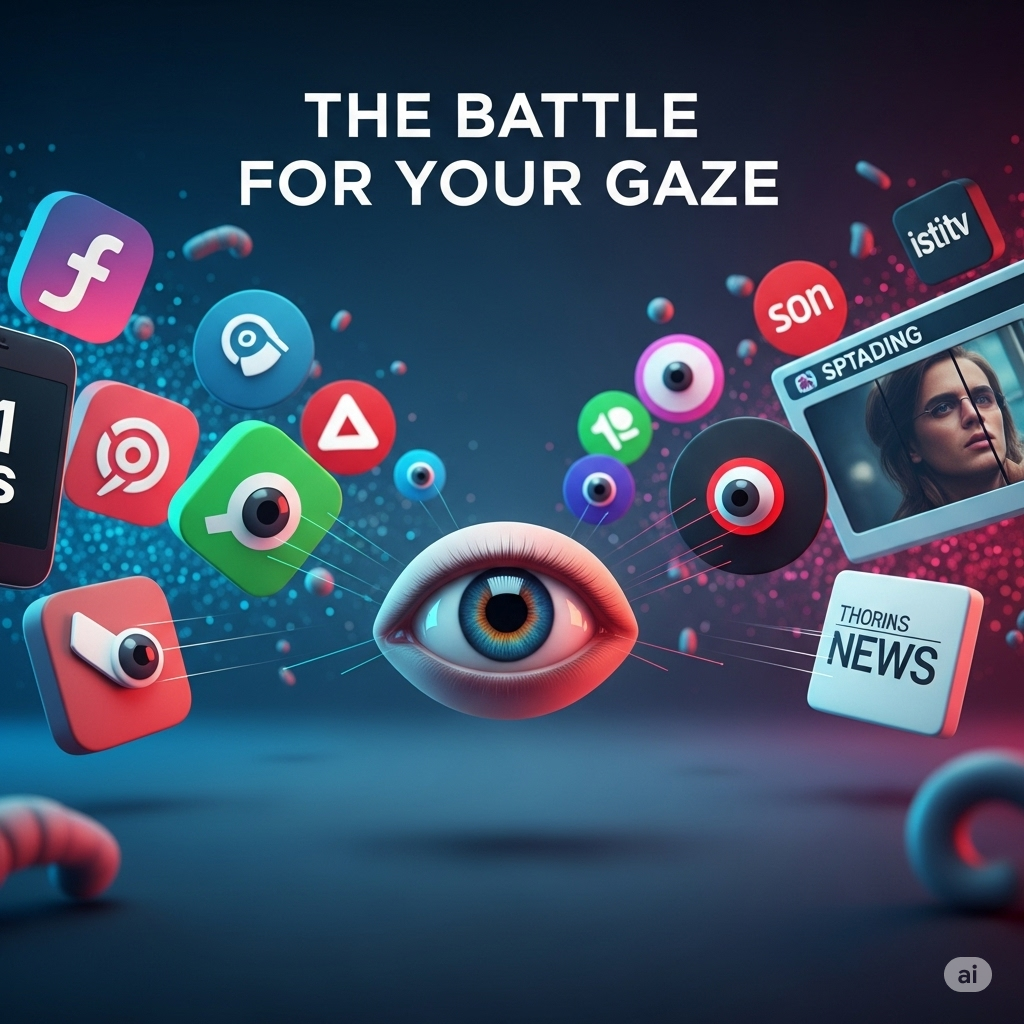
In today’s fast-paced digital landscape, one intangible resource has emerged as the most coveted asset: human attention. This phenomenon, known as the “Attention Economy,” describes an economic system where people’s ability to focus is monetized and becomes the primary driver of business development.1Since its conception by Herbert Simon in 1969, who observed that the increasing abundance of information would inevitably generate a shortage of attention, this concept has gained unprecedented relevance.3Companies, especially those driven by advertising, compete fiercely for every second of our attention, seeking to maximize the time users spend with their products and content.1
Attention is, in essence, the fuel that drives modern capitalism. Although its supply seems inexhaustible in theory, unlike finite resources like oil, its value lies precisely in its scarcity in an oversaturated environment.2A curious fact that illustrates this dynamic is how virtual reality and video games, by requiring active “intention” from the user, manage to capture large percentages of attention, demonstrating the power of immersive and engaging content.5
Content Overload: The Challenge of the Digital Age

The digital age has unleashed a veritable flood of information. In 2011, it was estimated that Americans consumed five times more information daily than in 1986, an amount equivalent to 174 newspapers. Today, the figure is even more staggering: IBM estimates that 2.5 quintillion bytes of data are generated every day on the internet.6This constant stream of content, flowing through multiple channels such as social media, websites, emails, and mobile apps, has given rise to a phenomenon known as “infoxication.”8
This information overload has a profound impact on human attention span. A curious fact that has been widely circulated, although it is a myth, is that the human attention span has been reduced to less than 8 seconds, even surpassing that of a goldfish.6However, research by Dr. Gloria Mark and her team offers a more nuanced and troubling perspective: while not quite 8 seconds, the average sustained attention span on a screen-based task has declined dramatically, from 2.5 minutes in 2004 to just 45 seconds in the final years of her studies.6This underscores that while our brains have the capacity to process information, they do so at a considerable cognitive cost.6
The consequences of this information overload are multifaceted and detrimental. It causes mental fatigue, difficulty concentrating, stress, anxiety, and can lead to “analysis paralysis,” where the abundance of options impedes decision-making, leading to suboptimal choices.7Overwhelmed consumers often skim content without time to verify its accuracy, which can impair their ability to identify false information and lead them to rely on selective sources.13
For brands, the effects of this saturation are direct and significant. Poor data quality and information overload can lead to a 45% increase in customer complaints and a loss of brand loyalty that can increase by up to 20%.10In this noisy environment, capturing and, more importantly, retaining attention becomes a monumental challenge. Today’s consumers, empowered by technology, expect near-immediate responses (80% prefer brands that offer quick answers), personalization, and a seamless experience across multiple channels (omnichannel can improve customer retention by up to 89%).15Attention, therefore, is not just an objective, but the foundation upon which the relationship between brand and consumer is built in the digital age.
The Digital Abundance Paradox
The digital age has plunged us into a fascinating paradox: the same abundance of information that promised to empower us has led to a critical shortage of attention. Herbert Simon anticipated this in 1969: if there is more to perceive, more to think about, and more to do, choosing between alternatives becomes more difficult.4Today, this prediction is a palpable reality. We are generating quintillion bytes of data daily, and the channels of information have multiplied exponentially.6Far from making information more accessible and useful, this deluge has led to “infoxication,” where individuals feel overwhelmed, their attention spans are drastically shortened, and their decision-making ability is compromised.6
This dynamic creates a vicious cycle. Digital platforms and social media, designed to connect us with more content, aggressively compete for our attention, which in turn intensifies the overload. Users, feeling overwhelmed, develop mechanisms to consume information in the shortest possible time, often skimming content instead of processing it thoroughly.7This means that the value of attention does not only lie in being seen, but in generating a
meaningful engagementThe real battle isn’t just about clicks, but about a brand’s ability to resonate enough for consumers to dedicate their limited cognitive resources to it.
Attention as a Strategic and Vulnerable Asset
Attention has established itself as the “most valuable commodity” in the capitalist economy, driving economic development and content monetization.2However, this strategic asset is inherently vulnerable. Constant exposure to information overload subjects it to relentless assault, resulting in decreased attention span and widespread cognitive fatigue.6
This vulnerability has direct consequences for brands. When consumers are overwhelmed, their ability to process information and make decisions deteriorates.8This translates into a loss of brand loyalty and a decrease in the effectiveness of marketing strategies, as messages struggle to stand out in the digital noise.10Brands that fail to recognize this shift and adapt their approaches not only risk being ignored, but also actively damaging their relationships with their customers due to a perception of intrusion or irrelevance. Attention management, therefore, transcends marketing tactics to become a fundamental strategic imperative for business survival and growth.
Table 1: Interesting Facts about Human Attention and Information Overload
| Metric / Phenomenon | Fun Fact / Impact |
| Daily Information Consumption (USA, 2011) | 5 times more than in 1986, equivalent to 174 newspapers6 |
| Daily Data Generation (IBM) | 2.5 quintillion bytes6 |
| Average Screen Time (Dr. Gloria Mark) | From 2.5 minutes (2004) to 45 seconds (recently)6 |
| Impact of Poor Data Quality | 45% increase in complaints, 20% loss of brand loyalty10 |
| Customers who change for Service | 40% of customers switch to a competitor because of their excellent customer service.17 |
| Willingness to Pay for a Better Experience | 86% of customers are willing to pay up to 25% more for a better experience17 |
| Expectation of Speed in Customer Service | More than 80% of customers prefer fast and efficient responses15 |
| Improving Retention with Omnichannel | Up to 89% improvement in customer retention with omnichannel strategies15 |
Learn to create a brand that leaves a mark Get the ebook now
II. Predictive Marketing: Your Compass in the Digital Noise

In a world where attention is scarce and information is abundant, predictive marketing is emerging as an indispensable compass for brands. This discipline goes beyond analyzing historical data; it uses machine learning algorithms and statistical models to anticipate future consumer behaviors, identify emerging trends, and ultimately make informed decisions with a strategic advantage.18It’s not about guessing, but about understanding complex patterns to act proactively.19
The functioning of predictive marketing is based on a series of fundamental steps. First, thedata collection and preparationHigh-quality data is crucial. This involves gathering and cleaning information from diverse sources, ensuring its consistency and accuracy. Data quality is the foundation upon which effective predictive models are built.25Once the data is ready, we proceed to the
model and algorithm selectionappropriate for the specific problem at hand. This may include classification models (to predict categorical outcomes such as the likelihood of customer churn), clustering models (to segment customers with similar behaviors), forecasting models (to estimate numerical values such as future sales), or time series models (to analyze data over time and predict trends).27Machine learning algorithms, such as Random Forest, K-Means, Prophet, or neural networks, are the basis of these models.27
The next step is themodel training and validation, where historical data is used to fine-tune model parameters and improve their predictive capabilities. Validation with independent test data sets is essential to ensure that models are reliable and accurate in their future predictions.25Finally, the
implementation and continuous monitoringallow companies to use these models to make real-time decisions and periodically adjust them to reflect changes in market behavior.19
From Personalization to Hyperpersonalization: The Art of Connecting
Predictive marketing takes personalization to a whole new level, transforming it intohyperpersonalizationWhile traditional personalization segmented audiences in a general way (by age, gender, location), hyperpersonalization uses artificial intelligence to analyze much deeper data, such as browsing habits, social media interactions, and past purchases, creating tailored experiences for each individual.30This capability allows brands to deliver highly targeted and relevant content, offers, and services in real time, often anticipating customer needs and desires even before they clearly express them.30
The benefits of this strategy are overwhelming and extend throughout the entire customer lifecycle. Hyperpersonalization dramatically improves the customer experience, building long-term trust and loyalty.35By reducing friction in the purchasing process and making the experience more enjoyable, useful, and streamlined, conversion rates are increased and new customers are attracted more easily.35Iconic examples of companies that have mastered this technique include Netflix, which uses AI algorithms to recommend personalized content, and Amazon, whose intelligent recommendation engine is responsible for a significant percentage of its sales.35Spotify, for its part, creates personalized playlists like “Weekly Discovery” that capture 70% of user engagement with AI recommendations, increasing retention.36Sephora uses AI-powered chatbots to deliver personalized makeup recommendations in real time, achieving 11% higher conversions.30
Key Applications of Predictive Marketing
Predictive marketing isn’t a one-dimensional tool; its applications are vast and transform various areas of an organization, enabling smarter and more proactive decision-making:
- Marketing and Sales:It enables market demand prediction, accurate identification and segmentation of potential customers, personalization of marketing campaigns, and forecasting of sales and purchasing trends.19This translates into budget optimization and an increase in return on investment (ROI).19
- Customer service:It facilitates the prediction of customer complaints and issues, the analysis of social media sentiment to anticipate brand reputation issues, and the personalization of customer service experiences.25
- Operations and Logistics:It helps optimize inventory and supply chain management, predict delivery times, and plan routes.25Companies can anticipate peak demand and prepare inventories further in advance, which is crucial in sectors such as retail and fashion.19
- Finance:It is essential for assessing credit risk, detecting fraud and suspicious activity, and forecasting financial performance and evaluating investments.37
- Customer Churn Prediction:Anticipating customer churn allows companies to act before they decide to abandon a service, offering benefits or targeted campaigns to retain them. Retaining customers is, in most cases, more profitable than acquiring new ones.19
- Product Recommendations:Offering specific products that a customer is likely to be interested in based on past purchases and browsing behavior, as Amazon does, improves conversion rates and satisfaction.19
- Price Optimization:Platforms like Uber adjust fares in real time based on demand and other factors, maximizing revenue.21
Successful implementation of predictive marketing requires a combination of high-quality data, advanced analytics tools, and analytical talent.25It’s a constantly evolving field, and companies that embrace it with a clear strategy and a focus on data quality will be better positioned to compete in the attention economy.19
III. Disruptive Strategies to Capture and Retain Attention
In the battle for attention, mere presence is no longer enough. Brands must adopt disruptive strategies that not only capture attention but also generate a deep and memorable connection. The key lies in constant innovation, extreme personalization, and the creation of experiences that transcend the conventional.
Artificial Intelligence and Automation: The Heart of Disruption
Artificial Intelligence (AI) has ceased to be a novelty and has become the central pillar of disruptive digital marketing. Its ability to analyze large volumes of data enables more precise and efficient personalization in real time, optimizing everything from audience segmentation to campaign execution.30AI not only automates tasks, but also drives innovation, allowing brands to anticipate future market trends and behaviors.30
Among the most notable applications of AI in disruptive strategies are:
- Advanced Chatbots:Powered by AI, they improve customer service by answering questions in real time and offering personalized recommendations based on interaction history.40Companies like Sephora use these bots to provide advice on beauty products, achieving higher conversion rates.30
- Custom Content Generation:AI can create text, images, and videos tailored to different audiences, streamlining content production without compromising quality. This allows brands to tell their story in a more personal way on an individual level.40
- Optimization of Advertising Campaigns:AI-based tools adjust ads in real time based on audience response, maximizing ROI. This includes hyper-targeted advertising on platforms like Facebook Ads and Google Ads.30
- Image and Voice Recognition:These technologies open up new ways to interact with customers, such as image search or voice assistants, which are estimated to account for 50% of searches by 2025.38
- AI-Assisted Influencer Marketing:AI helps identify the most suitable influencers for a brand based on audience and performance data, optimizing collaborations and campaign impact.40
- Customer Churn Prediction:AI algorithms identify early signs of disinterest, allowing brands to take proactive steps to retain customers before they are lost.40
Adopting an “AI-first” approach is a key trend for 2025 and beyond, as AI will increasingly be integrated into digital marketing strategies, supporting personalization and creative testing.38
The Explosion of Immersive Experiences: AR, VR, and the Metaverse
Immersive experiences, driven by Augmented Reality (AR), Virtual Reality (VR), and the concept of the Metaverse, represent one of the most disruptive strategies for capturing and retaining attention. These technologies allow consumers to interact with products and services in innovative and deeply engaging ways, blurring the lines between the physical and digital worlds.38
- AR and VR in Action:Brands are using AR to enable virtual product try-ons, such as viewing furniture in your home with the IKEA Place app or virtually trying on shoes with Gucci Try-On before buying.46Sephora, for example, uses AR to help customers select and match cosmetic colors.52Virtual showrooms and interactive 3D events offer experiences that reach a global audience without geographical limitations.38
- The Metaverse as a New Marketing Canvas:The Metaverse, a 3D-enabled virtual environment, offers a vast array of commercial and interaction opportunities.45Brands like Gucci have created “Gucci Town” on Roblox, a virtual world where users can explore and purchase exclusive items, while Balenciaga has launched digital collections within Fortnite.40These initiatives not only generate monetization through virtual goods, but also enable a deeper emotional connection and a highly personalized and dynamic brand experience.45
- Opportunities and Challenges:Immersive marketing in the Metaverse enables advanced segmentation and real-time data collection, strengthening the emotional connection with consumers and positioning brands as leaders in innovation.43However, there are significant challenges, such as data privacy and security, technological accessibility (device cost, connectivity), and the need to avoid intrusive or overly commercial experiences that could alienate users.43
Gamification and Interactive Content: Turning Interaction into a Game
In the age of overload, static content often goes unnoticed. This is where thegamificationand theinteractive contentThey become key disruptive tools. Interactive content requires user action (a click, a drag, a response), transforming passive consumption into a dynamic and personalized experience.53Gamification, on the other hand, integrates game mechanics (rewards, challenges, levels, rankings) into marketing strategies to increase engagement and motivation.56
The benefits of these strategies are notable:
- Greater Interaction and Loyalty:They make brand interactions fun and rewarding, keeping customers engaged and encouraging return visits.56This strengthens the emotional connection and transforms users into brand ambassadors.60
- Increased Conversion Rates:Gamification can increase conversion rates by up to 8% by creating a sense of urgency and excitement, especially when points or rewards expire.56Interactive content attracts qualified leads, as prolonged interaction indicates genuine interest in the offer.55
- Deep Data Collection:By observing how people interact with gamified or interactive elements, brands can gather valuable data on customer preferences and behavior, enabling them to optimize strategies and personalize approaches.55
- Differentiation and Viral Potential:By offering unique and engaging experiences, brands differentiate themselves from the competition and increase their viral potential. Creative and exciting campaigns are more likely to be shared on social media, expanding their reach without the need for paid advertising.56
Successful examples include Coca-Cola with its “Happiness Machine” that offered surprises upon interaction, or IKEA transforming bus stops into living rooms so passengers could experience its furniture.62L’Oréal used QR codes in its “Mobile Taxi Shops” to direct consumers to a shopping app, achieving tremendous results.53Spotify and Netflix, through their interactive recommendation systems, keep users engaged and foster loyalty.51
Despite their advantages, gamification and interactive content face challenges. Gartner estimates that 80% of gamification efforts fail due to poor design and execution.58Lack of resources, the cost of customization, and the need for continuous updates are barriers, in addition to potential resistance from users who perceive gamification as artificial or intrusive.58Overcoming these challenges requires strategic planning, robust tools, and user-centered design.
The Integration of the Internet of Things (IoT): Continuous and Contextual Marketing
The Internet of Things (IoT) represents another disruptive frontier in marketing, transforming episodic campaigns into continuous engagement and contextual guesswork into real-time information.65By connecting a vast network of devices (smart homes, wearables, proximity sensors in stores, connected packaging), businesses can collect accurate data and gain deep insights into customer behavior.65
This integration allows:
- Moment-Based Marketing:Promotions are triggered by specific behaviors or situations, such as offers based on proximity to a store or environmental conditions.66
- Optimizing the In-Store Experience:Smart shelving that activates product information on shoppers’ devices, interactive displays that personalize content based on customer profiles, and traffic analytics to optimize store layout.66
- Continuous Points of Contact:Connected products are becoming constant marketing touchpoints. For example, IoT-enabled Oral-B toothbrushes offer personalized oral care advice through a companion app based on actual brushing habits, increasing user engagement by 300% and retention rates by 28%.66
- Predictive Engagement and Anticipatory Marketing:IoT data allows brands to anticipate consumer needs, such as offering predictive maintenance before product issues occur or restocking marketing before supplies run out.66
The future of IoT in marketing points toward “ambient intelligence,” where marketing is seamlessly integrated into environments without explicit device interaction, and toward immersive brand experiences powered by connected sensors.66Organizations that leverage IoT will gain deeper consumer insights through passive behavioral data, more relevant engagement, and stronger brand relationships.66
IV. Challenges and the Ethical Future of Care
The adoption of disruptive strategies and predictive marketing, while promising an unprecedented competitive advantage, is not without significant challenges, particularly in the areas of ethics and data management. The future of the attention economy will depend largely on how companies navigate these complexities.
Data Quality and Privacy: Fundamental Pillars
The accuracy of predictive marketing and the effectiveness of disruptive strategies depend directly on thedata qualityIncorrect, outdated, or incomplete data can lead to poor decisions, wasted investments, and missed opportunities, resulting in lost revenue and a 45% increase in customer complaints, with a subsequent 20% decrease in brand loyalty.10Therefore, collecting and preparing high-quality data is a crucial and fundamental step for success.25
Beyond quality, theprivacy and protection of personal datahave become the main ethical challenge.23AI’s ability to analyze large volumes of data raises significant questions about individual privacy.67It is imperative that companies comply with regulations such as the GDPR in Europe and ensure transparency in the handling of information.23This involves investing in security technology to protect consumer data from unauthorized access and ensuring that all data management practices comply with applicable regulations.23Minimizing and anonymizing collected data are essential practices for leveraging AI ethically, protecting users’ identities and reducing the potential for misappropriation.68
Algorithmic Bias and Transparency: The Need for Fair AI
Another critical ethical dilemma is thealgorithmic biasAI models learn from the data they’re trained on. If this historical data contains biases inherent in society, algorithms can replicate and even amplify these inequalities, leading to discriminatory automated decisions.19For example, an algorithm trained on biased data could discriminate against certain groups of users when personalizing messages or content.68
To address this challenge, it is essential to:
- Diversify Training Data:Conduct a thorough review of data sets to ensure their diversity and representativeness, implementing bias-correcting algorithms to minimize disparities and promote fairer and more equitable AI.24
- Regular Audits:Implementing periodic audits of algorithms helps identify and correct any biases, ensuring more ethical use of artificial intelligence.68
- Transparency and Explainability:Decisions made by AI can be complex and difficult for humans to interpret.68It’s essential that algorithms be clear and that their decisions can be explained and justified. Developing AI models with explanatory capabilities, where decisions can be broken down and understood, is a critical step.67Human interpretation remains essential to contextualize results and make sound decisions.19
The Future of the Attention Economy: Trends 2025-2030
The future of the attention economy is shaping up to be an increasingly sophisticated battlefield, where technology and ethics will converge to redefine the interaction between brands and consumers. Predictions for 2025 and 2030 point to a constant and profound evolution:
- Continuous Evolution of AI and Machine Learning:AI will continue to be the primary driver, with increasingly sophisticated predictive capabilities and deeper integration into all aspects of marketing. This will allow companies to anticipate consumer behavior more accurately, create new business opportunities, and drive innovation.23
- Hyperpersonalization as Standard:Extreme personalization, driven by AI and real-time data analytics, will cease to be a competitive advantage and become a basic consumer expectation.38
- Generalized Immersive Experiences:Augmented Reality (AR), Virtual Reality (VR), and the Metaverse will become more accessible and mainstream, offering new avenues for engagement and commerce. From virtual product try-ons to virtual showrooms and events, these technologies will redefine the customer experience.38
- Optimization for Voice Search and Social Commerce:Voice search will become even more important, with estimates that 50% of searches will be done by voice by 2025.38At the same time, social platforms will evolve into comprehensive shopping ecosystems, consolidating social commerce.38
- Sustainability and Ethics as Central Axes:Consumers will increasingly demand responsible and transparent brands. Sustainability and ethics will not only be an added value, but a key factor in purchasing decisions, directly impacting marketing strategies and investments.38This implies greater transparency in the use of data and algorithms.70
- Seamless Omnichannel Integration:AI will facilitate the unification of the customer experience across all sales channels, ensuring consistent and seamless communication and service.40
- Focus on Customer Relationships:Customer service will evolve from reactive to proactive, using data to anticipate and resolve problems before they arise. Building relationships of trust and loyalty will be at the heart of the business model.50
- Data Governance as a Central Discipline:Given the growing concern about privacy, data governance will become a central discipline for ensuring ethical and auditable models.23
- Change in Talent:Human skills such as critical thinking, digital ethics, and the ability to orchestrate human teams alongside AI will be highly valued. The role of knowledge workers may diminish in complex tasks, while the tangible creation of marketing materials will be more valued.44
These trends paint a picture of a future where a brand’s ability to capture and retain attention will depend on its agility in adapting to technological innovations, its commitment to ethics and transparency, and its ability to build authentic and personalized relationships with consumers.
Conclusions and Recommendations
The “Attention Economy” in the age of content overload is not a passing fad, but a fundamental reality of today’s marketplace. Human attention, a finite and valuable resource, is under unprecedented pressure due to the deluge of information. Brands that fail to master this environment risk irrelevance, loss of loyalty, and a direct impact on their bottom line.
To master this economy and transform the challenge of overload into a competitive advantage, brands are advised to adopt a strategic, multifaceted approach:
- Embracing Predictive Marketing as a Strategic Imperative:Investing in the collection, preparation, and analysis of high-quality data is the first and essential step. Predictive marketing is not an option, but a necessity to anticipate consumer behavior, optimize campaigns, and personalize experiences at a scale that human intuition cannot match. Starting with small pilot projects and measuring the results is a smart way to begin this transformation.
- Prioritize Real-Time Hyperpersonalization:Personalization is no longer enough. Brands must strive for hyperpersonalization, using AI to deliver ultra-relevant content, offers, and services at just the right moment. This not only improves the customer experience but also boosts loyalty and conversions by making every interaction feel unique and valuable.
- Innovate with Disruptive Experiences:To stand out from the noise, brands must go beyond traditional advertising. Exploring and experimenting with immersive technologies such as Augmented Reality, Virtual Reality, and the Metaverse, as well as with gamification strategies and interactive content, will allow them to create memorable and emotionally engaging experiences that effectively capture and retain attention.
- Integrating IoT for Continuous Engagement:The Internet of Things offers a unique opportunity to transform marketing interactions into a continuous and contextual dialogue. Leveraging data from connected devices will allow brands to anticipate needs and proactively offer value, strengthening customer relationships over time.
- Establish a Solid Ethical Framework:Consumer trust is the most valuable asset in the attention economy. Brands must commit to data privacy and security, ensure transparency in their use of algorithms, and actively combat algorithmic bias. Fair and explainable AI is not only an ethical obligation, but a crucial competitive differentiator that fosters long-term loyalty.
- Foster a Culture of Adaptation and Continuous Learning:The digital landscape is evolving at a dizzying pace. Companies must cultivate agility, invest in training their teams in new technologies, and be willing to constantly reevaluate and adjust their strategies. The key to success lies not in having all the answers today, but in the ability to adapt and learn in an uncertain future.
Ultimately, the Attention Economy demands that brands stop simply shouting louder in the digital noise. Instead, they must learn to whisper more intelligently, offering value, relevance, and meaningful experiences that resonate deeply with an increasingly selective and overwhelmed consumer. Attention isn’t earned; it’s deserved.
Bridge the gap between “Big Data” and “Human Connection.” Use our built-in AI Assistant to draft captions and hooks that capture attention in under 8 seconds. Refine your brand voice to ensure that your automated content still feels authentic, empathetic, and culturally relevant to 2026 consumers. Draft your innovation at GGyess.com
Sources cited
- en.wikipedia.org, accessed June 25, 2025,https://en.wikipedia.org/wiki/Attention_economy
- Understanding the Attention Economy and its Negative Effects: Consumerism is Consuming Us, acceso: junio 25, 2025, https://surface.syr.edu/cgi/viewcontent.cgi?article=1531&context=intertext
- Attention economy and machine vision: towards an asignifying semiotics of the image9 – UNLP journals, access: June 25, 2025,https://revistas.unlp.edu.ar/hipertextos/article/download/7759/6788/
- Full article: Rethinking the cognitive foundations of the attention economy, acceso: junio 25, 2025, https://www.tandfonline.com/doi/full/10.1080/09515089.2025.2502428
- From the attention economy to the intention economy, access: June 25, 2025,https://telos.fundaciontelefonica.com/?pdf=4414
- Have we reduced our attention span? – YouTube, accessed June 25, 2025,https://www.youtube.com/watch?v=lJN4JVZy5Cc
- Information Overload – When Information consumes our Attention – Duffy Agency, acceso: junio 25, 2025, https://duffy.agency/blog/information-overload-when-information-consumes-our-attention/
- How can companies combat information overload and help potential customers? – Rock Content, accessed June 25, 2025.https://rockcontent.com/es/blog/infoxicacion/
- Information overload | EBSCO Research Starters, acceso: junio 25, 2025, https://www.ebsco.com/research-starters/library-and-information-science/information-overload
- The negative impact of information overload and poor…, accessed: June 25, 2025,https://www.puromarketing.com/101/214589/impacto-negativo-sobrecarga-informacion-mala-gestion-datos-empresas
- The Impact of Information Overload – FasterCapital, accessed June 25, 2025,https://fastercapital.com/es/tema/el-impacto-de-la-sobrecarga-de-informaci%C3%B3n.html
- How to Overcome Information Overload – ClickUp, accessed June 25, 2025,https://clickup.com/es-ES/blog/206032/sobrecarga-de-informacion
- EFFECTS OF INFORMATION OVERLOAD ON NEWS CONSUMER BEHAVIOR – VisualCOM Scientific Publications, accessed June 25, 2025,https://visualcompublications.es/revVISUAL/article/download/4592/2915
- www.puromarketing.com, access: June 25, 2025,https://www.puromarketing.com/101/214589/impacto-negativo-sobrecarga-informacion-mala-gestion-datos-empresas#:~:text=Las%20quejas%20relacionadas%20con%20informaci%C3%B3n,volverse%20un%2035%25%20m%C3%A1s%20lento.
- Customer Service in the Digital Age: Key Points – Slack, accessed June 25, 2025,https://slack.com/intl/es-es/blog/collaboration/atencion-al-usuario-en-la-era-digital-claves-fundamentales
- Digital Marketing Challenges: Are You Ready to Face Them? – Micaela Sabja, accessed June 25, 2025https://micaelasabja.com/desafios-del-marketing-digital/
- The Importance of Customer Service in the Digital Age – Smart Marketing, accessed June 25, 2025,https://mint.com.sv/la-importancia-de-la-atencion-al-cliente-en-la-era-digital/
- www.il3.ub.edu, access: June 25, 2025,https://www.il3.ub.edu/blog/que-es-el-marketing-predictivo/#:~:text=El%20marketing%20predictivo%20es%20aqu%C3%A9l,una%20experiencia%20de%20consumo%20personalizada.
- Predictive Marketing: The Evolution of Data-Driven Strategy – Bonner MX, accessed June 25, 2025,https://bonner.mx/marketing-predictivo-la-evolucion-de-la-estrategia-basada-en-datos/
- What is predictive marketing? – IL3 Blog – UB, accessed June 25, 2025https://www.il3.ub.edu/blog/que-es-el-marketing-predictivo/amp/
- Predictive Models in Marketing: What They Are, Applications, and Benefits – APD, accessed June 25, 2025,https://www.apd.es/modelos-predictivos-marketing/
- Understand the Importance and Types of Behavioral Data, acceso: junio 25, 2025, https://www.customerlabs.com/blog/what-is-behavioral-data-in-marketing-importance/
- How AI-Based Predictive Marketing Transforms the…, accessed: June 25, 2025,https://byoptimos.com/como-el-marketing-predictivo-basado-en-ai-transforma-el-comportamiento-del-consumidor-2/
- Predictive Behavioral Analytics → Term, acceso: junio 25, 2025, https://prism.sustainability-directory.com/term/predictive-behavioral-analytics/
- The Power of Predictive Analytics in Business Decisions, accessed June 25, 2025,https://blog.bismart.com/kale/analisis-predictivo-decisiones-empresariales
- Predictive Marketing: What It Is, What It’s Used For, and Its Advantages – UNIR FP, accessed June 25, 2025,https://unirfp.unir.net/revista/comercio-marketing/marketing-predictivo/
- Top 5 Analytics Models and Algorithms… – insightsoftware, accessed June 25, 2025,https://insightsoftware.com/es/blog/top-5-predictive-analytics-models-and-algorithms/
- Predictive Modeling Types and Algorithms for Data Success, acceso: junio 25, 2025, https://www.dasca.org/world-of-data-science/article/predictive-modeling-types-and-algorithms-for-data-success
- How Predictive Behavior Analytics Helps Businesses to Move Beyond Reactive Customer Insights – Xerago, acceso: junio 25, 2025, https://www.xerago.com/xtelligence/Predictive-behavioral-analytics
- How to Use AI in Marketing: Personalization and Predictive Analytics – Skillnest, accessed June 25, 2025https://www.skillnest.com/blog/como-usar-la-ia-en-marketing/
- Predictive Personalization and Competitive Advantage – rochiconsulting, accessed June 25, 2025,https://www.rochiconsulting.com/blog/personalizacion-predictiva/
- Marketing Sales Strategies: What Is “Hyper-Personalization” of a Sale?, accessed June 25, 2025,https://www.zenvia.com/es/blog/estrategias-de-ventas-marketing/
- Hyperpersonalization Marketing with AI: Advanced Strategies to Segment Audiences in Real Time and Personalize Content – ICEMD, accessed: June 25, 2025,https://icemd.esic.edu/knowledge/articulos/marketing-de-hiperpersonalizacion-con-ia-estrategias-avanzadas-para-segmentar-audiencias-en-tiempo-real-y-personalizar-contenidos/
- How AI-Based Predictive Marketing Transforms Consumer Behavior – Market Research in Colombia and Latin America. – Byoptimos, accessed June 25, 2025.https://byoptimos.com/como-el-marketing-predictivo-basado-en-ai-transforma-el-comportamiento-del-consumidor/
- How data personalizes and improves customer experience in companies – ISDI, accessed: June 25, 2025,https://www.isdi.education/es/blog/datos-y-experiencia-del-cliente
- 10 Success Stories of Artificial Intelligence Applied to Marketing, accessed: June 25, 2025,https://www.growfik.com/blog/10-casos-de-exito-de-inteligencia-artificial-aplicada-al-marketing
- What is Predictive Analytics? – AWS, accessed June 25, 2025https://aws.amazon.com/es/what-is/predictive-analytics/
- Emerging Trends in Digital Marketing for 2025, accessed: June 25, 2025,https://agenciakarmina.com/blog/tendencias-marketing-digital-2025-2/
- Emerging Marketing Trends to 2025: Innovation and…, accessed June 25, 2025,https://mk-ventas.blog/marketing/tendencias-emergentes-en-marketing-para-2025-innovacion-y-transformacion-en-la-era-digital/
- Marketing Innovation: How AI Is Transforming the Industry | APD, accessed June 25, 2025https://www.apd.es/innovacion-marketing-ia-ejemplos-estrategias/
- Digital Marketing Trends for 2025: Innovative Strategies for Business Success – WindUp, accessed June 25, 2025,https://windup.es/blog/tendencias-de-marketing-digital/
- Five things you should know about predictive marketing – Impulsa Popular, accessed: June 25, 2025,https://impulsapopular.com/marketing/cinco-cosas-que-debes-saber-sobre-el-marketing-predictivo/
- Immersive Marketing in the Metaverse: Opportunities for Brands in 2025, accessed June 25, 2025,https://csldigitalglobal.com/marketing-inmersivo-en-el-metaverso-oportunidades-para-las-marcas-en-2025/
- 20 Marketing Trends and Predictions for 2025 – Quad, accessed June 25, 2025,https://www.quad.com/es/insights/20-marketing-trends-and-predictions-for-2025
- Innovative business ideas in the metaverse – Esade, access: June 25, 2025,https://www.esade.edu/beyond/es/ideas-negocio-innovadoras-metaverso/
- Do you want to do disruptive marketing or communication…, access: June 25, 2025,https://solodeinteres.com/quieres-hacer-marketing-o-comunicacion-disruptiva/
- 6 Immersive Marketing Trends That Will Grow Your Brand – Rebold, accessed June 25, 2025,https://letsrebold.com/es/blog/tendencias-de-marketing-inmersivo/
- What is immersive marketing? Definition, examples, and trends | Amazon Ads, accessed June 25, 2025https://advertising.amazon.com/es-es/library/guides/immersive-marketing
- The 13 Emerging Trends in Digital Marketing – Emeritus, accessed June 25, 2025,https://latam.emeritus.org/blogs/las-13-principales-tendencias-emergentes-del-marketing-digital/
- Predictions for the Future of Marketing by 2032 – Think with Google, accessed June 25, 2025,https://www.thinkwithgoogle.com/intl/es-es/colecciones/futuro-del-marketing-2032/
- 4 Marketing Challenges for Brands in the Digital Age – WOM Group, accessed June 25, 2025,https://www.womgp.com/blog/retos-de-marketing-era-digital/
- 5 innovative examples of AI in marketing and customer experience strategies, accessed: June 25, 2025,https://blog.digimind.com/es/tendencias/5-ejemplos-innovadores-de-ia-en-estrategias-de-marketing-y-customer-experience
- 11 Interactive Marketing Examples That Prove Its Power – Rock Content, accessed June 25, 2025,https://rockcontent.com/es/blog/ejemplos-de-marketing-interactivo/
- How to Make Interactive Content a User Experience? – Vero Contents, accessed June 25, 2025https://verocontents.com.br/es/blog/como-hacer-contenido-interactivo-en-la-experiencia-del-usuario-2/
- Interactive Content: What Is It and Why Should You Use It? – Rock Content, accessed June 25, 2025https://rockcontent.com/es/blog/contenido-interactivo/
- Using Gamification Techniques in Marketing – Mailchimp, accessed June 25, 2025,https://mailchimp.com/es/resources/gamification-marketing/
- Gamification in Brands: Revolutionizing Interaction in 2025 – ISDI, access: June 25, 2025,https://www.isdi.education/es/blog/la-gamificacion-en-las-marcas
- Gamification in Marketing: Trends for 2025 – Rhapsody, accessed: June 25, 2025,https://www.rhapsodymedia.com/es/blog/gamification-in-marketing-trends-for-2025
- Gamification: Why is it so useful in marketing? – Qualifio, accessed June 25, 2025https://qualifio.com/es/blog/gamificacion/
- What is Interactive Marketing? Characteristics and Examples – UNIR, accessed June 25, 2025https://www.unir.net/revista/ingenieria/marketing-interactivo/
- Experiential Marketing: What It Is and Why It Works – Mailchimp, accessed June 25, 2025https://mailchimp.com/es/resources/experiential-marketing/
- Guerrilla Marketing: What It Is, Advantages, and 17 Examples – Doofinder, accessed June 25, 2025,https://www.doofinder.com/es/blog/marketing-de-guerrilla
- Guerrilla Marketing: Low-Cost Creative Campaigns – MailerLite, accessed June 25, 2025,https://www.mailerlite.com/es/blog/guerrilla-marketing
- Guerrilla Marketing: What It Is, Examples, and Benefits – HubSpot Blog, accessed June 25, 2025https://blog.hubspot.es/marketing/marketing-de-guerrilla
- The Integration of IoT in Digital Marketing: Enhancing Customer Engagement Strategies, acceso: junio 25, 2025, https://profiletree.com/integration-of-iot-in-digital-marketing/
- Integrating IoT in Marketing Campaigns – Rajiv Gopinath, acceso: junio 25, 2025, https://www.rajivgopinath.com/real-time/next-gen-media-and-marketing/integrating-iot-in-marketing-campaigns
- Ethical Challenges in the Age of Generative Artificial Intelligence…, accessed June 25, 2025,https://madisonmk.com/los-desafios-eticos-en-la-era-de-la-inteligencia-artificial-generativa
- Ethical Challenges of AI in Marketing: Data Privacy and Bias…, accessed June 25, 2025,https://econsultoria.net/blog/desafios-eticos-de-la-ia-en-marketing-privacidad-y-sesgo-de-datos/
- Future of Digital Marketing: 50 Trends You Should Know About, accessed June 25, 2025,https://blog.impulse.lat/futuro-marketing
- Key Trends in Financial Services 2025-2030 – Heinsohn, accessed June 25, 2025,https://www.heinsohn.co/blog/tendencias-clave-en-servicios-financieros-2025-2030/
- Marketing in 2025: Six Key Trends That Will Shape the Future – Oppizi, accessed June 25, 2025,https://www.oppizi.com/es/es/blog/marketing-trends/marketing-in-2025-five-key-trends-that-will-drive-the-future/
- 4+1 trends that will shape the economy in 2024 – UOC Institutional Blogs, accessed: June 25, 2025,https://blogs.uoc.edu/economia-empresa/es/5-tendencias-economia-2024/
- What is the Future Economy? Are we ready? – Iberdrola, accessed June 25, 2025.https://www.iberdrola.com/innovacion/economia-del-futuro
- Trends in Corporate Sustainability in 2025 – Global Compact, accessed: June 25, 2025,https://www.pactomundial.org/noticia/tendencias-sostenibilidad-empresarial-en-2025/
- 6 Customer Service Predictions for 2030 – Contact Center Hub, accessed June 25, 2025,https://contactcenterhub.es/predicciones-servicios-atencion-cliente-21140/