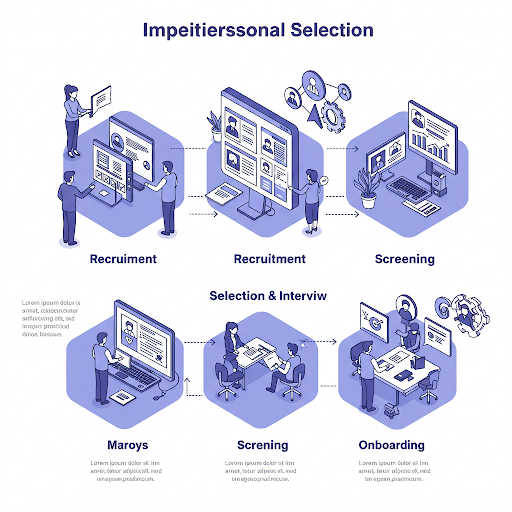
In today’s business landscape, employee collaboration is essential for success.1. A motivated and cohesive team, where each member feels valued and an integral part of the organization, is a fundamental engine for growth and competitiveness.1. To build this ideal team, it is crucial to have a seamless recruiting process that attracts and retains talented people who fit the company’s culture and needs.
This article outlines the 5 essential stages of impeccable recruiting, providing practical tips and examples for each. The goal is to guide companies in optimizing their hiring processes, allowing them to build high-performing teams that drive organizational success.
1. Planning: The Basis of Success
“If you fail to plan, you plan to fail.” This phrase, attributed to Benjamin Franklin, takes on special relevance in the personnel selection process. Planning is the cornerstone of any successful selection process2. Before starting the search for candidates, it is crucial to spend time precisely defining the needs of the company, the profile of the position to be filled and how it aligns with the organizational culture.3. To achieve exhaustive planning, it is essential to consider the following aspects:
- Needs Analysis: Determine the reason why the vacancy needs to be filled, what objectives are sought to be achieved with the new incorporation and how the new position will be integrated into the company structure3.
- Profile Definition: Describe in detail the responsibilities, tasks and functions of the position, as well as the technical skills, soft skills and experience necessary to perform it successfully.2. It is also important to define whether you are looking for candidates with a specialized profile or whether you are open to people with less experience but with high learning potential.1.
- Business Culture: From the beginning of the process, it is crucial to consider the company’s culture and values to ensure that the candidate adapts to the work environment and the team.2. This not only increases the likelihood of a successful integration, but also contributes to long-term talent retention.
- Objectives and Expectations: Define the short and long-term objectives expected of the candidate in the position2. Setting clear expectations from the beginning makes it easier to evaluate the new employee’s performance and professional development.
- Process Standardization: Implement standardized procedures to ensure efficiency and objectivity at each stage of the selection process5. This ensures consistency in the evaluation of candidates, promotes equity and reduces the risk of bias.
Comprehensive planning allows you to establish clear and objective selection criteria, which facilitates the evaluation of candidates and the making of informed decisions.2.
2. Recruitment: Attracting the Right Talent
Once the job profile has been defined and a selection strategy established, the next step is to attract the right candidates2. It is important to remember that recruitment and selection are different, although interrelated, processes.6. Recruiting focuses on attracting a diverse group of potential candidates, while selection focuses on identifying the ideal candidate from that group.
To attract the right talent, it is essential to use a recruitment strategy that fits the needs of the company and the type of profile sought.7. Below is a table with some common recruiting channels, their description and their benefits:
| Recruitment Channel | Description | Benefits |
| Employment Portals | Online platforms such as Infojobs, LinkedIn, Indeed, etc., where job offers are published3. | Wide reach, access to a large candidate database, filtering and search tools. |
| Social networks | Platforms such as LinkedIn, Facebook, Twitter, etc., to disseminate the job offer3. | Segmentation of the target audience, direct interaction with potential candidates, construction of employer brand. |
| Direct Search (Headhunting) | Contact potential candidates directly through databases, professional networks or referrals5. | Access to passive candidates, greater precision in the search for specific profiles, reduction of recruitment time. |
| Job Fairs | Recruiting events to connect with candidates in person. | Direct interaction with candidates, promotion of the employer brand, opportunity to evaluate soft skills. |
| Referral Programs | Encourage current employees to recommend candidates from their network of contacts9. | Access to pre-screened candidates, greater likelihood of cultural fit, reduced recruiting costs. |
It is important to use a variety of channels and methods to reach a diverse audience and increase your chances of finding the ideal candidate.10. Furthermore, it is essential that the job offer is clear, concise and attractive, highlighting the most relevant aspects of the position and the company.11. Including a “trick” in the offer, such as requesting an email with a specific keyword, can help filter out candidates who don’t pay attention to details or aren’t really interested in the position.5.
In the case of digital profiles, where the volume of applications can be overwhelming, it is advisable to use specialized external recruitment sources that help filter and shortlist the most suitable candidates12.
3. Selection: Evaluating Skills and Suitability

The selection stage is crucial to identify the candidates who best fit the position profile. This process must be rigorous and objective, using appropriate tools and techniques to evaluate the skills and suitability of the candidates.3.
It is important to highlight that the lack of diversity in the team can be an obstacle to creativity and innovation13. Therefore, it is essential that the selection process promotes inclusion and equal opportunities, seeking candidates of diverse origins, genders and experiences.
Some of the most common tools for evaluating candidates include:
- Technical Tests: Evaluate the specific skills and knowledge required for the position3. For example, for a programmer position, code tests or programming challenges could be used.
- Psychotechnical Tests: Measure skills such as reasoning ability, attention, memory, etc.13. These tests are useful to evaluate the candidate’s learning potential and adaptability.
- Personality Assessments: Analyze personality traits such as introversion/extroversion, emotional stability, openness to new experiences, etc.2. These assessments help to understand how the candidate relates to others and how he or she adapts to different situations.
- Structured Interviews: Conduct interviews with predefined questions to assess experience, competencies, and compatibility with company culture2. Structured interviews allow candidates to be compared objectively and reduce the risk of bias.
- Group Dynamics: Observe candidate interaction in group situations to evaluate skills such as teamwork, communication, and leadership. Group dynamics are especially useful for positions that require a high capacity for collaboration.
- Proctoring: In the case of online evaluations, use “proctoring” tools to guarantee the integrity of the process and avoid fraud7. Proctoring allows candidates to be monitored during online tests using auditory and visual monitoring techniques.
It is important to combine different assessment tools to obtain a complete view of the candidate and reduce subjectivity in decision making.7The choice of tools should be aligned with the skills and competencies required for the position. For example, for a copywriter position, a writing sample might be requested, while for a customer service position, a simulated phone call might be conducted.
The key to an unforgettable brand is here Click for more
4. Hiring: Formalizing the Incorporation
Once the ideal candidate has been selected, we proceed to the hiring stage, which involves formalizing the incorporation of the new employee into the company.6. It is important to remember that the candidate’s experience during the selection process influences their decision to accept the offer and their future retention in the company.11. A transparent, efficient and respectful hiring process helps build a positive company image and attract the best talent.
Key steps in the hiring stage include:
- Formal Offer: Present the candidate with a job offer that includes details about the position, salary, benefits and working conditions10. In addition to the economic benefits, it is important to highlight the “emotional salary”, which includes aspects such as flexible hours, teleworking, professional development opportunities and a good work environment.7.
- Negotiation: If necessary, negotiate the terms of the offer with the candidate, seeking an agreement that benefits both parties.
- Contract: Formalize the employment relationship by signing an employment contract6. The contract must be clear and concise, specifying the responsibilities, rights and obligations of both parties.
- Documentation: Collect the necessary documentation from the new employee, such as their ID, Social Security number, etc.
It is essential that the hiring stage is managed efficiently and transparently, ensuring that the candidate has a positive experience and feels valued by the company.11. Answering the candidate’s questions in a timely manner and maintaining fluid communication throughout the process are key aspects to building trust and ensuring a good experience.
5. Incorporation: Facilitating Adaptation
The last stage of the selection process is incorporation, which consists of facilitating the adaptation of the new employee to the company and the job.2. A good onboarding process not only accelerates the integration of the new employee, but also contributes to their motivation, productivity and long-term retention.
An effective onboarding process includes the following actions:
- Welcome: Welcome the new employee and introduce him to his teammates3. Organizing a small welcome meeting or lunch with the team can help the new employee feel integrated from day one.
- Training: Provide the necessary training so that the employee can perform their duties successfully3. Training must be clear, concise and adapted to the needs of the position.
- Accompaniment: Assign a mentor or partner who can guide the new employee during their first days at the company10. The mentor can answer the new employee’s questions, help them understand the company culture, and facilitate their integration into the team.
- Follow-up: Track the new employee’s progress and offer support for their adaptation3. Monitoring may include periodic meetings with the supervisor or mentor to evaluate performance, resolve questions, and provide feedback.
An effective onboarding helps the new employee feel integrated into the company, increases their motivation and develops their potential from day one.8.
Conclusion: The Importance of an Impeccable Process
A seamless recruitment process, from planning to onboarding, is essential to the success of any organization.2. Each stage of the process contributes to the construction of a high-performance team, motivated and committed to the company’s objectives.
Meticulous planning allows you to define the company’s needs and the profile of the ideal candidate, laying the foundations for a successful selection process. Strategic recruiting, using a variety of channels and methods, ensures the attraction of a diverse pool of talented candidates. Rigorous selection, using objective evaluation tools, allows us to identify the candidates who best fit the position and the company culture. Transparent and efficient hiring guarantees a positive experience for the candidate and formalizes their incorporation into the company. Finally, an effective onboarding facilitates the adaptation of the new employee, increases their motivation and contributes to their long-term retention.
By investing time and resources in each of these stages, companies can ensure the incorporation of talented people who drive the growth and success of the organization. Implementing the strategies described in this article will allow companies to optimize their selection processes, build high-performing teams and achieve their business objectives.
Map out your “Success Profile” before you post. Impeccable recruiting starts with planning. Use the Planily module to organize your role requirements and team needs. Map out the skills, competencies, and cultural “non-negotiables” in a collaborative Kanban board to ensure your hiring managers and recruiters are perfectly aligned. Plan your hiring strategy at GGyess.com
Sources cited
1. 11 steps to select perfect personnel – Gael Cloud, accessed: March 12, 2025, https://blog.gael.cloud/11-pasos-para-seleccionar-personal/
2. 5 steps to choose the best candidate – Page Personnel, accessed: March 12, 2025, https://www.pagepersonnel.es/advice/empresas/5-pasos-para-elegir-al-mejor-candidato
3. Selection process: what it is and what its phases are – Escuela Select, access: March 12, 2025, https://escuelaselect.com/pasos-del-proceso-seleccion-recursos-humanos/
4. Improve your worker selection process with these 5 tips – Hirint, accessed: March 12, 2025, https://hirint.io/mejora-tu-proceso-de-seleccion-de-personal-con-estos-5-consejos/
5. How to carry out a Selection Process and what are its phases? – Grupo Castilla, access: March 12, 2025, https://www.grupocastilla.es/proceso-seleccion-personal/
6. Recruitment and selection of personnel: know the entire process – Veigler Formación, access: March 12, 2025, https://veiglerformacion.com/reclutamiento-seleccion-personal-etapas/
7. Recruitment Challenges: 16 Tips to Overcome Them – SMOWL, accessed: March 12, 2025, https://smowl.net/es/blog/desafios-de-reclutamiento/
8. 5 stages for effective personnel selection | Kopen Software | Tryton, accessed: March 12, 2025, https://www.kopen.es/proceso-seleccion-personal/
9. The biggest challenges in recruiting (and how to solve them) – Outbound People, accessed: March 12, 2025, http://www.outboundpeople.com/retos-reclutamiento/
10. Personnel selection: what it is, phases, techniques and good practices – Genomawork, access: March 12, 2025, https://www.genoma.work/post/seleccion-de-personal
11. 8 problems in recruiting and selecting personnel – Endalia, accessed: March 12, 2025, https://www.endalia.com/news/problemas-en-el-reclutamiento-y-seleccion-de-personal/
12. Learn about the main phases of the selection process – TalentFY, access: March 12, 2025, https://ytalentfy.com/fases-proceso-de-seleccion/
13. What difficulties may arise in a selection process – Psigma, accessed: March 12, 2025, https://www.psigmacorp.com/que-dificultades-se-pueden-presentar-en-un-proceso-de-seleccion/