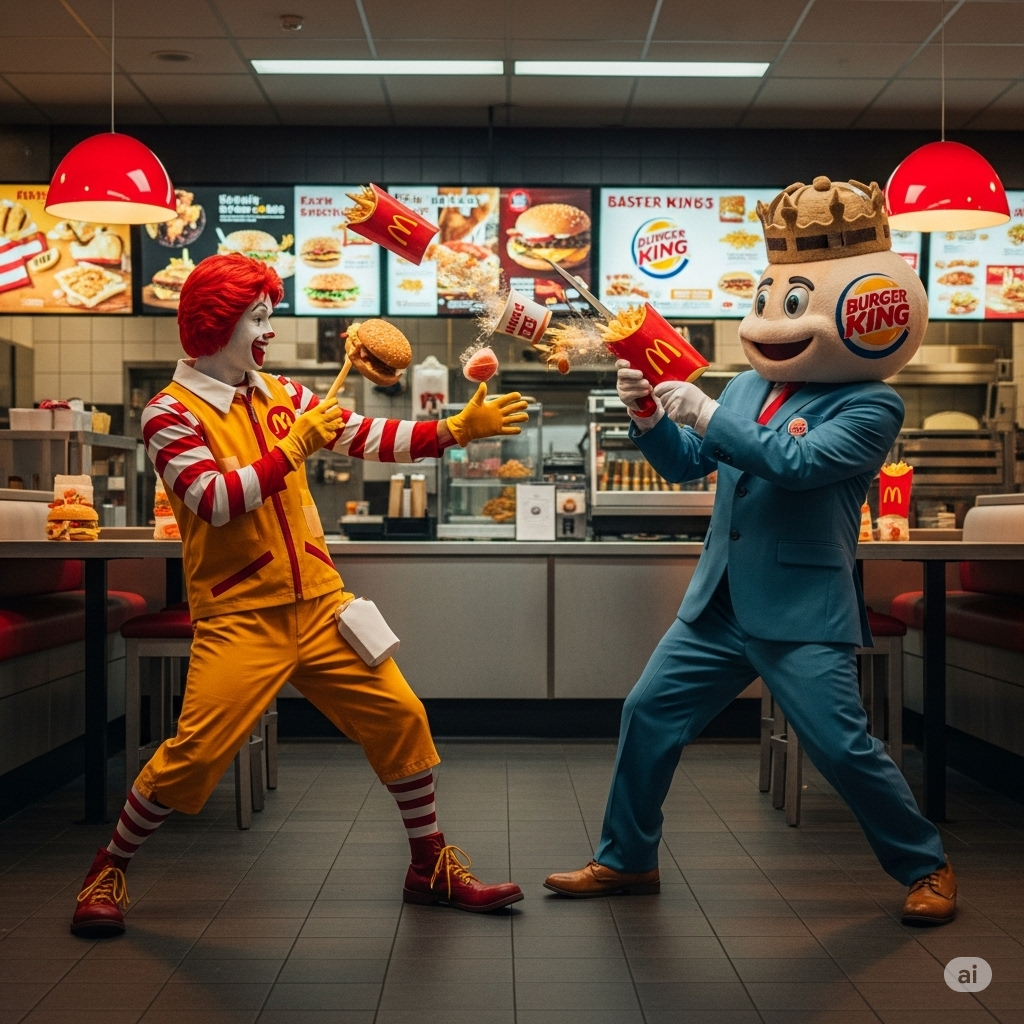
Introduction: A Fast Food Clash of the Titans
The global fast-food industry has been a fierce battleground for decades, with Burger King and McDonald’s emerging as the most prominent contenders. These two chains not only compete for market share and consumer loyalty but also represent contrasting brand philosophies. Burger King has often positioned itself as the “challenger,” the bold alternative that offers customization and a distinctive taste. McDonald’s, meanwhile, has cemented its position as the established global leader, focused on consistency, convenience, and an ever-present presence. This dichotomy is most clearly manifested in its flagship products: the Whopper and the Big Mac.
Beyond being simple menu items, the Whopper and the Big Mac are cultural and commercial icons that have shaped the evolution of fast food. Each embodies the identity of its parent company and its competitive strategy. For example, Burger King’s “Have It Your Way” philosophy is directly reflected in the Whopper’s customizable capabilities and signature chargrilled design.1In contrast, McDonald’s focus on standardization and global reach is evident in the Big Mac’s uniform recipe and its worldwide availability.3This is not a coincidence; it’s a direct manifestation of how each company has strategically defined its value proposition. The Whopper, from its origin as a larger burger, and its continued emphasis on customization5, reinforce Burger King’s identity as a challenger. The Big Mac’s consistent formula and its use as a global economic index3They underline McDonald’s leadership and its standardization model.
The long-running feud between these two iconic burgers serves as a microcosm illustrating the broader evolution of the fast-food industry itself. This rivalry reflects changing consumer preferences, marketing innovations, and responses to societal trends, such as growing concerns about health and sustainability. Examining the historical trajectory of these two products—from their initial conception and ingredient modifications to their dynamic marketing strategies and adaptations to wellness trends—gains a condensed view of how the entire fast-food industry has undergone transformations over several decades. For example, the bold “Moldy Whopper” campaign5and the introduction of plant-based options8These aren’t mere isolated product tweaks, but direct responses to macro shifts in consumer preferences toward transparency and conscious eating. This phenomenon demonstrates how these two industry giants have not only influenced market forces, but have also been shaped by them and by evolving social values.
Chapter 1: Origins and Evolution of Two Culinary Legends

The Whopper: Birth, creators, and its evolution through the decades
The Whopper, Burger King’s flagship product, was conceived in 1957 by James McLamore, co-founder of the chain.5Its creation was a strategic response to McLamore’s observation that a rival restaurant in Gainesville, Florida, was having success selling a larger hamburger. Believing that size was key to a product’s appeal, McLamore devised the Whopper and named it to convey the “image of something big” (in English, “whoopper” means something that exceeds its usual proportion).5Initially, the Whopper sold for 37 cents, which would be equivalent to approximately $4.01 USD in 2023.5This strategic move by Burger King, offering a larger burger, gave them an early advantage, as major fast-food chains didn’t launch similarly sized products until the early 1970s, with the emergence of the McDonald’s Quarter Pounder and Burger Chef’s Big Chef.5
Over the years, the Whopper has undergone several modifications in its composition and presentation. Around 1970, the original plain bun was replaced with a sesame seed bun. In 1985, the Whopper’s weight was increased to 120 grams, and the bun was replaced with a Kaiser roll. These adjustments were part of a product improvement program, supported by a $30 million advertising campaign (equivalent to $85 million in 2023) that featured celebrities such as Mr. T and Loretta Swit.5The goal was to differentiate Burger King and its products from the competition. However, in 1987, a new Burger King management team reversed many of these changes, and the Whopper returned to its previous size and bun. Finally, in 1994, the Kaiser bun was eliminated entirely, and the Whopper permanently returned to the sesame-seed bun, thus eliminating the last vestige of the 1985 redesign.5
Whopper packaging has also evolved. Unlike McDonald’s, Burger King never used clamshell polystyrene foam boxes. This allowed the company to highlight its use of cardboard boxes when environmental concerns about polystyrene arose in the late 1980s.5To reduce paper consumption, the cardboard box was eliminated in 1991 and replaced with waxed paper. For a brief period in 2002, as part of the Whopper’s 45th anniversary, a gold foil wrapper was used. In 2012, the packaging changed again, opting to wrap half the burger and place it in a cardboard box, marking a return to this type of packaging.5
One of the most notable Whopper-related innovations was the accidental creation of the Whopper Jr. in 1963 by Luis Arenas-Pérez, then president and CEO of Burger King in Puerto Rico.5When the first Burger King restaurant opened in Carolina, Puerto Rico, the molds for the standard Whopper buns hadn’t arrived. To meet the announced opening date, Arenas decided to use smaller, regular hamburger buns available locally. The result was an unexpected success, leading Burger King to adopt the Whopper Jr. globally.5This episode highlights how significant innovations can emerge from unforeseen circumstances or local adaptations, and how a decentralized franchise model can identify and scale these “happy accidents” into global product lines, transforming a constraint into a strategic opportunity.
The Big Mac: Its invention, the purpose of the center bun, and its rapid global expansion
The Big Mac, a McDonald’s mainstay, was invented in 1967 in Uniontown, Pennsylvania, by Jim Delligatti, one of Ray Kroc’s first franchisees.3Its creation arose from a practical need: to effectively manage two pieces of meat and multiple toppings within a single burger. Delligatti’s ingenious solution to prevent the burger from becoming “slippery” when incorporating two patties was to add a third slice of bread in the middle, known today as the “Club” layer.3This structural innovation not only solved a functional problem, but also became a distinctive and iconic feature of the Big Mac.
The name “Big Mac” was coined by Esther Glickstein Rose, a 21-year-old advertising secretary at McDonald’s corporate headquarters in Oak Brook, Illinois. Her suggestion was well received by management and immediately adopted.10This fact highlights the early importance of a catchy and effective name in fast food branding.
The Big Mac experienced rapid global expansion shortly after its launch. Canada became the first country outside the United States to offer it to customers in 1968. By 1971, the Big Mac was available on the menu in several non-North American countries, including the Netherlands, Germany, Guam, Japan, and Australia.3This rapid internationalization is a testament to McDonald’s aggressive global expansion strategy.
The Big Mac’s impact goes beyond its presence on the menu. It has left a significant cultural imprint, as evidenced by the fact that Irwindale, California, was declared the “Big Mac Capital” in 1998 due to its high per capita consumption.3Furthermore, the existence of a Big Mac Museum in North Huntingdon, Pennsylvania, celebrating its inventor and history, solidifies its status as a global icon.3
Table 1: Comparison of Key Milestones and their Market Impact
| Year | Whopper/Burger King Evento | Impact | Big Mac/McDonald’s Evento | Impact |
| 1957 | Whopper created by James McLamore5 | Established Burger King’s flagship product; an early innovation in hamburger size. | ||
| 1963 | Whopper Jr. created by Luis Arenas-Pérez5 | Accidental innovation that led to a successful global extension of the product line. | ||
| 1967 | Big Mac invented by Jim Delligatti3 | Revolutionary multi-layer design to contain ingredients; unique product. | ||
| 1968 | Big Mac expands to Canada3 | It marked the beginning of the rapid global expansion of the Big Mac. | ||
| c. 1970 | Whopper switches to sesame seed bun5 | Product refinement to enhance appeal. | ||
| Early 1970s | McDonald’s launches the Quarter Pounder5 | Direct competitive response to the larger size of the Whopper. | ||
| 1985 | Whopper weight increased to 120g, Kaiser bun introduced5 | Attempt at product improvement and differentiation, part of a $30M campaign. | ||
| 1986 | The Economist creates the Big Mac Index3 | It elevates the Big Mac to a global economic indicator, demonstrating its ubiquity. | ||
| 1987 | Whopper returns to its previous size/bread5 | Indicates strategic changes and course corrections based on market response or new direction. | ||
| Finales 1980s | Burger King highlights the use of cardboard boxes5 | Gained a competitive advantage by avoiding polystyrene amid environmental concerns. | ||
| 1994 | Whopper permanently returns to sesame seed bun5 | Final reversion to core elements preferred by the consumer. | ||
| 1998 | Irwindale, CA declared “Big Mac Capital”3 | It stands out for its deep cultural penetration and high regional consumption. | ||
| 2018 | Campaña “Whopper Detour” 11 | Highly successful digital marketing, achieving a 37:1 ROI and millions of new app users. | ||
| 2019 | Impossible Whopper launched nationwide in the US8 | Significant response to growing plant-based food trends. | ||
| 2020 | “Moldy Whopper” Campaign5 | Bold transparency campaign highlighting the absence of artificial preservatives, achieving high recognition. | ||
| 2021 | Burger King makes a major rebranding11 | Visual update that aligns with the “real food” narrative and modern branding. | ||
| In progress | “My Burger King” loyalty program13 | Strategic focus on customer retention and increasing visit frequency. | ||
| In progress | Programa McDonald’s Rewards 14 | Major strategic effort to increase customer frequency, average spend, and retention. | ||
| Recent | McDonald’s loses the “Big Mac” trademark in the EU15 | Legal challenge that boosts the brand’s potential for reinvention and adaptation in specific markets. |
Build a brand that impacts everyone Download the guide
Chapter 2: Anatomy of a Classic: Ingredients, Preparation and Distinctions
Detailed breakdown of the Whopper’s components and processes
Burger King’s Whopper is distinguished by a combination of fresh ingredients and a signature cooking method. Its base is a flame-grilled beef patty, complemented by tangy pickles, a drizzle of ketchup, freshly sliced tomatoes, crisp, fresh-cut lettuce, freshly sliced onions, and creamy mayonnaise, all served on a 5-inch toasted sesame bun.16
The grilling method is a key differentiator for Burger King, as it gives the meat a distinctive, smoky flavor.2This technique is central to the Whopper’s flavor profile and Burger King’s brand identity. The Whopper uses a single, larger patty, generally understood to weigh approximately a quarter of a pound (4 ounces). This represents a noticeably larger amount of meat compared to the combined weight of the two smaller patties found in a Big Mac.2
A key feature of the Whopper is the use of fresh, whole ingredients for its toppings, such as real pieces of lettuce (not shredded) and slices of tomato and onion (not finely chopped or rehydrated), which contribute to a perception of freshness and quality.2Unlike its rival, cheese is not a standard ingredient on the Whopper and must be added as an optional extra.2This flexibility aligns with Burger King’s “Have it your way” philosophy, allowing for greater product customization.
The Whopper preparation process involves toasting the bun, grilling the patty, and then layering the burger, adding mayonnaise, ketchup, pickles, onion, tomato, and lettuce to the bun before wrapping it.18The emphasis is on grilling and assembly with fresh ingredients. Burger King has actively promoted the Whopper’s transition to a version free of artificial flavors, preservatives, and added colors, a commitment highlighted by its bold “Moldy Whopper” campaign.5
Analysis of the ingredients and the “special sauce” of the Big Mac
The McDonald’s Big Mac consists of two 100% beef patties, signature Big Mac Special Sauce, shredded lettuce, a slice of pasteurized processed American cheese, pickle slices, and finely diced onions, all inside a three-piece sesame bun, including the iconic “Club” center layer.10
The “Special Sauce,” a variation on Thousand Island dressing, is a proprietary ingredient and is often cited as the defining flavor element of the Big Mac. It is applied in precise amounts (one-third of an ounce on each bun).2A closer look at the Big Mac sauce reveals a high number of ingredients (more than 33), including components such as high fructose corn syrup and propylene glycol alginate, which have been the subject of debate regarding their nutritional profile.24
The Big Mac’s burgers are two smaller, frozen beef patties, each about 1.6 ounces, for a total of 3.2 ounces of beef per sandwich.2Some consumers have noted that these patties can be perceived as “bland” or overpowered by other ingredients.2The use of shredded lettuce and finely chopped, rehydrated onion contributes to a distinct texture and flavor distribution compared to the Whopper’s fresh, sliced toppings.2The innovative center bun, or “Club,” was specifically designed by inventor Jim Delligatti to keep the numerous ingredients and two patties contained, preventing spills during consumption.3
The Big Mac is a layered assembly process: the special sauce is applied to the base of the bun, then chopped onions, shredded lettuce, cheese, and the first burger are added; then the middle bun is placed, followed by more sauce, onions, lettuce, pickles, and the second burger, finally closing with the top layer of the bun.25This intricate layering process contributes to its unique flavor experience.
Comparison of distinctive features and cooking methods
The battle between the Whopper and the Big Mac is clearly manifested in their fundamental characteristics. The cooking method is a key differentiator: the Whopper is distinguished by its flame-grilled meat, giving it a smoky, charred flavor, while the Big Mac’s patties are typically cooked on a griddle (implied by their description as “flash-frozen” and McDonald’s standard operations), resulting in a distinct flavor profile.
In terms of the quantity and size of the meat, the Whopper features a single, larger patty (approximately 4 ounces), while the Big Mac contains two smaller patties (3.2 ounces total), which directly influences the proportion of meat to other ingredients.2The bun structure also differentiates them: the Whopper uses a conventional sesame bun, while the Big Mac is defined by its iconic three-piece sesame bun, which includes the distinctive “Club” center layer.10
The presentation of toppings varies significantly. The Whopper emphasizes fresh, sliced ingredients (lettuce, tomatoes, onions), in contrast to the Big Mac’s shredded lettuce and finely chopped onions.2As for condiments, the Whopper relies on the standard ketchup and mayonnaise, with cheese as an optional extra, while the Big Mac’s unique “Special Sauce” and standard cheese slices are central to its flavor.10
The Whopper’s flavor profile is often described as meat-centric with a smoky aftertaste, allowing the individual flavors of the ingredients to shine through. On the other hand, the Big Mac’s flavor is heavily influenced by its “Special Sauce” and cheese, which some argue can “overwhelm” the flavor of the meat.2
Differences in ingredients and preparation methods translate directly into distinct sensory experiences. For example, the Whopper’s flame-grilled texture and fresh toppings create a sense of “grilled meat” and natural ingredients.2This aligns with Burger King’s “Have It Your Way” philosophy and focus on “real food.”1In contrast, McDonald’s reliance on its proprietary sauce and use of grated and chopped ingredients creates a consistent, highly recognizable, and, for many, addictive flavor profile, which supports its global standardization model. This consistency ensures that the Big Mac experience is the same anywhere in the world.
Table 2: Comparison of Key Ingredients and Features (Whopper vs. Big Mac)
| Feature | Whopper | Big Mac |
| Inventor/Creator | James McLamore 5 | Jim Delligatti 3 |
| Year of Release | 1957 5 | 1967 3 |
| Cooking Method | Flamed on the grill2 | Griddle cooking (implied by “deep-frozen” and McDonald’s standard operations)10 |
| Quantity and Size of Meat | One, approx. 4 oz 2 | Two, approx. 1.6 oz each (3.2 oz total)2 |
| Type of Bread | 5″ Toasted Sesame Bread16 | Toasted sesame bread with distinctive “Club” center layer10 |
| Lettuce | Crispy, fresh cut2 | Grated2 |
| Onion | Fresh sliced2 | Finely chopped, rehydrated10 |
| Tomato | Fresh sliced2 | None standard2 |
| Pickles | Sour pickles16 | Sliced pickles10 |
| Queso | Optional, with extra charge2 | Two slices, standard10 |
| Salsa | Ketchup, creamy mayonnaise16 | “Special Sauce” (Thousand Island Variation)10 |
| Artificial Ingredients | No artificial flavors, preservatives, or colors5 | Pickles contain artificial preservative22; sauce contains high fructose corn syrup, propylene glycol24 |
Contrasting approaches to artificial ingredients, exemplified by Burger King’s proactive “Moldy Whopper” campaign5in front of the detailed list of ingredients in the Big Mac sauce24, reflect a broader industry trend toward greater transparency and health awareness. Burger King has actively capitalized on its “cleaner” label as a marketing advantage, suggesting that McDonald’s could face increasing scrutiny and pressure regarding the composition of its iconic sauce. This has the potential to influence long-term consumer trust and loyalty, especially among the most health-conscious segments.
The “Moldy Whopper” campaign5 y “Clean Whopper” 21Burger King’s explicit and high-profile efforts to communicate the elimination of artificial ingredients directly address a growing consumer demand for healthier, more natural foods. In stark contrast, it has been pointed out that Big Mac sauce contains ingredients such as high fructose corn syrup and propylene glycol.24, which are often perceived negatively by health-conscious consumers. This divergence suggests that Burger King is strategically positioning itself to capture the “clean eating” market, which could create a significant perception gap with McDonald’s, whose flagship product remains linked to ingredients some consumers may find undesirable. This could, in the long run, affect purchasing decisions and overall brand perception.
Chapter 3: Marketing Strategies: The War for the Consumer Palate

Burger King’s “Have it your way” approach and disruptive campaigns
Burger King’s marketing strategy is deeply rooted in its long-standing “Have It Your Way” philosophy, which empowers customers to customize their Whopper by adding or removing ingredients.1This emphasis on personalization is a cornerstone of its brand identity and a key differentiator from its competitors.
Burger King consistently positions itself as “the alternative” or “the challenger” to McDonald’s. This often translates into bold, humorous, and provocative campaigns designed to directly contrast or even mock its larger rival.11This “anti-McDonald’s” stance is an integral part of its marketing DNA.
Over the years, Burger King has launched iconic and innovative campaigns that have captured the public’s attention:
- “McWhopper” (2015):A highly publicized campaign in which Burger King proposed a joint “McWhopper” burger with McDonald’s for the International Day of Peace. Although McDonald’s rejected the offer, the campaign generated immense viral success and global media coverage, reinforcing Burger King’s image as a bold and creative brand.11
- “Whopper Detour” (2018):This innovative digital campaign used geolocation technology to offer a Whopper for just one cent to users within 600 feet of a McDonald’s restaurant. The campaign was a resounding success, achieving a 37-to-1 return on investment and attracting millions of new users to the Burger King mobile app.11This example illustrated the effective integration of creativity, technology, and guerrilla marketing.
- “Burn That Ad” (2020):An augmented reality (AR) campaign that allowed users to “burn” competing digital ads on their mobile phones to unlock a coupon for a free Whopper. This action-oriented campaign further solidified Burger King’s reputation for innovative and engaging marketing.11
- “Moldy Whopper” (2020):A bold and impactful global advertising campaign that featured a time-lapse video of a Whopper decomposing over a 34-day period. The campaign’s goal was to visually demonstrate the Whopper’s absence of artificial preservatives, achieving 50% more awareness than Burger King’s 2019 Super Bowl ad and effectively communicating its commitment to “real food.”5
In 2021, Burger King undertook a comprehensive rebranding, reintroducing a retro logo and adopting a simpler, more colorful, and nostalgic visual design that aligns with its “real food” narrative. Its digital marketing strategy includes strong SEO, engaging content marketing (e.g., creative videos, viral social media posts), and gamification features within its official app to improve user engagement.11Burger King has also invested in loyalty initiatives, such as the “My Burger King” program, which offers rewards like “crowns” and promotions like 2-for-1 Whoppers to encourage repeat visits and customer loyalty.13
McDonald’s brand power and its loyalty and promotion strategies
McDonald’s leverages its vast global presence (more than 39,000 restaurants worldwide)27) and seeks to maintain high brand awareness through a vibrant and consistent presence on major social media platforms (Instagram, X/Twitter, Facebook). Regular posts featuring new products, promotions, and community engagement are key to this strategy.28
The iconic slogan “I’m Lovin’ It” encapsulates McDonald’s promise of a positive and enjoyable customer experience, positioning the brand as a source of satisfaction and enjoyment.28McDonald’s carefully selects high-traffic locations for its restaurants, such as busy intersections, shopping malls, airports, and educational institutions. This strategic location prioritizes accessibility and visibility, maximizing customer acquisition.28
McDonald’s has implemented highly effective promotional campaigns:
- “Monopoly Game”:A recurring and highly successful promotional campaign that engages customers with the chance to win prizes, effectively incentivizing purchases, increasing sales, and improving brand loyalty and retention.28
- “Find the Biggest Big Mac Fans in Spain”:A campaign designed specifically to celebrate the Big Mac’s most devoted fans, often introducing new variations like the Grand Big Mac BLT to generate excitement.29
- “The Big Mac: The Most Popular Among Latinos”:A targeted advertising campaign, developed by del Rivero Messianu DDB, focused on the popularity of the Big Mac within the Latin market.30
McDonald’s invests in attractive restaurant designs, family-friendly amenities such as play areas, and interactive ordering kiosks. These elements are designed to enhance the dining experience, streamline the ordering process, and serve a diverse customer base.28Recognizing the importance of repeat business, McDonald’s launched its rewards program (McDonald’s Rewards) to significantly increase customer purchase frequency, average spend, and retention.14Studies indicate that loyalty programs can increase conversion rates for existing customers from 5-20% to 60-70%.27McDonald’s specifically sought to increase the frequency of customer visits, as 8 out of 10 people visited only once a year.14McDonald’s constantly introduces new flavors, product variations, and packaging options to keep its menu fresh and appealing. This strategy of continuous innovation is crucial to attracting new customers, retaining existing ones, and staying ahead in a competitive market.28
The competitive strategies of Burger King and McDonald’s are asymmetrical. Burger King employs a disruptive “challenger brand” strategy, often directly targeting McDonald’s through clever, technology-based guerrilla marketing tactics. This is evident in campaigns such as “Whopper Detour” and “Burn That Ad.”11, designed to capture attention and gain market share. This approach suggests that a brand challenging the leader must be more agile and creatively provocative to advance.
In contrast, McDonald’s leverages its immense scale, brand ubiquity, and consistent positive message (“I’m Lovin’ It”28), focusing on general appeal, convenience, and loyalty programs to drive frequency among its vast customer base.14This indicates that a market leader can focus on reinforcing its established strengths and optimizing existing channels for sustained growth. The divergence in these strategies reflects their different market positions: Burger King seeks to disrupt and differentiate itself, while McDonald’s aims to optimize and reinforce its established leadership.
The growing dependence on digital channels (mobile applications, social networks, geolocation, augmented reality) by both brands11indicates that the main competitive battleground has significantly shifted from traditional advertising to digital engagement. Burger King’s high ROI demonstrated on digital campaigns (e.g., the 37:1 ROI for “Whopper Detour”)12) underscores the effectiveness of targeted, technology-enabled marketing in generating measurable business results. This trend is driving the fast food industry toward more data-driven, personalized, and interactive consumer interactions, making digital dexterity a critical factor for future success.
Burger King campaigns like “Whopper Detour”11They explicitly used geolocation technology and their mobile app to drive sales, generating an impressive return on investment. McDonald’s also emphasizes its digital marketing, social media presence, and loyalty apps like McDonald’s Rewards.14This widespread adoption and strategic use of digital tools by both industry giants indicate that consumer engagement, brand loyalty, and ultimately, sales, are increasingly being driven by mobile platforms and personalized digital experiences. The success metrics associated with these digital initiatives strongly suggest that brands that master these channels will gain a significant competitive advantage, transforming marketing from broad, one-way communication to highly targeted, interactive, and measurable consumer engagement.
Chapter 4: Market Impact and Consumer Perception
Influence of both burgers on the fast food industry and popular culture
The Whopper has played a pivotal role in shaping Burger King’s identity, leading the company to proudly declare itself the “Home of the Whopper.”1Its introduction marked a significant moment by offering a larger, flame-grilled, customizable alternative, influencing subsequent product development across the industry.1
The Big Mac, for its part, transcends its function as a mere food; it has become a “symbol of fast, convenient, and cheap food” and a “cultural phenomenon,” frequently referenced in popular media such as movies and television programs.31Its consistent recipe and wide availability in more than 70 countries have made it a universal reference.4
Perhaps the most unique aspect of the Big Mac’s impact is its role as an economic indicator. Since 1986, the magazineThe Economisthas used the Big Mac Index to informally measure purchasing power parity (PPP) between different countries’ currencies.3This demonstrates the unprecedented global recognition and standardization of the Big Mac, making it a tool for economic analysis beyond its culinary function. The concept of “Burgernomics” originated from the Big Mac Index and has evolved beyond simple currency comparisons. Today, it is used by economists and analysts to understand consumer spending patterns and analyze the dynamics of the fast food industry itself, providing insight into economic conditions and consumer habits in various countries.7The Big Mac’s enduring popularity and global reach have contributed significantly to McDonald’s dominant market share, which stood at 17.6% in the fast-food industry in 2020.31This underlines the product’s direct impact on its parent company’s market leadership.
The Big Mac’s unique status as an economic indicator3elevates it beyond a simple food product, turning it into a widely recognized symbol of global economic comparison. This unparalleled level of cultural and economic integration by McDonald’s highlights its profound impact on global trade and its ability to set a universal benchmark, an achievement the Whopper has not matched. The Big Mac Index is not just a marketing strategy; it is a recognized economic tool used by
The Economist.3This represents a level of standardization and global ubiquity that few, if any, other consumer products achieve. The Whopper, while iconic for Burger King, lacks the same external, academic, and widely adopted validation of its global presence or economic significance. This distinction underscores McDonald’s broader influence, which extends beyond the fast-food industry into global economic discourse and cultural understanding.
Analysis of customer loyalty and factors influencing preferences
Burger King actively works to foster customer loyalty through its “My Burger King” program, which encourages app usage and offers exclusive deals like 2-for-1 Whoppers.13Her distinctive, often bold communication style also aims to build a strong connection, particularly with younger audiences and families.26
Although McDonald’s has a massive global presence, a recent study indicated a decline in its customer loyalty rating.27In response, McDonald’s has intensified its focus on loyalty programs like McDonald’s Rewards. The primary goal of this program is to increase customer visit frequency (as 8 out of 10 people visited only once a year), boost average spending, and improve overall customer retention.14Research supports that loyalty programs significantly increase conversion rates for existing customers (60-70% compared to 5-20% for new customers).27
Several key factors influence consumer preferences for these burgers:
- Price:For both chains, competitive prices remain a significant draw for consumers.32
- Advertising and Promotion:Effective advertising campaigns play a crucial role in attracting new customers and strengthening brand appeal.32
- Family Experience:The option of dining with family is a very influential factor in purchasing behavior for consumers who choose either brand.32
- Flavor Profile and Sensory Experience:Consumers show strong preferences based on distinctive flavor profiles. Many prefer the Whopper’s flame-grilled flavor, larger patty, and fresh toppings.2Others are drawn to the Big Mac’s unique “Special Sauce” and distinctive texture, although some find its patties bland.2Opinions are highly subjective and often tied to specific sensory attributes.
- Digestive Comfort:Anecdotal evidence suggests that some consumers prefer the Big Mac because the Whopper can cause stomach upset, highlighting an often overlooked factor in consumer choice.23
- Personalization vs. Consistency:Burger King’s “As You Wish” Philosophy1appeals to consumers who want customization, while McDonald’s consistent Big Mac offers reliability and a predictable experience around the world.
The reported decline in McDonald’s customer loyalty rating27, despite its historically massive market share and brand recognition, suggests that market leadership does not guarantee lasting customer loyalty in a dynamic industry. This situation creates significant opportunities for competitors like Burger King, whose disruptive marketing tactics11, focus on “cleaner” ingredients5, and targeted loyalty programs13They can appeal to consumer segments that seek alternatives or value specific attributes. The fast-food industry is witnessing a shift in consumer behavior, where loyalty is no longer based solely on convenience or brand recognition, but increasingly on value alignment, personalization, and perceived product quality. This means that, to maintain relevance and growth, even market leaders must continually innovate and adapt their customer engagement strategies, or risk losing ground to more agile competitors who are more responsive to emerging trends.
Conclusions
The battle between the Whopper and the Big Mac is much more than a simple burger rivalry; it’s a reflection of the competitive dynamics, evolving marketing strategies, and changing consumer preferences that have defined the fast-food industry for more than half a century. Both burgers, born out of a need for innovation and differentiation, have forged distinctive brand identities for their respective chains.
The Whopper, with its chargrilled cooking and emphasis on customization, embodies Burger King’s philosophy as a bold challenger and defender of “real food.” Its disruptive marketing campaigns and focus on ingredient transparency demonstrate an agile strategy for capturing consumer attention and loyalty in a saturated market.
The Big Mac, on the other hand, is the epitome of McDonald’s global standardization and consistency. Its unique three-bun design and ubiquitous “Special Sauce” have elevated it to the status of a cultural icon and, notably, a global economic indicator through the Big Mac Index. Although McDonald’s has faced challenges in customer loyalty, its vast scale and investment in rewards programs seek to solidify its leadership position.
The continued evolution of both burgers, from changes in ingredients and packaging to the adoption of plant-based options, underscores the need for constant adaptation in the fast-food industry. The growing importance of digital channels and ingredient transparency are key battlegrounds that will determine future success. The Whopper and the Big Mac have not only defined the history of fast food, but continue to be barometers of its most significant trends and challenges.
Ensure your “Standardized Message” reaches every market. McDonald’s strength is consistency. Use the Publish module to schedule and deploy unified brand narratives across TikTok, Instagram, and LinkedIn simultaneously. GGyess ensures your brand remains as recognizable and consistent as a Big Mac, no matter where your audience is scrolling. Sync your consistency at GGyess.com
Sources cited
- BURGER KING BRAND ANALYSIS – EXPO LDG, accessed: July 10, 2025,https://expo.ldgitson.com.mx/wp-content/uploads/2020/05/PROYECTO-FINAL-NARRATIVA-equipo-burguer-king-MIRNA-GUADALUPE-GALLEGOS-GERMAN.pdf
- Burger King’s Whopper Vs. McDonald’s Big Mac: What’s The Difference (And Which Is Better)? – Tasting Table, acceso: julio 10, 2025, https://www.tastingtable.com/1848336/whopper-vs-big-mac-difference/
- Do you know who invented the Big Mac? – Apetito Magazine, accessed July 10, 2025.https://apetitoenlinea.com/sabe-quien-invento-big-mac/
- The evolution of the Big Mac Index over the past two decades, in an interactive chart, accessed: July 10, 2025,https://www.xataka.com/magnet/evolucion-big-mac-index-durante-ultimas-dos-decadas-grafico-interactivo
- Whopper – Wikipedia, the free encyclopedia, accessed July 10, 2025,https://es.wikipedia.org/wiki/Whopper
- Burger King’s strategy to “reintroduce America’s love affair with the Whopper” – Mercado Negro, accessed: July 10, 2025,https://www.mercadonegro.pe/marketing/la-estrategia-de-burger-king-para-reintroducir-la-historia-de-amor-de-estados-unidos-con-la-whopper/
- From the Big Mac Index to Today – FasterCapital, accessed July 10, 2025,https://fastercapital.com/es/tema/desde-el-%C3%ADndice-big-mac-hasta-la-actualidad.html/1
- Whopper – Wikiwand, accessed: July 10, 2025,https://www.wikiwand.com/es/articles/Whopper
- The Future of McDonald’s and the Big Mac – FasterCapital, accessed July 10, 2025https://fastercapital.com/es/tema/el-futuro-de-mcdonalds-y-big-mac.html/1
- Big Mac – Wikipedia, the free encyclopedia, accessed July 10, 2025,https://es.wikipedia.org/wiki/Big_Mac
- Burger King’s History and Marketing Strategy – Storimake, accessed July 10, 2025,https://storimake.com/estrategia-marketing-burger-king
- How Burger King Increased Monthly Active Users by 50%: Strategy, Results, and Lessons Learned – Minders, accessed July 10, 2025,https://minders.io/es/como-burger-king-aumento-un-50-sus-usuarios-activos-mensuales-estrategia-resultados-y-lecciones-aprendidas/
- Burger King launches “My Burger King,” its new loyalty program for those who give it their all for the grill, access: July 10, 2025,https://burger-king.another.co/burger-king-lanza-mis-coronas-rifan-su-nuevo-programa-de-lealtad-para-quienes-lo-dan-todo-por-la-parrilla
- Restaurant Loyalty Program – The Success of McDonald’s Rewards – Spoonity, accessed July 10, 2025,https://www.spoonity.com/es/programa-de-lealtad-mcdonalds-rewards/
- The Impact of the Loss of the “Big Mac” Brand on McDonald’s – Commerce and Justice, accessed July 10, 2025,https://comercioyjusticia.info/opinion/el-impacto-de-la-perdida-de-la-marca-big-mac-para-mcdonalds/
- Whopper – BURGER KING®, acceso: julio 10, 2025, https://burgerking.com.my/Menu/Item/%208
- WHOPPER® Meal Large – Burger King, acceso: julio 10, 2025, https://www.burgerking.co.uk/menu/picker-23d38263-8347-4ddc-aec0-a738c3cc6578
- Homemade Whopper, the Burger King hamburger – YouTube, acceso: julio 10, 2025, https://www.youtube.com/watch?v=sruQ1ie7ArE
- Burger King Whopper Making Process | Physics Diagrams and Concept Maps | Docsity, accessed July 10, 2025https://www.docsity.com/es/docs/proceso-de-elaboracion-de-una-whopper-de-burger-king/9493732/
- The iconic burger gets a makeover with no artificial preservatives, colors, or flavorings – Infobae, accessed July 10, 2025,https://www.infobae.com/inhouse/2021/06/24/la-iconica-hamburguesa-se-renueva-en-su-version-sin-conservantes-colorantes-ni-aromatizantes-artificiales/
- Burger King and its campaign for a healthier menu – Insider Latam, accessed: July 10, 2025,https://insiderlatam.com/burger-king-y-su-campana-por-un-menu-mas-saludable/
- Big Mac®: The Classic McDonald’s Beef Burger, acceso: julio 10, 2025, https://www.mcdonalds.com/us/en-us/product/big-mac.html
- What’s better, Whopper or Big Mac? : r/AskReddit, acceso: julio 10, 2025, https://www.reddit.com/r/AskReddit/comments/12apyps/whats_better_whopper_or_big_mac/
- What’s Really In A Big Mac? | FOOD MATTERS®, acceso: julio 10, 2025, https://www.foodmatters.com/article/whats-really-in-a-big-mac
- McDonald’s Big Mac: How to Make It at Home – YouTube, acceso: julio 10, 2025, https://www.youtube.com/watch?v=sZetUkPoVl0
- Burger King: Transforming Creativity into Impact, accessed July 10, 2025,https://we-are-family.com/es/portfolio/burger-king-transformando-la-creatividad-en-impacto/
- McDonald’s declines in customer loyalty, study finds, accessed July 10, 2025,https://www.merca20.com/estudio-revela-que-mcdonalds-desciende-en-ranking-de-lealtad-del-cliente/
- McDonald’s Marketing Strategy (2025) – Business Model Analyst, accessed: July 10, 2025,https://businessmodelanalyst.com/es/Estrategia-de-marketing-de-McDonald%27s/
- McDonald’s Is Looking for the Biggest Big Mac Fans in Spain | Advertising Control, accessed July 10, 2025https://controlpublicidad.com/campanas-publicitarias/mcdonalds-busca-a-los-mayores-fans-de-la-big-mac-en-espana/
- The Big Mac: The Most Popular Among Latinos – Latinspots.com, accessed July 10, 2025https://www.latinspots.com/noticia/el-big-mac-el-ms-popular-entre-los-latinos/5527
- The Big Mac and the Fast Food Industry – FasterCapital, accessed July 10, 2025https://fastercapital.com/es/tema/the-big-mac-y-la-industria-de-comida-r%C3%A1pida.html/1
- Consumer Analysis | PPT – SlideShare, accessed July 10, 2025https://es.slideshare.net/slideshow/analiss-del-consumidor/34836322