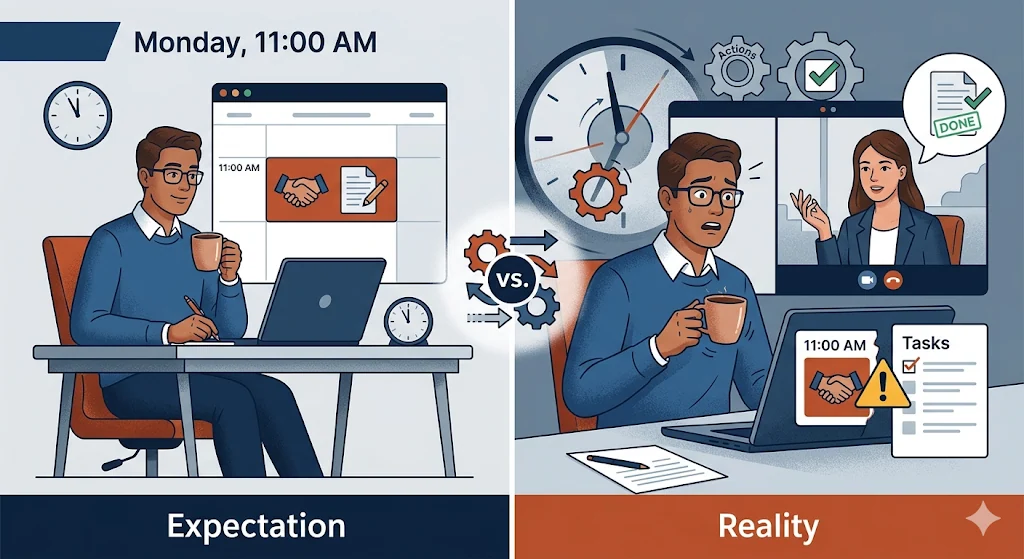
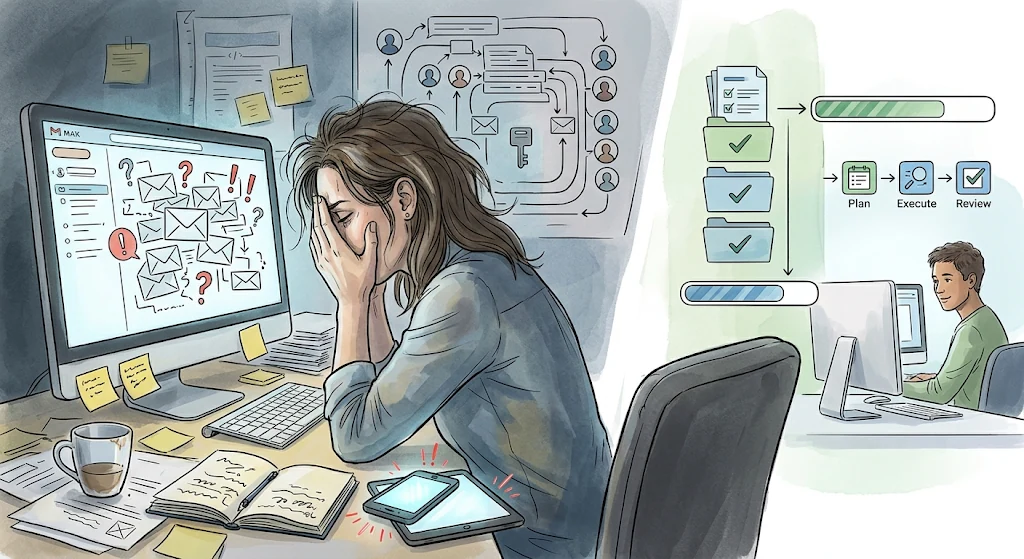
Open your inbox right now. Chances are you’ll find a subject line like this:
“Re: Fwd: Re: Changes Design_V3_FINAL (2) – URGENT”
You open it and find a thread of 14 messages between you, your client, their assistant, and your freelance designer. Somewhere in that thread is the server password. In another email, the document with corrections. And in the latest reply, the client says: “Please ignore the previous file, use the one I just sent via WhatsApp.”
You’ve just lost 25 minutes of your morning trying to reconstruct what you’re supposed to do today.
If you’re an agency, consultant, or freelancer, this level of chaos feels normal. It’s the B2B industry standard. But behind this “normal” workflow lies a silent capital leak.
Running your projects through email isn’t just frustrating—it’s an operational mistake that’s destroying your margins. In this article, we’ll break down why email is the enemy of profitability and how implementing the “Zero Email Rule” can transform your business from reactive chaos into an efficiency machine.
The Inbox Trap: Communication vs. Management
The core problem with email is a design flaw. Email was built as the digital equivalent of sending letters. It’s great for one-way communication, formal announcements, or initial contact.
But at some point, companies decided email should also act as a task manager, cloud storage, and project discussion hub.
Using email to manage complex projects is like building a skyscraper with carrier pigeons. It fails for three critical reasons:
1. It’s Linear and Ephemeral
Projects are multidimensional—they have states (To Do, In Progress, In Review). Email is linear and chronological.
If a new team member joins three weeks later, they must read and decipher dozens of old emails just to understand the current state. Context disappears as new messages bury old ones.
2. File Hostage Situation (Information Silos)
When a client sends an important PDF via email, that file gets trapped in your personal inbox. If you’re unavailable, your team can’t access critical information.
This creates dangerous dependencies on individuals instead of systems.
3. Your Inbox Is Other People’s Agenda
As productivity expert Brendon Burchard says: “Your inbox is nothing but a convenient organizing system for other people’s agendas.”
When you manage projects via email, you react to what arrives—not what matters. You lose control of prioritization.
How Email Kills Your Profitability
If you charge hourly, email inefficiency is annoying. But if you charge fixed-price (like scalable agencies do), it’s costing you real money.
Imagine you sold a $5,000 project estimated at 50 hours ($100/hour).
Because you manage via email:
- You lose 3 hours/week searching for files or links
- You lose 2 hours/week writing status emails
- You lose 4 hours redoing work due to missed messages
Now the project takes 70 hours instead of 50.
Your effective rate drops from $100/hour to $71/hour.
You’ve just lost 30% of your margin—without delivering any extra value.
The “Zero Email Rule”: A New B2B Standard
To stop this financial bleed, you need a radical but necessary shift.
The Zero Email Rule states:
Once a project begins, absolutely no execution-related communication, file delivery, or feedback should happen via email.
Email is still fine for invoices or greetings—but it’s banned from production.
Where Does Work Happen Instead?
All execution moves into a Contextual Work Environment (WorkSuite) built on three pillars:
- Visual Boards (Kanban/Gantt): Instead of asking “Where are we?”, everyone checks the board.
- Task-Based Comments: Feedback happens inside the task that contains the work.
- Automated Reminders: No more manual follow-ups—the system handles it.
Framework to Implement the Zero Email Rule
Many professionals fear clients will resist. The opposite is true—high-level clients love structure.
Here’s how to implement it:
Step 1: The “Protected Context” Agreement
At kickoff, position your method as a premium benefit:
“Carlos, to ensure your project is delivered on time and error-free, we use a protected context system. Email causes delays and lost information, so all communication happens inside this shared workspace where you have full visibility 24/7.”
Frame it as quality assurance—not restriction.
Step 2: The “Polite Re-routing” Strategy
Clients will still send emails out of habit. Don’t ignore them—but don’t accept them either.
Reply with a template:
“Hi Carlos! Got it. To ensure the design team doesn’t miss this and we maintain version control, I’ve added your comment to the relevant task here [link]. For future updates, please add them directly there so the team can act immediately.”
After a few repetitions, behavior changes.
Step 3: The Escape Hatch (Appointments)
Sometimes clients send long emails because the issue is complex.
If a discussion exceeds 3 back-and-forth messages, stop typing.
Send your Appointments link, schedule a quick call, resolve the issue live, and document the outcome inside the task.
Consolidate Operations with GGyess WorkSuite
The Zero Email Rule only works if your alternative is simple. If your system is complex, clients will revert to email.
You need a platform that’s intuitive for both you and your clients. That’s where GGyess comes in.
As a complete WorkSuite, GGyess eliminates inbox chaos by centralizing everything into one seamless workflow:
- Contextual Collaboration: No more endless threads. Discussions happen inside tasks tied to real work.
- Files Always Accessible: No more “I sent it last week.” Files live alongside tasks with clear context.
- Smart Notifications: Clients get automated reminders without needing constant login.
- Appointments + Video Integration: When async isn’t enough, clients book time and meet directly inside the workspace—no external tools needed.
Every hour spent organizing your inbox is an hour not spent creating, billing, or growing.
It’s time to leave outdated communication tools behind and adopt execution-driven systems.
Protect your margins, educate your clients, and work with total clarity. Implement your zero-email environment today at https://ggyess.com.
Frequently Asked Questions (FAQ)
What is the Zero Email Rule in B2B project management?
It’s an operational principle that eliminates email from project execution, file delivery, and feedback—moving everything into centralized platforms for clarity and accountability.
Why does email reduce agency profitability?
Because it creates “ghost work”: time spent searching for files, clarifying context, and fixing errors. This inflates project hours and reduces margins.
How do I stop clients from sending emails?
Set expectations during kickoff, explain the benefits of centralized tools, and consistently redirect email communication into your platform until the habit changes.
Put your next project in motion.
Explore GGyess and find a place to organize the work with your team.
Explore GGyess ↗