Imagine this scene: Monday, 10:00 AM. You join the long-awaited Kickoff (project kickoff meeting) video call for your company’s new big project. On screen, there are six little squares with your team’s faces—some sipping coffee, others glancing at their phones.
The project lead starts: “Alright team, we just closed this client. We need to launch their full campaign in a month. Ideas? Where do we start?”
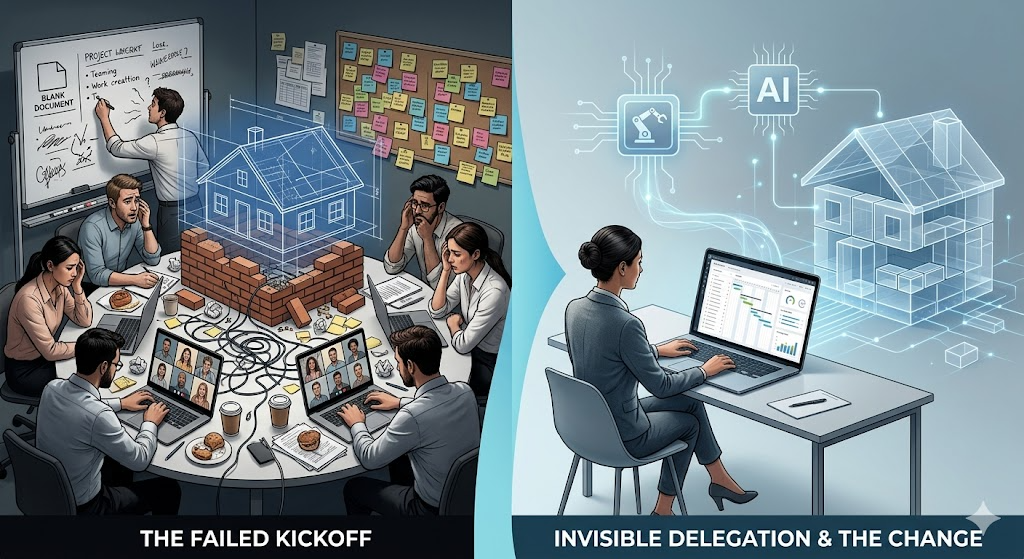
What follows is 45 minutes of collective wandering. Someone opens a blank document and starts taking messy notes. Brilliant ideas are discussed, along with tiny irrelevant details. At the end of the hour, everyone signs off with a motivated “Let’s go all in!”, but once the cameras turn off, reality hits: no one knows exactly what they need to do, by when, or who depends on whom.
This is the anatomy of a failed Kickoff, and unfortunately, it’s the norm in 90% of companies. Using a synchronous meeting (everyone present at the same time) to try to plan from scratch is like designing a house blueprint while you’re already buying bricks. It’s expensive, exhausting, and error-prone.
Today, the rules have changed. Welcome to the era of “Invisible Delegation”, a work model powered by Artificial Intelligence that transforms your video calls from painful brainstorming sessions into short, strategic approval meetings.
What Is “Invisible Delegation”?
Historically, delegation has been a vocal, directive act. A manager sits with an employee and assigns responsibilities. “Invisible Delegation” is a paradigm shift toward asynchronous, automated task assignment—where the project structure is created and distributed within the digital ecosystem before any real-time human interaction happens.
Instead of using humans to break down “what needs to be done” (a logical, mechanical process), we use AI to structure the project skeleton. This frees up human bandwidth for “how to do it better” (a creative, strategic process).
The End of the Operational “Blank Page Syndrome”
The biggest bottleneck in any project isn’t execution—it’s the start. That moment when you receive a client email asking for “a website redesign with e-commerce integration” and must turn that single sentence into 40 interconnected tasks.
That initial cognitive effort drains Project Managers. For an AI trained in workflow management, breaking this down takes about 30 seconds.
The 3-Step Framework: AI-Powered Pre-Kickoff
If you want to stop wasting time and money on unproductive meetings, implement this workflow before sending your next meeting link.
Step 1: The “Brain Dump” into AI
Instead of calling a meeting to explain the project, take 5 minutes alone. Open your project management tool and use its built-in AI assistant. Write what you need in natural language.
Example Prompt:
“Create a project plan for redesigning Client X’s website. The goal is to migrate their site to Shopify in 4 weeks. Include phases for SEO audit, UI/UX design, front-end development, product upload, and testing. Assign tentative roles (Designer, Developer, SEO Specialist) and staggered deadlines.”
Step 2: Automatic Structuring
In seconds, AI won’t just return text. A truly intelligent system will convert your request into a functional Kanban board or Gantt chart.
You’ll see detailed cards appear:
- Task 1: Broken link audit (Assigned to: SEO – Due: Day 3)
- Task 2: Homepage wireframes (Assigned to: Design – Due: Day 7)
- Task 3: Payment gateway setup (Assigned to: Dev – Due: Day 14)
The base structure exists. The skeleton is built. AI has already handled dependencies (the developer can’t start until design is done).
Step 3: Asynchronous Assignment & Context (The Invisible Magic)
Before the meeting, assign AI-generated tasks to specific team members based on workload. Each person receives a silent notification. When they open their dashboard, they instantly see what’s expected of them—along with full context.
This is the magic: You’ve delegated an entire 40-task project without saying a word, sending long emails, or interrupting anyone’s Deep Work.
Anatomy of the New Kickoff Call
Now fast forward to Monday, 10:00 AM.
You’ve sent the meeting invite—but this time, you included a link to the AI-generated board.
Everything changes. The meeting is no longer about discovering what to do. Your team has already seen the board. They know their tasks, deadlines, and deliverables.
The project lead opens by sharing the structured board:
“Team, as you saw in the platform, AI mapped out the critical path for Client X’s e-commerce project. I’ve assigned the initial tasks. This call is just to fine-tune details: María, can you realistically deliver the wireframes by day 7 given your workload? Carlos, do you need an extra license for the payment gateway?”
Results of This Approach:
- Meetings cut in half: A 60-minute call becomes a 20-minute calibration session.
- Instant empowerment: With tasks pre-assigned, team members actively participate instead of passively brainstorming.
- Zero context loss: Everything is documented—nothing depends on memory.
- Respect for focus cycles: Developers and designers benefit from fewer interruptions and less “Zoom fatigue.”
The Psychology of Not Being “That Boss”
There’s an underrated benefit to Invisible Delegation: reduced relational friction.
When a manager assigns tasks verbally, it can feel heavy and hierarchical. But when AI structures the project and tasks appear in each person’s dashboard as part of a system, the emotional tension drops.
The “enemy” is no longer the demanding boss—it’s the project itself. The leader becomes a facilitator, not a task enforcer.
This fosters a culture of accountability through transparency, not micromanagement. If a task is on the board with your name, it’s yours—no need for constant reminders.
Why You Need an Integrated Ecosystem (Not More Apps)
Invisible Delegation is impossible with fragmented tools. If you generate tasks in ChatGPT, copy them into Trello, notify via Slack, and meet on Zoom—you’re not automating, you’re adding administrative overhead.
For this to work, ideation, task creation, assignment, and communication must live in the same ecosystem.
This is where GGyess changes the game.
As a complete WorkSuite, GGyess lets you execute Invisible Delegation end-to-end in one place:
- Native AI: Turn ideas into structured projects instantly.
- Dynamic Views: Switch between Kanban, Gantt, or Calendar in one click.
- Integrated Video Calls: Launch meetings directly from your workspace, with tasks and files visible in real time.
You don’t need more hours—you need a system you can trust. Let AI handle the structure so your team can focus on execution.
Make your projects move before you even say “hello” on camera. Discover the power of the ultimate WorkSuite at ggyess.com.
Frequently Asked Questions (FAQ)
Will AI replace Project Managers?
Absolutely not. AI handles mechanical structuring. Project Managers become more valuable as strategists and facilitators—focusing on resources, risks, and human communication.
What is an asynchronous Kickoff meeting?
It’s a method where all key project information, tasks, and context are shared in a workspace before any real-time meeting, allowing team members to process everything at their own pace.
How does automation reduce micromanagement?
By centralizing tasks and statuses (To Do, In Progress, Done) in visible boards, leaders can track progress in real time without interrupting the team. Transparency replaces intrusive supervision.