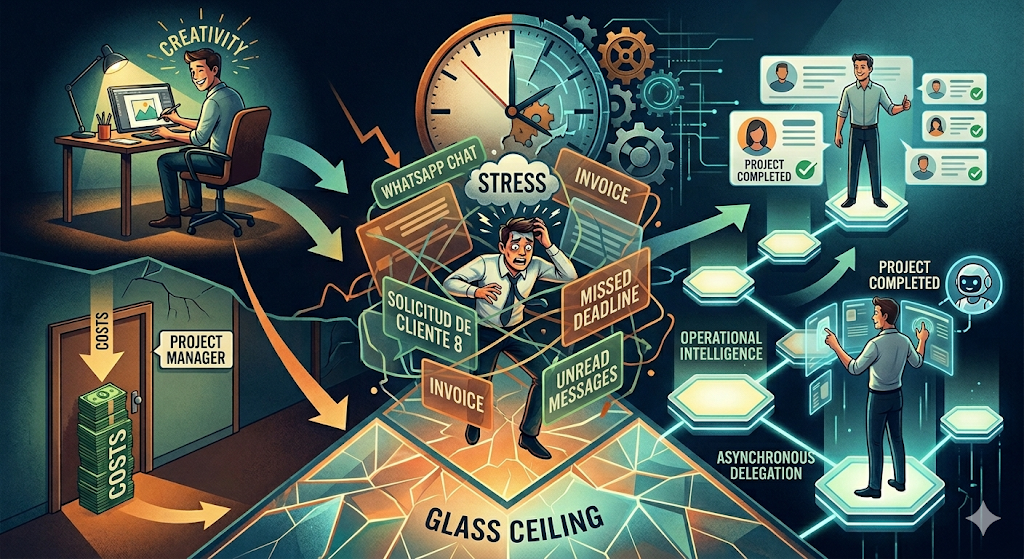
It all starts as a dream come true: you’re incredibly good at your craft (design, development, consulting, or marketing). You land your first big client, then a few more through referrals. You deliver excellent work and the money flows. With three or four clients, it feels like you’ve mastered the game of being an “independent professional.”
And then, you make the “mistake” of continuing to grow. You close your seventh, eighth, and tenth client.
Suddenly, your life turns into absolute chaos. You’re no longer designing or building; you’re moving WhatsApp messages into spreadsheets, trying to remember who you promised what, delegating fragments of work to freelancers you hired for support, and apologizing for late deliveries.
You’ve hit the solo professional’s glass ceiling. The industry’s default advice is clear: “It’s time to hire a Project Manager.”
But for an emerging agency, hiring a full-time Project Manager can destroy the profit margins you worked so hard to build. The alternative? Adopting an operational model based on Operational Intelligence Systems.
In this article, we’ll break down why you don’t need to increase headcount to scale—and how an Asynchronous Delegation Framework, powered by AI, can help you manage 10+ enterprise clients while preserving your sanity (and your margins).
The “Hero Syndrome” and the Operational Bottleneck
To scale without adding administrative overhead, you first need to understand why your business collapses after five clients. The culprit is the Hero Syndrome.
As a founder, the entire project architecture lives in your head. You know that to build Client A’s website, you need copy first, then images, then server setup. The problem is that extracting this structure and turning it into delegable tasks takes an absurd amount of time.
This is known as the Breakdown Tax. For every 10 hours of billable work, you spend 3 extra hours just planning—breaking tasks down, writing instructions, updating boards, or sending long emails.
With 10 clients, the Breakdown Tax consumes your entire week. You become the bottleneck of your own company. Your junior designers or freelance developers can’t move forward because they’re waiting for your instructions.
The Automated Delegation Framework: Scale Without Payroll
To evolve from “Lone Wolf” to “Scalable Agency” without sacrificing profitability, you must automate the Project Manager role. This is achieved through a three-pillar framework that shifts planning from your brain to software.
Pillar 1: AI as the Project Architect
The most expensive human task in project management is facing the blank page. AI eliminates that.
Instead of spending hours creating tasks, your process becomes:
- You receive the client request (“We need a Black Friday campaign with 3 emails and 5 posts”).
- You input that request into your AI-powered platform.
- In seconds, AI generates the full project: tasks, structure, dependencies, and suggested deadlines.
You’ve eliminated the Breakdown Tax. The architecture already exists—you just refine it.
Pillar 2: Noise-Free Compartmentalization (Workload Balancing)
A major scaling mistake is putting all clients and team members into a single chaotic workspace.
Instead, apply Asynchronous Compartmentalization:
- Each client has their own isolated workspace.
- Each collaborator sees only the tasks assigned to them.
Even more important: use workload balancing tools. Before assigning new tasks, you can visually assess team capacity. A good system warns you: “This user is overloaded on Thursday.”
This prevents burnout and ensures realistic deadlines—without meetings.
Pillar 3: The Automated Traffic Manager
A traditional Project Manager acts as a “traffic controller”—chasing people and moving tasks forward.
In a scalable agency, software controls the traffic:
- A copywriter finishes work and moves the task to “Review.”
- The system automatically notifies the client or reviewer.
- If deadlines approach without progress, alerts are triggered.
Your role shifts from task chaser to executive decision-maker. You only step in when there’s a real bottleneck.
Protecting Client Experience While Scaling
One of the biggest fears when scaling is losing quality:
“If I automate and delegate, clients will feel neglected.”
This is a false dilemma. B2B clients don’t value late-night WhatsApp replies—they value predictability and structure.
To scale client experience across 10+ accounts, enforce two rules:
1. Deliverables Barrier
Never deliver final work via email or chat. Everything lives inside structured project boards. This creates clarity, organization, and trust.
2. Appointments Over Interruptions
You cannot allow 10 clients to demand spontaneous calls.
Use an Appointments system where clients book time within your availability. This protects deep work while delivering a premium experience.
Scale Without Friction: Why GGyess Is Your New “Project Manager”
Achieving this level of operational sophistication used to require multiple tools: AI, project management software, scheduling tools, and automation platforms.
That complexity made hiring a Project Manager seem easier.
Not anymore. As the ultimate WorkSuite, GGyess consolidates everything into a single system—giving you enterprise-level infrastructure without enterprise-level costs.
Here’s how GGyess replaces operational overhead:
- Native AI Project Structuring: Describe what you sold, and GGyess builds the full project instantly.
- Dynamic Views for Full Control: Your team works in Kanban, while you oversee all clients via Gantt.
- Automated Time Enforcement: Smart reminders keep clients and collaborators aligned—no chasing required.
- Contextual VIP Meetings: Clients book time through Appointments, and meetings happen directly inside the workspace via integrated video calls.
Scaling your business doesn’t mean doubling your workload or hiring expensive management layers. It means leveraging smarter systems.
Let machines handle operations so you can focus on strategy, creativity, and growth. Transform your agency today at https://ggyess.com.
Frequently Asked Questions (FAQ)
What is the Breakdown Tax in project management?
It’s the hidden cost (time and mental energy) required to break down complex work into actionable tasks. As agencies grow, this becomes a major scalability bottleneck if done manually.
Can AI replace a Project Manager?
Not entirely—but it can handle up to 80% of mechanical tasks like planning, structuring, and scheduling. This allows agencies to scale without hiring administrative roles.
How do Appointments systems help agencies scale?
They eliminate chaotic scheduling and protect deep work time. Clients book within predefined availability, creating a structured and professional interaction model.