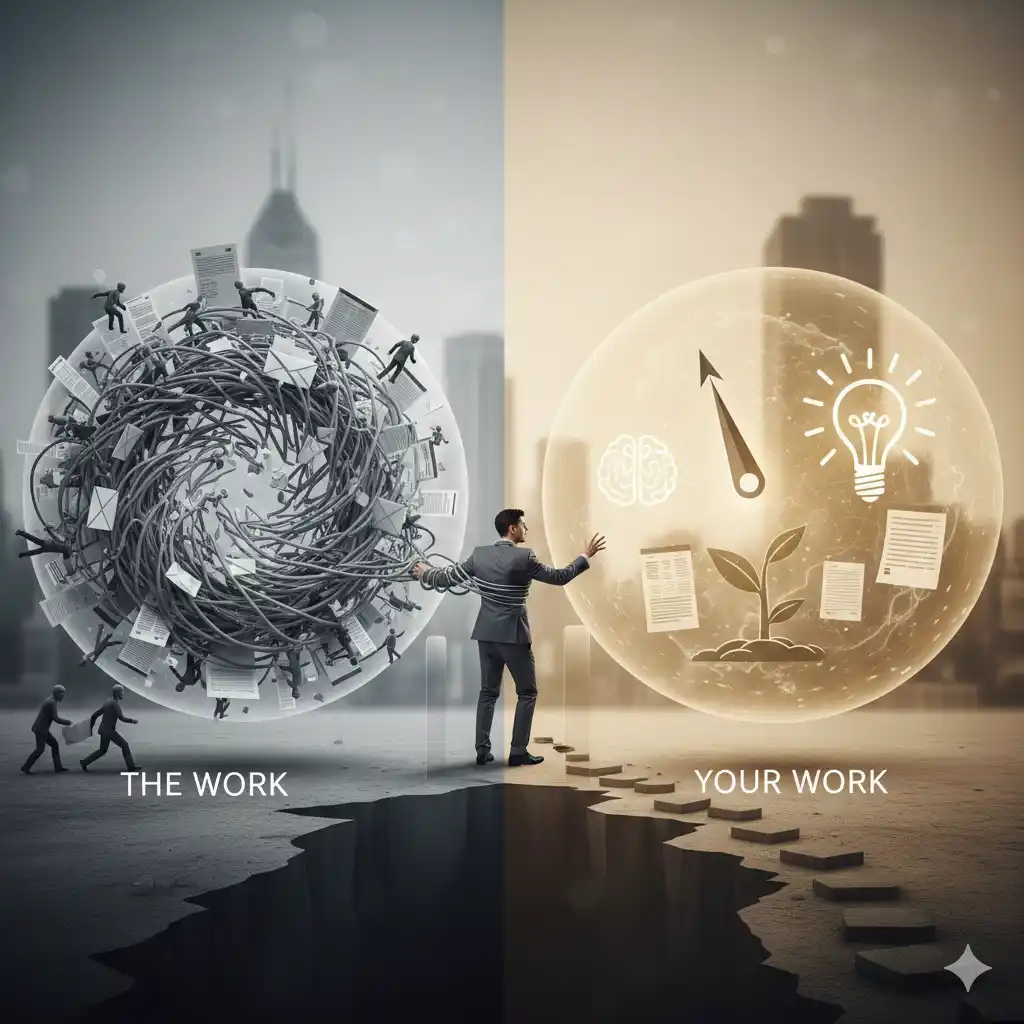
We live in a culture that has fetishized busyness. Ask someone “How are you?” and the default answer is a sigh followed by “Swamped.” We wear the word work like a protective shield against irrelevance. But what if I told you that 80% of what you call work is actually a sophisticated form of procrastination?
In Chapter 8 of Ultraproductivity, Isra García drops a nuclear bomb on our traditional work ethic: there is “The Work” (bureaucracy, noise, things that keep you busy) and there is “Your Work” (what moves the needle, what makes you win, what truly matters).
Most of us spend our lives doing The Work and leave Our Work for spare moments—or worse, for never. This is a survival guide to flipping that equation and starting to do what actually counts before it’s too late.
1. The Office-Hours Myth: Wake Up Early to Conquer
Let’s start with performance biology. Most professionals try to do their most important work—the personal project, the new strategy, the book—in the afternoon, after surviving eight hours of meetings, emails, and other people’s problems. It’s a losing battle. You arrive exhausted, low on glucose, and with willpower at rock bottom.
García’s solution is radical but effective: reverse the order. Real game-changers don’t wait for free time; they steal it at the start of the day. Waking up at 5:00 a.m. isn’t masochism; it’s territorial defense. At that hour, the world is asleep. No emails. No WhatsApp. No noise. It’s the only moment when you can do Your Work—the decisive work—with a full mental battery.
If you want to write a book, do it before opening your work inbox. If you want to build a company, give it the first two hours of the day. Let routine work (The Work) consume your leftover energy, not your prime energy.
2. Brutal Optimization: Doing Better What You Already Do
Once your sacred time is protected, you need to clean up the rest of your day. You can’t allow The Work to expand like a gas and fill every available hour. These are guerrilla tactics to compress mediocrity:
Micro-Segmentation
Stop trying to cover everything. Specialize. Find niches so small you can dominate them completely. Agility comes from being small and fast, not big and slow.
The Half Rule
Once a month, audit your tasks and cut 50%. Yes—half. You’ll discover the world doesn’t end when you stop doing half the things you thought were “essential.”
Proactive Networking
Stop going to events to “see what happens.” Network only with the person you want to do business with. Be direct. Be a sniper, not a shotgun.
Scalability
If your business depends on you being present every hour, you don’t have a business—you have a glorified job. Look for scalable assets (webinars, ebooks, software) that work while you sleep.
3. The Lie of “Quit Everything to Chase Your Dream”
There’s a dangerous narrative in entrepreneurship: “Quit your job, burn the ships, follow your passion.” García brings us back to reality. You don’t need to quit your job to pursue your dream; you need to quit Netflix.
Your current job pays the bills. It’s the angel investor of your dream. Don’t kill it too early. The problem isn’t your 9-to-5; it’s what you do from 5 to 11. We all have nonessential commitments: expensive hobbies, social obligations out of obligation, dead hours on social media. Make a list of everything you do in a week. Ruthlessly eliminate everything that isn’t “Paying rent” or “Building my dream.”
Working on your passion without quitting your paycheck is possible—but it requires sacrifice. It means sleeping a little less and living with deliberate intensity. Quantify your dream in hours (for example, “I need 100 hours to launch my website”) and find them in the margins of your current life.
4. Six Shortcuts to Immediate Excellence
If you want to be taken seriously, you need to get serious. Not formal—serious. Serious means extreme professionalism, impact, and results.
Guerrilla Planning
Forget five-year plans. The world changes too fast. Plan your day the night before. Be flexible and lethal in the short term.
Take It Personally
Business is personal. Treat key clients and partners like family. Politely ignore everyone else or say “no” clearly. You can’t take care of everyone.
Create Emotion
If your work makes no one feel anything, it’s irrelevant. Whether it’s a financial report or a T-shirt, it must transmit humanity.
Passion or Death
Avoid repetitive tasks you hate. If you’re not passionate, it shows—and you’ll burn out. Automate or delegate whatever doesn’t light you up.
Your Life Is Your MBA
Stop looking for answers in expensive courses. Your mistakes, failures, and crises are the best business school that exists. Use them.
Connect Dimensions
Don’t be one person at work and another outside. Bring your humor, quirks, and passions into the office. Authenticity is the scarcest and most valuable asset in the market.
5. The Night: The Champions’ Shift
We’ve talked about mornings, but night is the unexplored territory. After dinner, you have two options: zombify yourself in front of the TV or build your legacy. You have two to three golden hours before sleep.
Turn off the TV
Throw it out the window if necessary.
Find a Reason
If what you’re doing doesn’t excite you, you’ll end up on Instagram. Find a project so compelling you’d rather work on it than watch a series.
Change Scenery
If you can, leave the house. Go somewhere inspiring or collaborate on a night project. Books are written, languages learned, and startups launched in those dark, quiet hours when the rest of the world disconnects.
6. In Praise of (Healthy) Selfishness
The chapter closes with an idea that clashes head-on with our upbringing: you must be selfish.
You can’t give what you don’t have. If you’re exhausted, broke, and frustrated, you can’t help anyone. To lead, to care for your family, to impact the world, you first need to be full of energy, health, and resources.
Energy
Healthy selfish people take care of themselves. They sleep, eat well, exercise. Their tank is full when others need them.
Leadership
Only when you know who you are and what you want can you guide others.
Relationships
Two complete, happy people make an incredible couple. Two empty people who need each other create a codependent disaster.
Putting yourself first isn’t vanity; it’s strategic responsibility. It’s protecting the most important asset of your life—yourself—so it can perform at maximum capacity in service of others over the long term.
Your Job Is to Change Things
The final message is clear: stop hiding behind bureaucracy. Stop saying you’re “too busy” answering emails. That’s The Work. Anyone can do that. Your mission is to find Your Work—that unique intersection of your talent, your passion, and what the world needs. And once you find it, you must protect it fiercely, waking up early, staying up late, and being selfish with your time so you can give it to the world.
Make it count.
The Tool to Protect “Your Work”
Implementing a “important-first” philosophy requires a system that shields your attention. Willpower alone isn’t enough when daily chaos attacks.
GGyess WorkSuite is the digital bodyguard of your priorities.
Time Blocking
Use its calendar to reserve those sacred morning hours. Make them untouchable.
Energy Management
Identify which tasks are The Work (bureaucracy) and automate or delegate them through the platform.
Impact Visibility
GGyess lets you tag tasks by “Real Impact.” At the end of the week, you’ll see whether you were building your dreams—or just cleaning your inbox. With GGyess, you stop reacting to other people’s agendas and start executing your own.