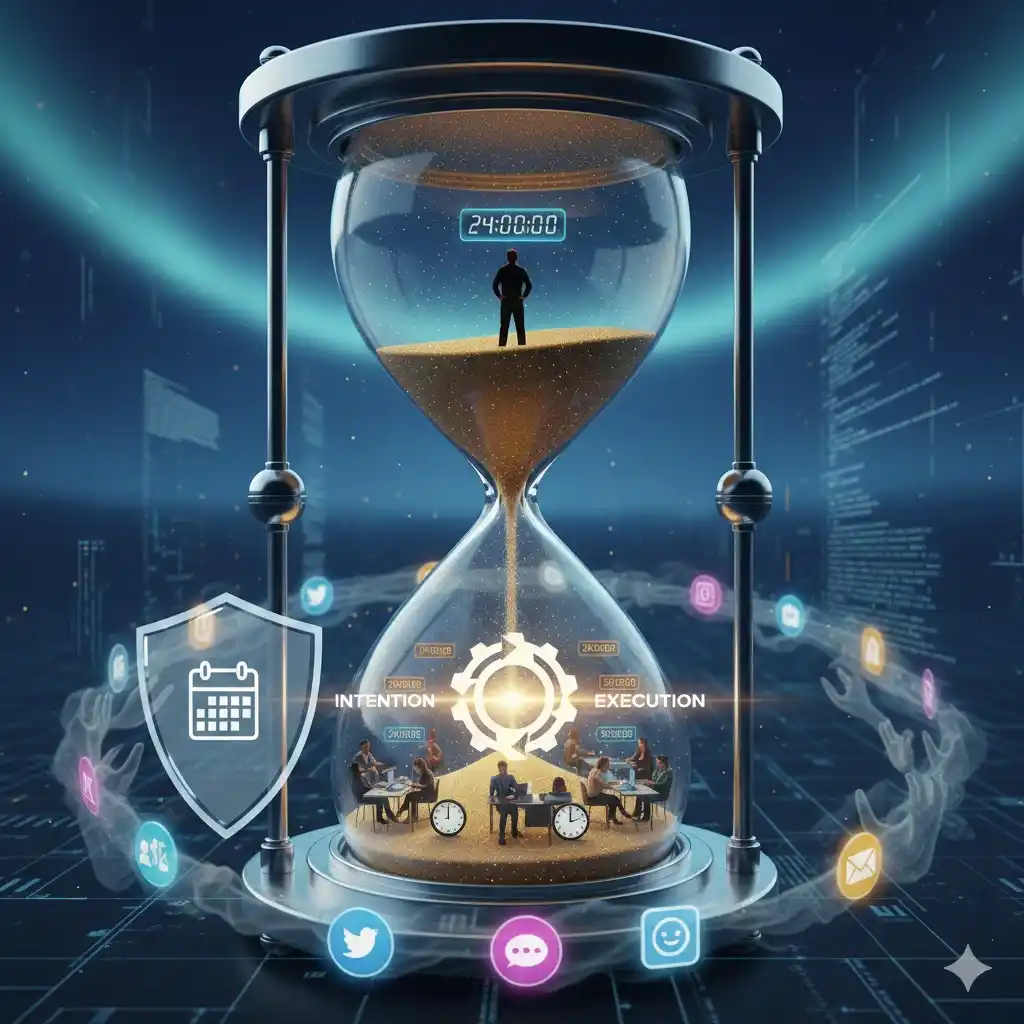
Time is the only truly democratic resource. Elon Musk has 24 hours. You have 24 hours. The difference between massive success and mediocrity isn’t having more time (impossible), but having more control over it.
In the ninth chapter of Ultra Productivity, Isra García delivers an existential warning: if you don’t control your time, you control nothing. We live in an era of professional time thieves. Social media, “urgent” emails, and our own tendency to procrastinate all conspire to steal our most precious asset. This article is a self-defense manual to protect your calendar and turn intention into execution.
1. Structured Procrastination: The Art of Being Busy While Doing Nothing
The number one enemy of productivity isn’t laziness; it’s structured procrastination. This concept, coined by John Perry, describes that deceptive feeling of having had a “productive” day because you answered 50 emails, cleaned your desk, and organized your folders—yet you didn’t do the one thing that actually mattered (that report, that sale, that project).
You feel satisfied, but it’s a hollow satisfaction. You’ve used low-value tasks as a shield to avoid hard work. To cure this disease, García proposes a shock-therapy morning protocol:
- Identify the Monster: before starting your day, write down the 2 or 3 tasks you fear the most or want to avoid.
- Isolate the Monster: don’t open email, don’t check WhatsApp, don’t read the news.
- Kill the Monster: dedicate the first hours of the day exclusively to those tasks. Until they’re done, your day hasn’t officially started.
Procrastination feeds on fear and ambiguity. By attacking what’s hard first, you cut off its oxygen supply.
2. The High Cost of Small Traps
We tend to think we waste time in big chunks (an afternoon lost to Netflix). But reality is more insidious: we lose our lives in micro-doses.
- Checking TikTok: 5 minutes
- Checking email: 3 minutes
- Replying to a WhatsApp: 1 minute
It feels harmless, like eating a single French fry. But if you do it 50 times a day, you’ve lost hours of deep focus. The cost isn’t just time; it’s attention residue. Every time you switch tasks, your brain needs time to refocus.
The solution is radical: batch the traps. Check email only three times a day. Reply to messages in 20-minute blocks. Don’t allow interruptions to drip constantly—turn them into scheduled events.
3. Stop Stealing Time (and Stop Letting Others Steal It)
We live in a culture that doesn’t respect other people’s time. Showing up 15 minutes late to meetings, sending endless emails that could be one line, or asking for “a coffee to pick your brain for free” are all forms of theft. And the worst part? We do it too.
García invites a brutally honest self-audit:
- Do you send 5-minute voice notes instead of writing a 30-second summary?
- Do you call meetings without a clear agenda?
- Do you interrupt your team with questions you could Google?
If you want your time respected, start by respecting others’. And when someone tries to steal yours, be ruthless.
- Meetings: maximum 30 minutes. If it can’t be solved in that time, it’s a management problem, not a time problem.
- Calls: reject them. Unless it’s a VIP client or a real emergency, the phone is an interruption tool, not a production tool. Train your environment to use asynchronous channels (email, messaging) where you control when you respond.
4. Personalize Your Time: The SMART Method
Not all time is equal. One hour at 9:00 AM is worth ten times more than one hour at 4:00 PM. To master your schedule, stop seeing it as an empty container and start seeing it as territory to conquer. Apply SMART goals (Specific, Measurable, Achievable, Relevant, Timely) to your time blocks.
- Don’t say: “I’m going to work on Project X.”
- Say: “From 9:00 to 11:00, I’ll write the first 10 pages of the report with my phone turned off.”
Label your calendar. Use colors.
- Fire Time: deep work
- Maintenance Time: emails, calls
- Life Time: exercise, family
If it’s not on the calendar, it doesn’t exist. And if it doesn’t have a clear objective, it’s wasted time.
5. The Time Manifesto: What to Do and What Not to Do
The chapter closes with a declaration of principles for those who want to live as authors of their lives, not spectators.
What an ultra-productive person does NOT do:
- Watch the news (if it’s important, you’ll hear about it).
- Worry about the past or the distant future (only “now” and “soon” exist).
- Accept other people’s priorities as their own.
- Complain (it drains energy and solves nothing).
What an ultra-productive person DOES do:
- Decide Fast: indecision is the greatest time thief. Better to decide wrong and correct quickly than not decide at all.
- Live Fast: not rushed, but intense. Fully present.
- Fail and Fix: perfectionism is procrastination disguised as quality. Launch, fail, fix, move on.
- Use Timers: work against the clock. Parkinson’s Law states that work expands to fill the time available.
Conclusion: Time Is Your Only Real Possession
At the end of the day, your bank account can recover. Your spent time cannot. Mastering time isn’t about becoming an efficient robot; it’s about creating space to live. It’s about finishing work at 2:00 PM so you can spend the afternoon with your kids, writing your novel, or doing absolutely nothing without guilt.
Ultra productivity is the path to freedom. But that freedom isn’t free—it costs discipline, saying “no,” and facing the monsters of procrastination every morning. The good news? The battle is won or lost today.
What are you going to do with your next hour?
The Tool to Master Your Clock
Applying these tactics requires a system stronger than your old habits. You need a tool that forces you to respect your own boundaries.
GGyess WorkSuite is the technological ally for conquering your time.
- Time Blocking: its integrated calendar lets you reserve deep-work blocks and protect them from interruptions.
- SMART Task Management: define specific objectives and deadlines for each task, eliminating the ambiguity that fuels procrastination.
- Asynchronous Communication: centralize team communication to avoid the tyranny of calls and instant messages, letting you respond when you choose—not when a notification goes off.
With GGyess, you stop chasing the clock and start directing it.