We live in an era that fetishizes the word “Innovation.” Companies put it in their mission statements, LinkedIn gurus preach it, and we feel guilty if we’re not “reinventing ourselves” every six months.
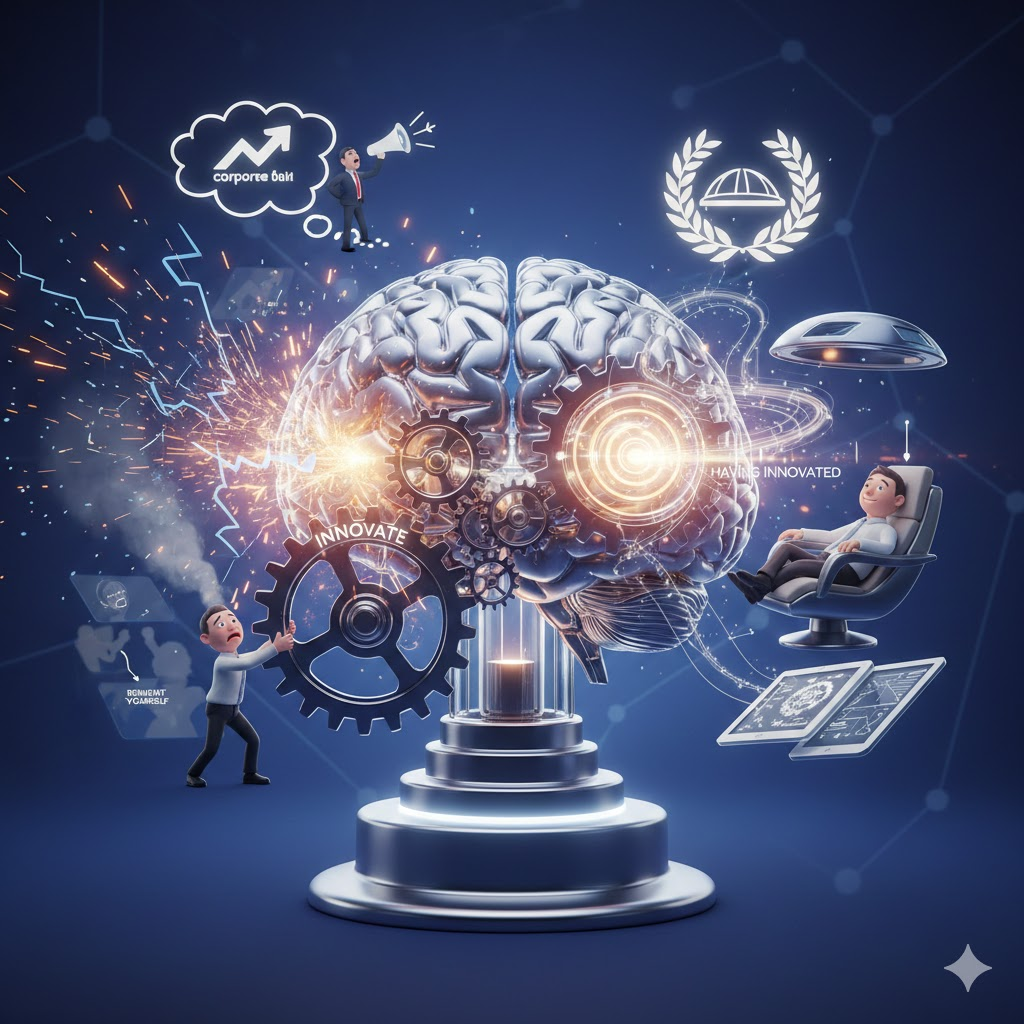
But there’s a problem: deep down, your brain doesn’t like innovating all the time.
It likes having innovated.
In the sixth chapter of his work, Elkhonon Goldberg reveals the fundamental paradox of the human mind. We are addicted to novelty; our biology pushes us to explore the unknown. But at the same time, processing novelty is metabolically expensive, slow, and stressful.
Your brain is a machine designed with a single goal: find what is new (novelty) and convert it as quickly as possible into something old (routine). Understanding this cycle is the difference between being a prolific innovator and becoming a victim of modern burnout.
1. The Challenge of Novelty: Why Thinking Is Exhausting
Imagine being dropped into the middle of an unknown jungle. Every sound could be a predator. Every plant could be poison or food. Your brain is on maximum alert. That’s novelty processing.
Now imagine you’re on your couch at home. You know where the remote is, you know the sounds your fridge makes. Your brain is at rest. That’s routine.
Goldberg explains that novelty is the ultimate cognitive challenge. Facing something for which we have no prior “script” requires a massive mobilization of neural resources. The brain must recruit vast areas of the cortex to try to make sense of chaos.
Innovation, therefore, is not a free state of grace. It’s a titanic effort. The brain tolerates this effort only because the reward (learning to survive better) is worth it. But its final goal is always efficiency: turning jungle chaos into couch comfort. The problem with modern life is that it keeps us permanently in the jungle.
2. The Hemispheres, Misunderstood: Goodbye to the “Artist vs. Accountant” Myth
You’ve probably heard the pop myth: “The left hemisphere is logical and analytical; the right hemisphere is creative and artistic.” If you want to innovate, they say, “unlock your right brain.”
Goldberg dismantles this caricature in Chapter 6. The real division is not by topic (art vs. math), but by novelty.
Right Hemisphere: The novelty specialist. The explorer. It activates when you don’t know what to do. It doesn’t matter whether it’s a new math problem or a new painting—if it’s unfamiliar, the right hemisphere takes command.
Left Hemisphere: The routine specialist. The librarian. It activates when you already have a plan. If you’re an expert mathematician solving a familiar equation, or a musician playing a scale you’ve practiced a thousand times, you’re using the left hemisphere.
Innovation, then, doesn’t live in one side. It is the journey of information from the right hemisphere (discovery) to the left hemisphere (mastery).
3. Wired for Novelty: The Physical Architecture of Genius
Why is the right hemisphere better at handling the new? It’s not magic—it’s wiring. Goldberg describes fascinating anatomical differences that explain our behavior.
The Right Hemisphere has more white matter (long, myelinated axons). It’s a “global interconnection” system. When you face something new, you don’t know what information is relevant. You need a wide, diffuse network capable of linking distant ideas. The right hemisphere is like a giant fishing net, casting hooks across the entire brain to see what it catches. That’s why new ideas often feel like strange associations (“What if we combine a phone with music?”).
The Left Hemisphere, by contrast, has a more compact, modular organization. It’s built for local precision, not global search.
This architecture tells us something crucial: to innovate, you must allow your mind to be diffuse and expansive (right-hemisphere mode). But to execute, you must become precise and narrow (left-hemisphere mode).
4. Driven by Novelty: The Exploration Instinct
We don’t innovate just because our jobs demand it. We do it because we are biologically programmed to. Goldberg talks about neophilia—the love of the new.
There is a dopaminergic drive that rewards us for discovering new patterns. It’s what a scientist feels when data suddenly clicks, or what a musician feels when finding the perfect melody. But here’s the key: the brain does not want to stay in novelty. It wants to resolve it.
The healthy innovation cycle looks like this:
Right-Hemisphere Phase: Curiosity, confusion, exploration, high energy expenditure.
Transition: The pattern is identified (“Aha!”).
Left-Hemisphere Phase: The pattern is stored as routine. Energy expenditure drops. Satisfaction and competence appear.
We are creatures designed to turn the unknown into the known. We are cognitive conquerors. Intellectual happiness doesn’t live in ignorance or omniscience, but in the dynamic process of learning.
5. Novelty Overload: The Disease of the 21st Century
And here we reach the chapter’s critical warning. If the brain is designed to turn Novelty into Routine… what happens when novelty arrives so fast that we never have time to build the routine?
What happens is what Goldberg calls Novelty Excess or cognitive overload. In today’s world, technology, protocols, and markets change at a dizzying speed.
You learn how to use an app (Right Hemisphere working hard).
Just when you’re about to turn it into routine (Left Hemisphere), an update changes the interface.
Boom. Your brain is kicked back into the Right Hemisphere.
This forces us to live in a state of Permanent Right-Hemisphere Mode. It’s exhausting. The right hemisphere is not designed to be on 24/7. It’s an emergency and exploration engine, not a cruising engine.
The result is decision fatigue, anxiety, and creative paralysis. It’s not that you’re incapable of innovating—it’s that your brain is so busy processing new “noise” that it has no energy left to search for the innovative “signal.” We get stuck in exploration and never reach mastery.
You Need an “External Left Hemisphere”
Goldberg’s final lesson is clear: sustainable innovation requires balance. You need the courage to seek the new, but you also need the infrastructure to stabilize it quickly. You cannot be a perpetual novice.
If your environment bombards you with excessive novelty, your biology will fail. The only solution is to externalize routine.
To survive this novelty bombardment without burning out your neural circuits, you need a system that plays the role of your “Left Hemisphere.” GGyess WorkSuite is designed to be that anchor of stability: it captures the chaos of your projects (novelty), organizes it into standardized workflows, and automates repetition. By trusting data and process management to GGyess, you allow your biological brain to rest from operational fatigue and reserve its precious right-hemisphere energy for what truly matters: real innovation and creative strategy—things no machine can replicate.