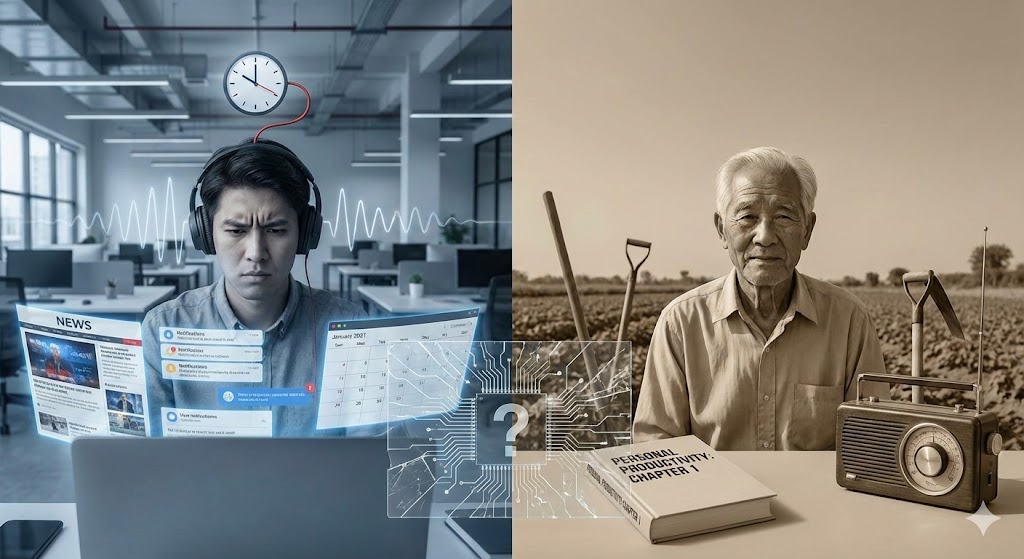
If you paused for a moment, closed your eyes, and listened to the background noise of your life, you probably wouldn’t hear silence. You’d hear a hum. A barely perceptible vibration, a static tension that settles at the base of your neck or in the pit of your stomach. It’s the persistent feeling that you’re forgetting something, that there’s a ticking time bomb hidden somewhere in your calendar, and you don’t know which wire to cut or when it will detonate.
We live in the Information Age, but our bodies seem to be living in an era of constant threat. We often look back at our grandparents’ generation with a mix of disbelief and envy. They worked marathon hours, often doing physical labor that would break a modern office worker’s back in a week. They had real worries: wars, post-war hardship, scarcity, incurable diseases. And yet, they didn’t suffer from this. They didn’t know the diffuse, chronic, corrosive anxiety that has become the soundtrack of the 21st century. They could be tired, but they were rarely “burned out” in the cognitive sense we now normalize.
So what changed? Why, surrounded by technological comforts designed to make life easier, do we feel more cornered than ever? The conventional—and wrong—answer is to blame technology or workload. But the first chapter of Personal Productivity invites us to look deeper, into evolutionary biology, to discover that the problem isn’t that we have “too much information,” but that we’ve broken the oldest safety mechanism of our species.
The Tiger in the Office: An Evolutionary Design Flaw
To understand our stress, we have to stop looking at our screens and start looking at our genes. Stress isn’t a system bug; at its core, it’s a brilliant survival feature. Like cholesterol, there’s a “good” kind and a “bad” kind, and understanding the difference is vital.
Eustress (positive stress) is the tension required for growth. It’s the electricity you feel before stepping on stage, the adrenaline that pushes you to learn a new language or close a tough deal. It’s adaptive. It pulls us out of lethargy and forces us to evolve.
The problem arises with distress (negative stress), and to understand why it’s killing us, we have to travel 50,000 years back. Imagine one of your ancestors walking across the savannah. Suddenly, they see bushes moving in the distance. Their brain doesn’t stop to run a statistical analysis or call a meeting. It triggers a binary, immediate response: Danger.
In milliseconds, the body floods with cortisol and adrenaline. Blood is pulled away from the stomach and skin—you don’t need to digest or look healthy if you’re about to be eaten—and redirected to the large muscles. Rational cognition shuts down to make way for instinct. There are only three options: fight, flee, or freeze.
If there really was a tiger behind the bushes and your ancestor ran, stress saved their life. Once safe, the parasympathetic system kicked in, shut off the alarm, and hormone levels returned to normal. The system was designed for sharp spikes of danger followed by long periods of calm.
The tragedy of the modern knowledge worker is that we’ve dropped this caveman brain into a glass office. For your nervous system, an email with the subject line “URGENT” at 11 p.m. isn’t a digital notification; it’s rustling bushes. A missed call from an unknown number isn’t phone data; it’s the crack of a dry branch under a predator’s paw.
The tragedy is that the modern “tiger” never attacks, but it never leaves either. It keeps circling. We keep the alert system switched on 24/7, generating chronic inflammation in our psyche. We don’t fight or flee; we remain in a state of vigilant paralysis, burning through our energy reserves in a battle that never ends because it’s never defined.
The Myth of Information Overload
This brings us to the great lie we tell ourselves to justify our exhaustion: “I have too much information. I need a digital detox.” We blame volume. We believe that if we could reduce inputs, we’d be happy.
But this is demonstrably false. Information itself is neutral; it has no intrinsic ability to cause stress. If volume caused heart attacks, no one could enter a public library without collapsing under the weight of millions of words. No one could run a Google search—returning 40 million results in 0.3 seconds—without a panic attack.
The author proposes a brilliant thought experiment that dismantles this myth. Imagine opening your computer on a Monday morning and seeing 100 unread emails in your inbox. You feel the immediate physical hit: pulse racing, shoulders tensing. Pure overload stress.
Now imagine you have a magical, 100% reliable filter that tells you those 100 emails are spam—junk ads for products you don’t care about. Are you still stressed? You might feel annoyed about deleting them, but the existential anxiety, fear, and pressure vanish instantly.
Analyze this: it’s the same 100 items, occupying the same screen space. The same information “volume.” What’s the difference? In the second scenario, you know what the information means. In the first, there’s ambiguity.
The Fear Equation: Unknown = Dangerous
This is the neuroscientific root of low productivity and high anxiety. What stresses us isn’t the number of things we have to do; it’s the number of things we haven’t defined.
In those 100 “normal” emails lies a chaotic mix of possibilities: a congratulatory note, an overdue invoice, a promotion opportunity, a client crisis, or a simple newsletter. There are “bombs” and “gifts,” wrapped in the same digital paper.
Your primitive survival brain applies ruthless logic in the face of uncertainty: “If I don’t know what it is, I must assume it’s a threat until proven otherwise.”
Every paper on your desk, every sticky note on your monitor that says “Call John,” every red notification badge on your phone is an open loop. An unknown your brain must constantly scan. It’s bushes rustling. Until you go look behind them, your brain can’t rest. It has to keep part of its RAM reserved to monitor that potential threat.
This is why you wake up at 3 a.m. thinking about something trivial. It’s not important; it’s unresolved. Undefined. Your mind is trying to close a loop you left open during the day. Hundreds of these micro open loops drain our cognitive energy, leaving us depleted for the work that truly matters. We’re not tired from working too much; we’re tired from mentally holding everything we haven’t defined.
The Circle of Influence: Taking Back Control
Faced with this reality, the instinctive reaction is complaint or escape. We wish the world would slow down. We wish emails would stop. We long for a simpler era. But as Stephen Covey pointed out, this keeps us stuck in the Circle of Concern—things beyond our control. Technological innovation won’t slow; it will accelerate. Information will keep doubling faster and faster. Fighting reality is a guaranteed recipe for frustration.
The solution lies in our Circle of Influence. We can’t control the river’s flow, but we can become master builders of dams and channels. The key to disabling the stress mechanism isn’t ignoring information, but aggressively clarifying it.
The antidote to anxiety isn’t relaxation; it’s definition. We must develop the disciplined habit of taking every ambiguous stimulus that enters our awareness and forcing it to reveal its true nature.
That vague email from your boss shouldn’t linger in your inbox like a ghost; it should become: “20-minute task: find March sales figures and send them.”
That note that says “Call mom” should become: “Calendar event: Sunday at 11:00 a.m.”
The instant you transform an ambiguous “thing” into a concrete “action,” neurological magic happens. The brain shuts off the alarm. The bushes stop moving because you’ve seen it’s not a tiger—it’s a rabbit. The threat disappears, and you regain control. The “bad” stress dissipates because you’ve removed fear from the equation.
The Need for an External Brain
Here we hit a fundamental human limitation. Our capacity to clarify and hold commitments is finite. Your brain is terrible at remembering things but excellent at having ideas. Trying to keep all those definitions, dates, projects, and reminders in your head is impossible. Something will drop—and when your brain realizes it can’t trust your memory, it turns the stress alarm back on.
To apply this philosophy of radical definition and eliminate ambiguity from our work lives, we need a trusted system. An external container where we can dump the noise, process it, organize it, and turn it into a calm execution plan. We need a tool that acts as an auxiliary brain that never sleeps and never forgets.
This is where technology stops being the problem and becomes the solution. Platforms like GGyess WorkSuite are designed precisely to close this cognitive gap. They aren’t just task lists; they’re clarification environments. By letting you capture ambiguous inputs, break them into actionable steps, assign clear ownership, and visualize the full workflow, tools like GGyess remove uncertainty from the equation. They transform the anguish of “I don’t know what I have to do” into the calm of a visible plan. By delegating remembering and organizing to a robust system, you free your mind from constant vigilance—allowing it to return to what it does best: create, solve, and execute without fear.