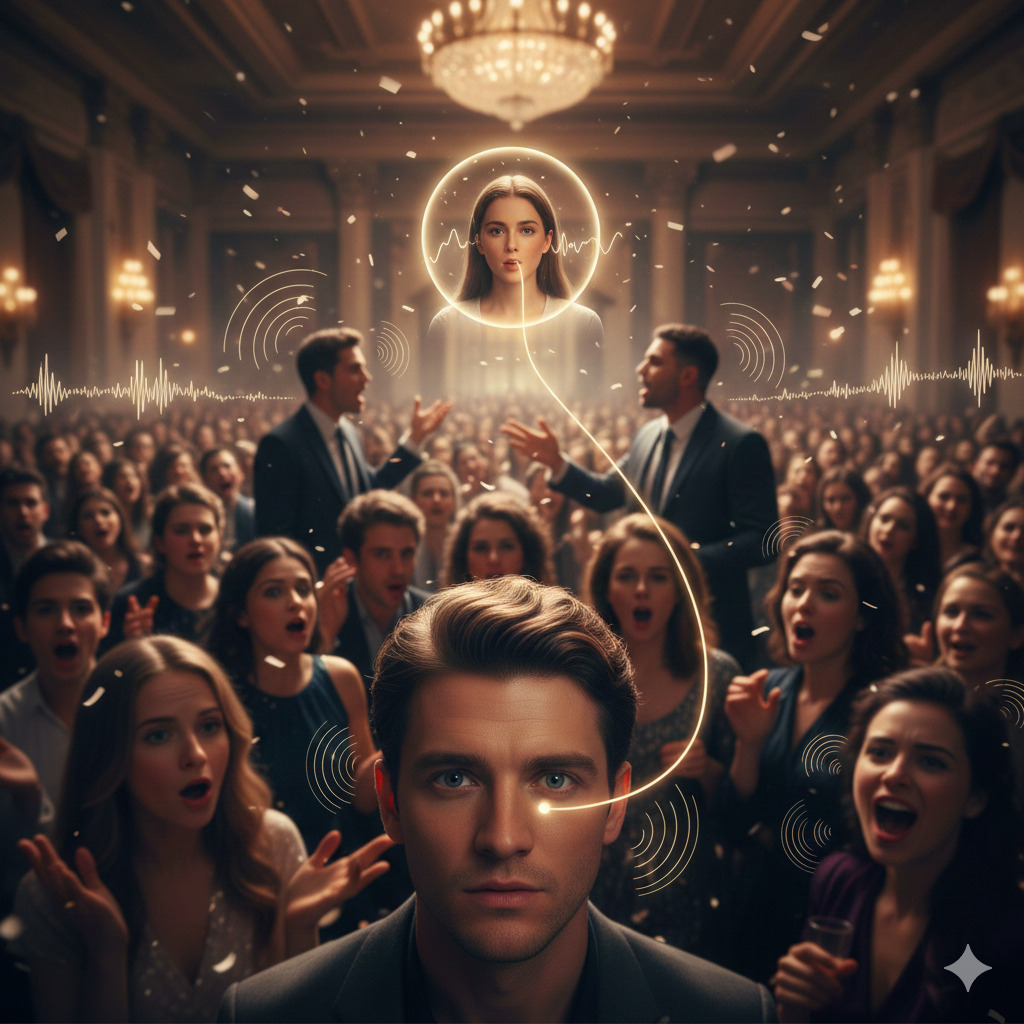
You’re at a noisy party. Hundreds of people are talking at the same time. The noise is overwhelming. But suddenly, someone across the room softly mentions your name—and miraculously, you hear it.
How is that possible? How did your brain filter tons of noise and let that single weak signal through?
The answer is one word: Relevance.
In the fifth chapter of his work, Elkhonon Goldberg introduces us to the forgotten hero of neuroscience. It’s not the logical genius of the frontal lobes, nor the vast warehouse of memory. It’s the Salience Network. It’s the nightclub bouncer of your mind. Its job is simple and ruthless: decide what enters your consciousness and what stays out.
And here’s the twist: creativity isn’t just about having many ideas—it’s about having a bouncer with exquisite judgment.
1. The Salience Network: The Bouncer of Your Mind
Imagine your brain as a massive corporation. You have the CEO (the Central Executive Network) who wants to work, and the Creative Department (the Default Mode Network) that wants to dream. But both are blind to the outside world. The only one who sees what’s happening outside is the Head of Security: the Salience Network.
Anchored in the anterior insula and the anterior cingulate cortex, this network is constantly scanning the environment for “signals.” Most things (the hum of the air conditioner, the color of the wall) are irrelevant and get blocked. But when something appears that breaks the pattern or promises a reward (your name, a threat, a new idea), the Salience Network hits the red button.
For the innovator, this circuit is vital. The difference between a genius and a distracted person isn’t the ability to think, but the ability to filter. The genius can detect relevance in a detail everyone else ignored (like Fleming seeing significance in mold that killed bacteria).
2. Default Relevance: We Are Egocentric by Design
What is most relevant to a human being? Goldberg doesn’t mince words: ourselves.
Biology has programmed us with a “default relevance.” Our names, our faces, our threats, and our desires have VIP access to the brain. But creativity requires hacking this egocentrism. To innovate means finding relevance in things that are not you. It means caring deeply about an abstract problem, someone else’s need, or an intellectual curiosity.
The creative brain is one that has expanded its definition of “what matters” beyond immediate survival. It has trained its salience circuit to get excited by ideas as much as it gets excited by food.
3. Dopamine: Not Pleasure, but “Pay Attention to This!”
Here Goldberg dismantles one of pop culture’s biggest myths. We’ve been told dopamine is the “pleasure molecule.” That it makes us feel good when we eat chocolate or get a like. False—or at least incomplete.
The primary function of dopamine, released from the ventral tegmental area, is not to make you feel good. It is to signal relevance. Dopamine is the brain’s fluorescent highlighter. When dopamine is released, the brain says: “This is important. Record it. Pay attention.”
The excitation of the frontal lobes depends on this chemical bath. Without dopamine, nothing matters. With too much dopamine, everything matters (which leads to psychosis or mania). Creativity happens in the dopaminergic sweet spot: enough chemical curiosity to pursue an idea obsessively, but not so much that you lose touch with reality.
4. Diluted Relevance: The Danger of Seeing Patterns Where None Exist
What happens when the bouncer lets everyone in? Goldberg talks about Diluted or Aberrant Relevance, which occurs in conditions like schizophrenia. The dopamine system fires uncontrollably. Suddenly, the red color of a traffic light isn’t just a traffic signal; it’s a secret message from the CIA. A bird’s flight isn’t random; it’s a sign from destiny.
The patient assigns “cosmic relevance” to trivial events. And here lies the thin red line of creativity: great artists and scientists also see connections where others see nothing. The difference is that the creative brain maintains executive control. It can say, “Hmm, interesting that this apple falls” (like Newton), but it doesn’t go as far as saying, “The apple is talking to me.”
Innovation is, in a sense, controlled madness—playing with assigning extra relevance to ordinary things to see what emerges.
5. The Curse of Indelible Memory: Unable to Forget
To illustrate the importance of filtering, Goldberg tells the story of Solomon Shereshevsky, the famous mnemonist studied by Luria. Shereshevsky couldn’t forget anything. He remembered every conversation from 15 years ago, every word of a book read once. Was he a genius? No. His life was a tragedy.
His brain couldn’t distinguish relevance from irrelevance. A cough in the audience was as important to him as the symphony he was listening to. Because he couldn’t forget the “noise,” he couldn’t think abstractly. He couldn’t see the forest because he was obsessed with every leaf on every tree.
The lesson for us is brutal: forgetting is as important as remembering. Creativity needs space. It requires the salience circuit to eliminate noise so you can focus on the signal. In the information age, where everything screams “Look at me!”, protecting your ability to ignore is the most valuable cognitive skill.
6. Memory and Relevance: The Emotional Glue
Why do you remember where you were on September 11, or your first kiss, but not what you ate last Tuesday? Because relevance is the glue of memory. The hippocampus (memory) and the amygdala (emotion/relevance) are neighbors that hug each other.
When something is tagged as “highly relevant” (intense fear, immense joy, intellectual discovery), the amygdala shouts to the hippocampus: “Store this in HD—it’s vital!” For the innovator, this means passion is not decoration; it’s a functional mechanism. You can’t have great ideas about topics that bore you, because your brain won’t release the dopamine needed to cement and recombine that knowledge. Emotion is the fuel of cognition.
7. Hijacked Relevance: The War for Your Attention
We live in an attention economy. Social media, news, and advertising are designed by behavioral engineers to hijack your Salience Network. They use bright colors, unpredictable notifications (dopamine), and social threats to trick your bouncer and crash your mental party.
Goldberg warns that when your relevance is externally hijacked, you lose the ability to generate it internally. You become a consumer of stimuli, not a creator of ideas. Reclaiming control of your salience circuit—deciding for yourself what matters—is the first act of creative rebellion.
Train Your Bouncer
Chapter 5 leaves us with a clear mission: if you want to be more creative, stop worrying so much about “thinking better” and start worrying about “feeling better.” Refine your sense of what matters.
Train your dopamine to fire at the beauty of a well-solved problem, not just at an Instagram like.
Protect your mind from irrelevant noise so you don’t end up like Shereshevsky.
And above all, pursue things passionately. Because only when something truly matters to you will your brain open the secret doors where the best ideas hide.
In a work environment where everything feels urgent and constant notifications hijack your dopaminergic system, it’s impossible to maintain the “relevance hygiene” required for innovation. GGyess WorkSuite acts as the external filter your brain needs: by prioritizing tasks, centralizing communication, and silencing irrelevant operational noise, GGyess protects your executive attention. It allows you to “forget” trivial administrative details (which the software manages for you) so your dopamine and mental energy are invested exclusively in what is truly relevant: value creation and high-level strategy.