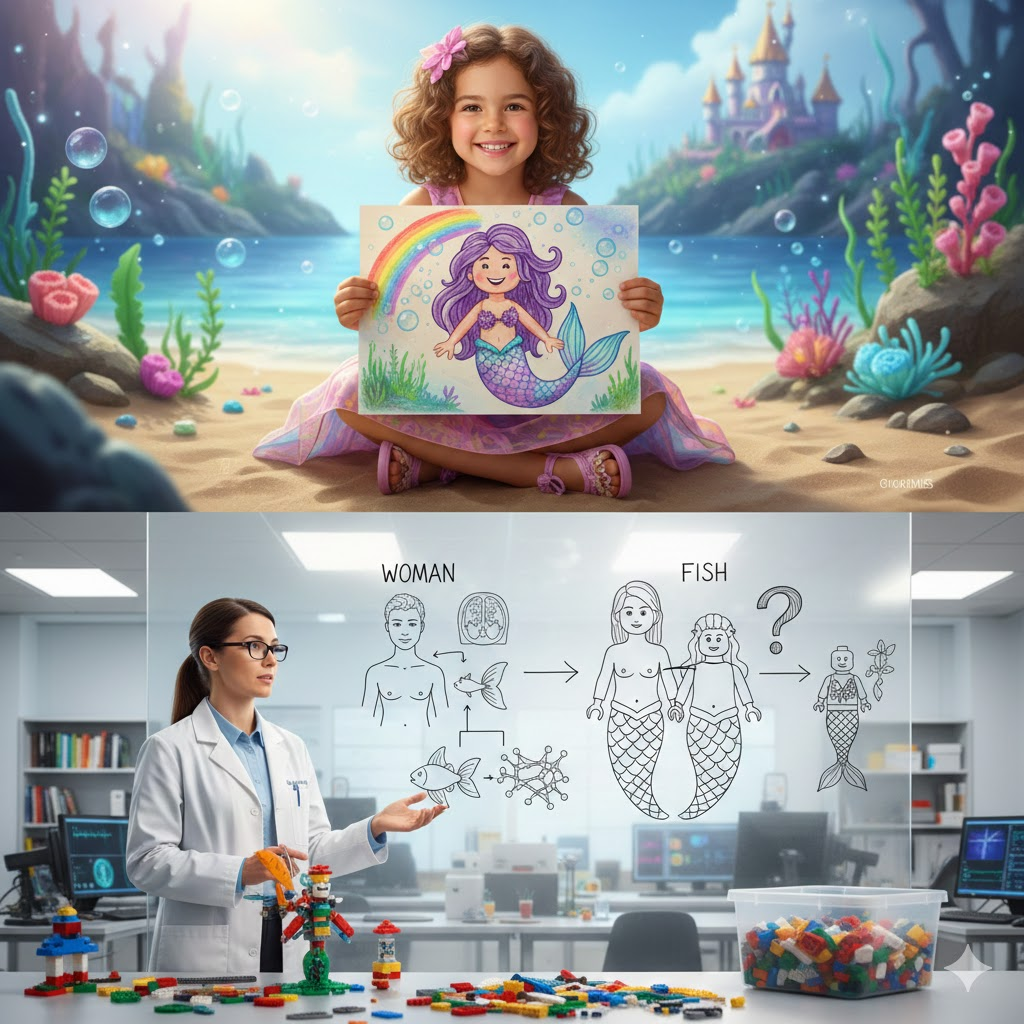
Ask a child what a mermaid is. They’ll tell you it’s a magical creature. Ask a cognitive neuroscientist what a mermaid is, and they’ll tell you it’s a fascinating category error: the forced fusion of one semantic concept (“woman”) with a completely different one (“fish”).
In the fourth chapter of his work, Elkhonon Goldberg uses this mythical metaphor to dismantle the most paralyzing belief about creativity: the idea that innovation means creating something out of nothing (creatio ex nihilo).
Biological reality is far more pragmatic—and far more accessible. Your brain is not a magician pulling rabbits out of empty hats; it is a Lego® Master. It has a finite box of pieces (your memories, knowledge, and past experiences), and its genius lies solely in its ability to dismantle old structures and recombine the pieces into forms the universe has never seen before.
To understand how a new idea is born, we must lift the hood of the mind and observe how language, memory, and the three major neural networks that govern your life interact.
1. Imagining the Future: The Tyranny of the Frontal Lobe
Goldberg begins with a bold claim: creativity and future planning are, neurologically, the same thing. Remembering the past is reconstructing what was. Imagining the future is constructing what could be. Both processes use the same “Lego pieces” stored in long-term memory.
Enter the undisputed protagonist of this chapter: the Frontal Lobes. They are the conductor of the orchestra. They are the only structures capable of Generativity. Think about language. With a limited number of words (pieces), you can build an infinite number of sentences. You can say, “The pink elephant dances salsa on Saturn.” That sentence has never been uttered before in the history of the universe, yet you constructed it and understood it instantly.
Your brain does the same thing with ideas. The frontal lobes take fragments of memory (the concept of “elephant,” the color “pink,” the planet “Saturn”) and assemble them into a new virtual reality. Creativity, therefore, is the brain manipulating itself: the executive ability to drag old files onto the mental desktop and edit them into a brand-new document.
2. The Brain’s Boardroom: The Three Canonical Networks
For decades, science focused on “which brain area does what.” Today, thanks to a macroscopic view, we know that what truly matters are Networks, not parts. Goldberg introduces the “Holy Trinity” of cognition, whose dance determines whether you are productive or creative.
A. The Central Executive Network (CEN)
This is the “Chief Operating Officer.” It activates when you are focused on an external, goal-directed task: solving a math problem, writing a report, driving in traffic. It is logical, linear, and excludes distractions. When the CEN is in charge, you get things done—but you rarely invent new things.
B. The Default Mode Network (DMN)
This is the “Dreamer.” For years, scientists believed the brain “shut down” when we did nothing. They were wrong. When you let your mind wander, the DMN lights up. This network is the seat of imagination, autobiographical memory, and mental wandering. This is where creative incubation happens. When you’re in the shower and suddenly have an epiphany, it’s because the tyranny of the CEN relaxed and the DMN was free to connect distant pieces (a mermaid and a microwave, for example) without logical censorship.
C. The Salience Network (SN)
This is the “Switch.” Its job is to detect what matters (a loud noise, pain, a brilliant idea) and decide whether to hand control to the Executive Network or the Default Mode Network. Genius often depends on how agile this network is at switching modes: dreaming the idea (DMN) and then executing it (CEN).
3. The Enigma of Working Memory: Ghosts in the Brain
If the frontal lobes are the builders, where is the workbench? Traditionally, we are taught that there is a separate “Working Memory” (like a computer’s RAM) distinct from “Long-Term Memory” (the hard drive). Goldberg challenges this classical view.
He proposes that there are not two separate memories. Imagine a dark theater filled with frozen actors (your long-term memories). Suddenly, a spotlight illuminates three of them. Those three actors come alive and interact.
The theater is Long-Term Memory (posterior cortex).
The spotlight is Attention (frontal lobes).
The illuminated scene is what we call Working Memory.
This changes everything. It means that “thinking” is not about moving data from one place to another, but about temporarily activating knowledge you already possess. Creativity occurs when the frontal spotlight is wide enough to illuminate two actors who have never shared the stage before: the concept of “Woman” and the concept of “Fish.”
4. Let the FROPs In (Frontal-Lobe Related Operational Patterns)
To explain how the new is assembled from the old, Goldberg coins a fascinating technical term: FROP (Frontal-Lobe Related Operational Pattern).
When you learn something (a language, a face, a skill), a pattern forms in your posterior brain. But when you use that knowledge to make a decision or create something, the frontal lobe generates a corresponding control pattern. Innovation is the collision of FROPs. Your brain activates the FROP for “Telephone” and the FROP for “Camera.” At first, they are separate networks. But if your frontal lobes can keep them active together long enough (in that “working memory” which is really activated long-term memory), the networks begin searching for points of connection. If the connection stabilizes—boom. The concept of the “Smartphone” is born. You’ve created a technological mermaid.
5. The Pandora’s Box of Consciousness
All of this leads to the chapter’s final question: how does an idea become conscious? Goldberg suggests that consciousness is an emergent property of intensity. When the Salience Network detects that a new assembly of ideas (a mermaid) has a strong, coherent signal, it “promotes” it into awareness.
Most of our recombinations are garbage (strange dreams, silly ideas), and the brain discards them in the subconscious. But the innovator is someone who has:
- A rich Long-Term Memory (many Lego pieces)
- Agile Frontal Lobes (skilled builders)
- A finely tuned Salience Network that can distinguish a brilliant idea from a distraction
How a Mermaid Is Made
The message of Chapter 4 is demystifying yet empowering. You don’t need to be touched by a divine muse to have a great idea. What you need is to feed your warehouse of pieces (constant learning), allow your Default Mode Network to play with them (boredom, walks, daydreaming), and have the Executive discipline to assemble them when they fit.
The mermaid metaphor teaches us that monstrosity and genius are close neighbors. Both are hybrids. The difference is that the monster dies, while the great idea survives to change the world. Your brain is designed to create mermaids; your job is to make sure they learn how to swim.
The creative process Goldberg describes—keeping multiple complex patterns (FROPs) active simultaneously in “working memory”—is metabolically expensive and extremely fragile in the face of interruptions. This is where GGyess WorkSuite becomes your cognitive exoskeleton: by externalizing the storage and organization of your “Lego pieces” (data, tasks, timelines) into a centralized platform, you free your Central Executive Network from maintenance fatigue. This allows your biological brain to devote its limited energy entirely to the higher function of synthesis and recombination, making it easier for innovative “mermaids” to emerge with greater frequency and clarity.