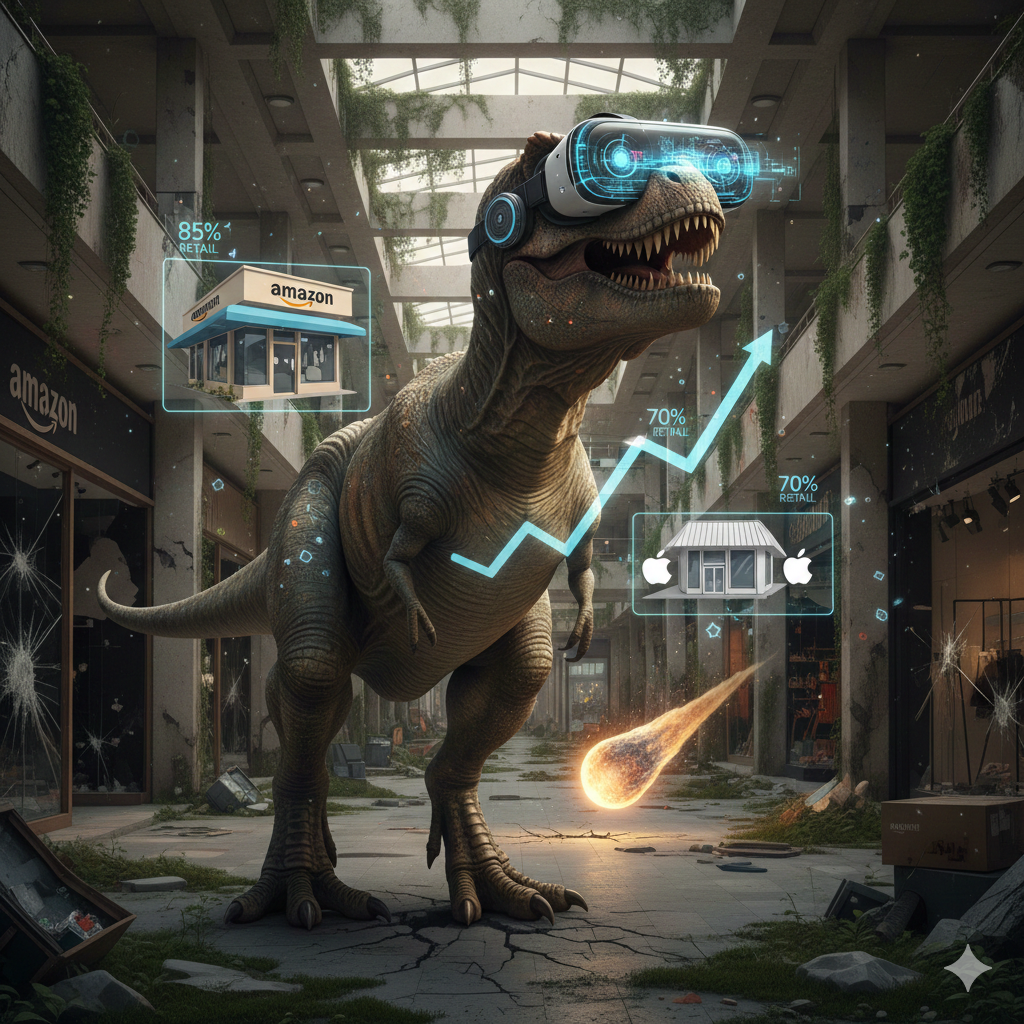
If you read the tech headlines of the past five years, you’d think physical stores are dinosaurs waiting for the meteorite. We’ve been sold the narrative that e-commerce will devour everything and that the future means living with VR headsets, never leaving home.
But the data says the exact opposite.
Even in 2022, e-commerce accounted for less than 15% of total retail sales in the U.S. In China—the digital mecca—it hasn’t even reached 30%. And what are the kings of the digital world like Amazon and Apple doing? They’re opening physical stores at full speed. Amazon bought Whole Foods, and Apple generates about $5,500 per square foot in its stores—almost double that of Tiffany & Co.
Chapter 6 of Marketing 6.0 delivers a counterintuitive revelation: the future isn’t just digital (URL); the future is radically physical (IRL—In Real Life).
There’s a catch, though. You can’t just open a store with four walls and a product. New generations (Gen Z and Alpha) demand that physical spaces behave with the intelligence of digital ones. Welcome to the era of Extended Realities.
1. Generation Z’s Loneliness and the Search for the “Third Place”
To understand why young people want to return to stores, we first need to understand their pain. Generation Z is the most connected generation in history, yet paradoxically the loneliest. According to Cigna, 73% of Gen Z reports feeling lonely. They’ve turned social media into their “public square,” but it hasn’t replaced the warmth of human contact.
This brings back a sociological concept from the 1980s: the Third Place.
The First Place is your home (privacy).
The Second Place is work or school (obligation).
The Third Place is where community happens—cafés, parks, gyms, bookstores. Inclusive, accessible spaces designed for conversation.
Brands like Starbucks built empires by becoming that third place. Today, however, Gen Z is looking for a “Third Place 2.0”: physical spaces where they can socialize while staying integrated with their digital lives. They don’t want to disconnect to enter your store; they want your store to be a physical extension of their Instagram feed.
2. Extended Reality (XR): How to Digitize Brick-and-Mortar
Extended Reality here doesn’t just mean VR headsets. It means extending the capabilities of physical space through technology. If your store is “dumb” (just shelves and a checkout), you’ll lose. If your store is “smart,” it becomes a magnet.
The book proposes five strategies to inject digital steroids into physical spaces.
A. Frictionless Transactions (The Uber Effect)
The worst part of going to a store is paying. Lines kill the experience.
The solution: technologies like Amazon Go or Nike’s Speed Shop. You walk in, grab what you want, and leave. Sensors and cameras handle the payment. Or use BOPIS (Buy Online, Pick Up In Store) with automated lockers.
The goal: make the transaction invisible so the customer only remembers the experience.
B. Contextual Recommendations (Live Personalization)
Online, you know who the customer is. In-store, they used to be anonymous. Not anymore.
The solution: smart fitting rooms like Ralph Lauren’s, which recognize what you’re wearing and suggest accessories. Or Uniqlo Australia’s extreme case with its UMOOD system—neural headbands that read your mood and recommend a T-shirt based on how you feel.
The goal: bring Netflix’s recommendation algorithm into the physical world.
C. Interactive Engagement (Gamification)
Screens are Gen Z’s native language.
The solution: Burberry in Shenzhen partnered with WeChat to gamify the store. The more you interact with products, the more “social currency” you earn, unlocking secret fitting rooms or exclusive café menus.
The goal: turn shopping into a multiplayer video game.
D. Augmented Discovery (Fighting Showrooming)
Retailers’ biggest fear is showrooming—customers check products in-store and buy them cheaper on Amazon.
The solution: apps with “Store Mode.” Home Depot or Best Buy let customers scan QR codes on shelves to see reviews, videos, and exclusive offers that only work while they’re physically there.
The goal: give customers the power of the internet without letting them leave your ecosystem.
E. Pre- and Post-Experience (The Infinite Loop)
A store visit doesn’t start when customers walk in or end when they leave.
The solution: Nike Live uses its app to understand what the local community wants and refreshes store inventory every two weeks based on neighborhood data.
The goal: make the physical store a living organism fueled by digital data.
3. The Anatomy of Space: Evidence, Processes, and People
Technology alone isn’t enough. If the place is ugly or the staff is rude, no amount of tech will save you. The chapter breaks down three psychological components of successful IRL spaces.
1. Physical Evidence (The Stage)
What hits the senses.
Design: IKEA’s maze that forces you to see everything, or Apple’s minimalist glass temples.
Sensory branding: Starbucks’ smell of burnt coffee isn’t an accident—it’s olfactory branding. Music playlists set the pace of shopping. Design must tell a story. If you sell luxury, the sofa should be leather. If you sell community, you need long shared tables.
2. Processes (The Script)
There are visible processes (ordering) and invisible ones (restocking). The secret is flow design. At Starbucks, watching the barista make your coffee is part of the show. At Amazon Go, the payment process disappears entirely. Decide which processes add value and eliminate the rest.
3. People (The Actors)
This is the critical factor. The only reason to visit a store instead of a website is human connection.
At Ritz-Carlton, every employee has a $2,000 discretionary budget to solve a customer problem without asking for permission.
At Singapore Airlines, the crew is the brand.
Technology should automate the boring stuff so humans can focus on empathy, creativity, and problem-solving. If your employees act like robots following a script, you might as well use real robots.
Conclusion: The Brick-and-Mortar Renaissance
Marketing 6.0 teaches us there’s no war between digital and physical. There’s a marriage.
The brands that will win the next decade aren’t the ones closing all their stores to sell exclusively in the Metaverse. They’re the ones who understand that physical space is the new luxury product. In a world of flat screens, offering a three-dimensional space that smells good, knows your name, and uses technology to create magic without getting in the way is the highest value you can provide.
Don’t build stores to sell products—products sell themselves online. Build “Third Places” to heal your customers’ loneliness. If they feel at home, the sale is inevitable.
Strategic Implementation Note with GGyess
Transforming a traditional store into a “Phygital Third Place” is a logistical nightmare. It requires coordinating architectural renovations (Physical Evidence), new workflows (Processes), staff training in soft skills (People), and sensor/software installation (Technology).
Trying to manage this transformation with spreadsheets and emails is a guaranteed failure. GGyess WorkSuite lets you orchestrate these multidisciplinary projects in one platform—managing construction timelines, IT rollouts, and HR training programs together—ensuring the strategic vision of “Extended Reality” is executed without operational friction.