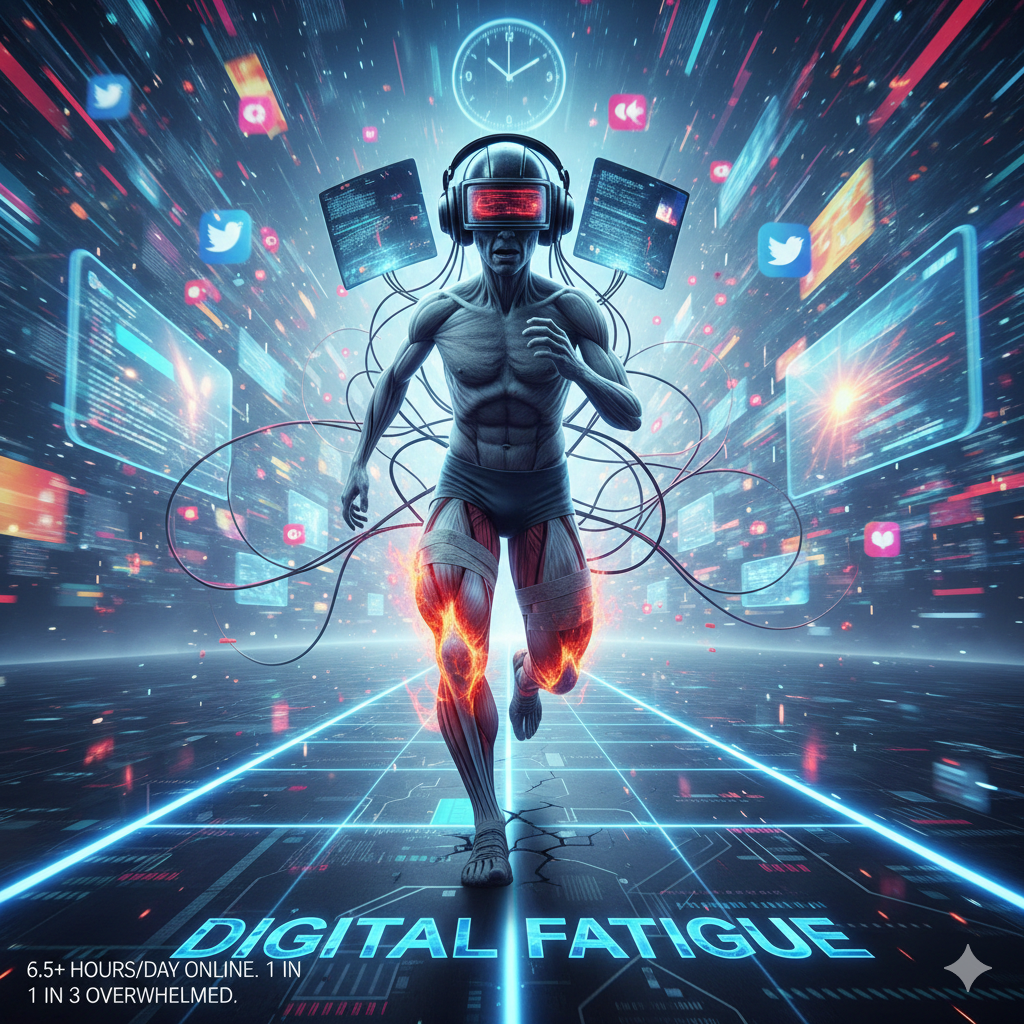
Imagine being forced to run a marathon using only two muscles in your body. The rest must remain completely still. By the end of the day, those two muscles would be torn, exhausted, and in pain, while the rest of your body would be atrophied.
That is exactly what modern life is doing to our customers.
According to the latest data, we spend more than 6.5 hours a day connected to the internet. In the United States, that number is close to 7 hours. We live under constant bombardment from pixels and notifications that overstimulate just two senses: sight and hearing.
The result is a clinical phenomenon that Marketing 6.0 identifies as Digital Fatigue. One in three people feels overwhelmed by technology. It’s not that they hate your content; it’s that their brains can’t process one more visual or auditory stimulus.
Chapter 8 of the new marketing era reveals a hard truth: the solution is not “shouting louder” on Instagram. The solution is activating the other three senses we’ve been ignoring. The future of marketing is not more digital — it’s biological.
1. The Digital Hangover: Detoxing, Vinyl, and Dumb Phones
The clearest sign that we’ve hit peak digital overload is found in the behavior of Gen Z. The generation we assumed would be eternally glued to screens is leading the counter-revolution.
The retro movement is booming. Sales of disposable film cameras have more than tripled. Vinyl records now account for 43% of all album sales. Nokia is selling more “dumb phones” — devices without apps — than it has in years.
Off-the-grid travel is also surging. Airbnb now offers filters for cabins without Wi-Fi. Disconnection has become the new luxury.
What does this tell us? Humans crave depth, texture, and presence. Digital marketing is efficient, but flat. Multisensory marketing is inefficient, but unforgettable.
2. Hacking the Brain: The Science Behind the Five Channels
To survive in the attention economy, marketers must stop thinking like advertisers and start thinking like neuroscientists. We have five entry points into the customer’s brain. If you only use two, you’re operating at 40% capacity.
A. Sight: The High-Speed Channel (and the Most Saturated)
Vision processes around 80% of all information. The brain decodes an image in just 13 milliseconds. It’s the dominant sense — and the most addicted and exhausted.
The strategy is to use sight for instinctive attraction, not deep reading. Mastercard removed its name from its logo because the red and yellow circles already said everything. Apple tilts MacBook screens at exactly 76 degrees in stores, not by accident but to trigger the urge to touch and activate the next sense: touch.
B. Hearing: The Remote Control of Mood
Sound accounts for about 10% of information, but it has a hidden superpower: tempo.
Fast music makes people move and buy faster, perfect for supermarkets and fast food. Slow music lowers heart rate and encourages lingering, ideal for jewelry stores and luxury boutiques.
Sonic branding is now essential. Brands like Mastercard and Netflix are recognizable with your eyes closed.
C. Smell: The Time Machine (The Proust Effect)
Smell bypasses rational filters and goes straight to the limbic system — emotion and memory.
Its power lies in nostalgia. Starbucks bans strong perfumes to protect the aroma of coffee. Westin Hotels uses a “White Tea” scent to relax guests, while W Hotels uses “Citron No. 5” to energize them. If your brand doesn’t smell like anything, you’re missing the chance to anchor a long-term memory.
D. Touch: The Creator of Ownership (The Endowment Effect)
Touch creates a false sense of ownership. That’s why Apple and Best Buy encourage hands-on interaction. Once you’ve felt the weight of aluminum and the smoothness of glass, putting the product back feels like a loss.
Touch also transmits human emotions — sympathy, gratitude, warmth — in ways no screen ever can.
E. Taste: The Social Glue
Taste is the most complex sense because it’s a fusion of the other four.
Brands that don’t sell food are entering the culinary space. IKEA discovered that 30% of visitors come for the meatballs, not the furniture. Food increases dwell time and creates positive social moments tied to the brand.
The New Coke failure proves the point. In blind tests, people preferred the sweeter taste. But emotionally, consumers weren’t drinking sugar — they were drinking memories.
3. How to Build a Multisensory Experience (Without Overwhelming People)
The danger of multisensory marketing is sensory overload. More stimuli does not mean a better experience.
The chapter proposes a three-step orchestration process.
Step 1: Define the Emotional Objective
What should the customer feel?
Excitement: red tones, fast music, bold flavors.
Trust: blue hues, wood or leather scents, solid and cool surfaces.
Everything must be coherent.
Step 2: Identify the Touchpoints
Multisensory experiences don’t only live in stores.
Point of sale is the main stage.
Pop-ups allow radical experimentation.
Digital spaces rely on visuals, sound, and limited haptics, especially in the metaverse.
Step 3: A Unified Narrative (The Disney Model)
Disney masters sensory congruence. Artificial popcorn scents trigger hunger. Floor textures signal zone changes. Music transitions seamlessly. Everything serves one story: “You are in a magical place.”
Your brand must do the same. If you promise sustainability visually, the texture must feel natural, not glossy plastic. Touch must confirm what sight promises.
Return to the Body to Save the Mind
Marketing 6.0 delivers a warning: we’ve reached the limit of what screens can do.
Digital fatigue is real. Click-through rates drop, attention fragments, anxiety rises. To reconnect with customers, we must return to fundamentals. Before being internet users, we are biological beings who explore the world by smelling, touching, and tasting.
The brands that will win the next decade will create sensory sanctuaries — physical or hybrid spaces where sight rests and the other senses awaken. It’s no longer about selling products. It’s about making people feel alive again.
Strategic Implementation Note with GGyess
Multisensory campaigns are far more complex than running Facebook ads. You must coordinate visual designers, sound engineers, scent specialists, interior designers, and frontline staff. If one element fails, the experience collapses.
GGyess WorkSuite acts as the conductor of this orchestra. It centralizes brand assets, coordinates physical and digital teams, and ensures narrative consistency across every touchpoint — so your team can focus on creating sensory magic.