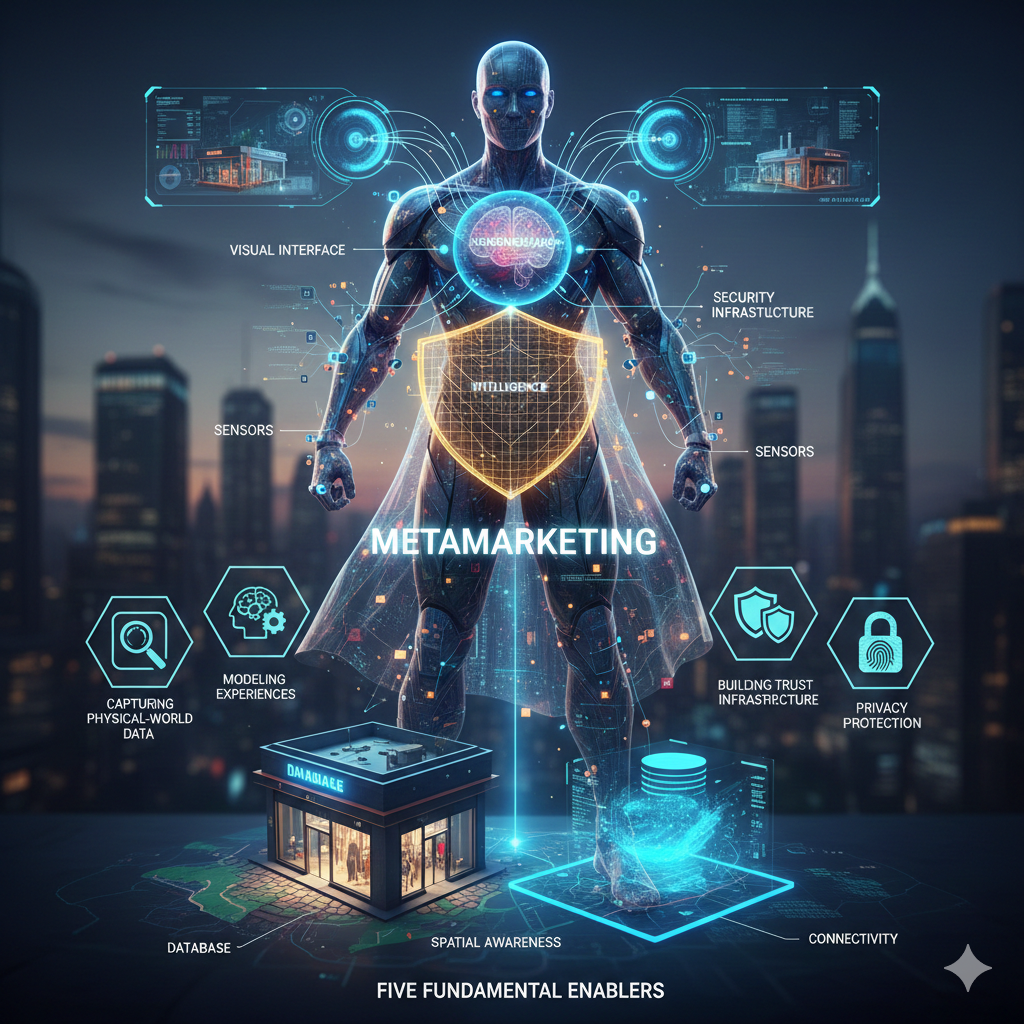
Imagine for a moment that you want to build a superhero. You need a nervous system that senses the environment (sensors), a brain that processes that information (intelligence), a map to understand where it is (spatial awareness), eyes that interpret reality (visual interface), and a security system that guarantees identity (infrastructure).
In today’s business world, that “superhero” is your brand, and the suit it must wear is called Metamarketing.
The biggest challenge companies face today is not “going digital.” That already happened in 2020. The real challenge is the post-pandemic paradox: we have more digital data than ever, yet customers have returned en masse to the physical world—a place where, traditionally, we are blind and deaf in data terms. How do you connect a three-dimensional physical store to a two-dimensional database? How do you protect privacy in an immersive world?
Chapter 5 of Marketing 6.0 delivers the technical blueprints. This is not about using technology because it’s trendy, but about integrating five fundamental enablers that together solve the three major problems of the modern era: capturing physical-world data, modeling experiences, and building trust infrastructure.
Below, we break down the five components of the engine that will power your business over the next decade.
1. The Nervous System: Internet of Things (IoT) for Data Capture
For years, e-commerce had an unfair advantage: it knew exactly where the customer clicked. Physical retail, by contrast, operated blindly. The Internet of Things (IoT) levels the playing field.
IoT is not about having a fridge tweeting. In marketing terms, IoT is the ability to digitize physical behavior. Through sensors, beacons, and smart cameras, we can turn a customer’s movement down an aisle into a usable data point—just as we turn mouse movement on a website into insight.
The power of micro-location: Major players like Walmart and Target use Bluetooth beacons to know you’re standing in front of the detergent aisle and send you a personalized offer to your app at that exact moment.
Connected creativity: It’s not just about sales; it’s about branding. The book highlights brilliant examples like Nivea’s paper wristband with sensors to track children on the beach, or Heineken’s “The Closer” bottle opener, which shuts down your work apps when you open a beer.
Most critically, IoT solves the attribution problem. For the first time, we can know whether that Instagram ad actually drove someone into your physical store. IoT turns the real world into a measurable data dashboard.
2. The Brain: Artificial Intelligence (AI) for Processing
If IoT is the nervous system capturing millions of signals, Artificial Intelligence (AI) is the brain that makes sense of them. Without AI, IoT data is just noise.
In Marketing 6.0, AI evolves from a passive analytics tool into a real-time prediction and creation engine. It’s no longer enough to deploy a basic chatbot. Leading companies use Machine Learning and Generative AI to personalize reality itself.
Invisible personalization: PepsiCo is the flagship example. They use AI to analyze social media conversations and detect flavor trends before they go viral—shrinking product development cycles from years to months. They also use AI to design perfect planograms (shelf layouts) for each retail location.
Edge AI: This is the next frontier. Instead of sending data to the cloud (slow), processing happens directly on the device (fast). Cooler Screens at Walgreens use fridges with cameras and sensors that analyze who you are (age range, gender, mood) and change the ad on the fridge door in milliseconds.
AI allows us to move from segment-based marketing (“women aged 30–40”) to individual marketing (“Ana, who is hot and in a hurry, is standing in front of the fridge right now”).
3. The Map: Spatial Computing for Experience Modeling
This is where things get futuristic. The digital world is flat (2D). The real world is volumetric (3D). Spatial Computing is the technology that allows machines to understand and manipulate three-dimensional space.
The key concept here is the Digital Twin. A digital twin is an exact virtual replica of an object, a store, or even an entire city.
Shanghai and Singapore have full digital twins to simulate traffic and disasters.
SoFi Stadium in Los Angeles uses a digital twin to manage crowds during the Super Bowl.
For marketing, this means we can simulate customer experiences before building physical spaces. Beyond planning, spatial computing enables experiences like Smart Fitting Rooms (used by Ralph Lauren and American Eagle). You enter the fitting room, the mirror “knows” what you’re wearing (via RFID sensors and computer vision), and shows how the item would look in a different color or suggests matching shoes—without you ever leaving the booth. It’s the perfect fusion of physical logistics and digital recommendation.
4. The Eyes: Augmented Reality (AR) and Virtual Reality (VR) as Interfaces
Once we have data (IoT), intelligence (AI), and a map (Spatial Computing), we need a way to present it to humans. This is where immersive interfaces come in.
It’s critical to distinguish between them, because they serve very different business purposes:
Virtual Reality (VR): Total Immersion (B2B and Training). It isolates you from the real world. It’s ideal for training and high-value sales. Walmart trains employees with VR headsets (reducing training from a full day to 15 minutes). Tesla and real estate companies use VR to let you “feel” the car or the home before buying.
Augmented Reality (AR): The Magic Layer (Mass Consumer). It overlays information onto the real world. It’s more powerful for mass marketing because it works on the smartphone everyone already carries. IKEA lets you see the sofa in your living room. L’Oréal lets you try on makeup.
Mixed Reality (MR): The Holy Grail. Where digital elements interact with the physical world. The Chipotle NHL ad, where a giant digital glove “broke” the real ice in the stadium, demonstrates the spectacle potential of this technology.
5. The Infrastructure: Blockchain for Trust and Economy
Finally, we reach the most misunderstood technology: Blockchain. Forget cryptocurrency speculation for a moment. In Marketing 6.0, Blockchain is the infrastructure of trust and ownership.
As we move deeper into AI and virtual worlds, two problems emerge:
Privacy: Who owns my data?
Ownership: If I buy a virtual T-shirt in the metaverse, is it really mine?
Blockchain solves this by being a decentralized database.
Back-end: Toyota used it to audit ad purchases and save 30% by eliminating fraudulent intermediaries. Walmart uses it to pay logistics providers without disputes.
Front-end (Metaverse): It underpins the virtual economy. Brands like Nike (.SWOOSH) and Coca-Cola are creating digital assets (NFTs) with real value. These aren’t just JPEGs; they are access keys to communities, exclusive physical products, and experiences. Blockchain enables loyalty programs that are interoperable and user-owned—not locked inside private servers.
Conclusion: This Is Not Science Fiction, It’s Survival
Chapter 5 leaves us with a clear conclusion: these technologies are not independent silos.
IoT captures the data.
Blockchain secures it.
AI processes it.
Spatial Computing contextualizes it.
AR/VR visualizes it.
The mistake many companies make is implementing only one of them—launching NFTs with no utility or installing screens in stores without sensors. The magic of Metamarketing happens when these five technologies converge to create an experience where the customer simply flows.
The future belongs to brands that manage to build this “Iron Man suit”: an invisible technological infrastructure that grants experiential superpowers to the customer.
Strategic Implementation Note
Deploying a tech stack of this magnitude—IoT sensors, AI algorithms, Blockchain assets—is a monumental management challenge. It requires IT, Marketing, Operations, and Legal teams to work as a single organism. Traditional project management falls short in the face of this complexity.
This is where GGyess WorkSuite becomes the operating system of your transformation. GGyess centralizes the management of complex technology initiatives, assigns resources, tracks critical milestones, and enables cross-functional collaboration. You can’t build the future with tools from the past—GGyess gives you the agile structure needed to orchestrate the implementation of these five technologies without losing operational control.