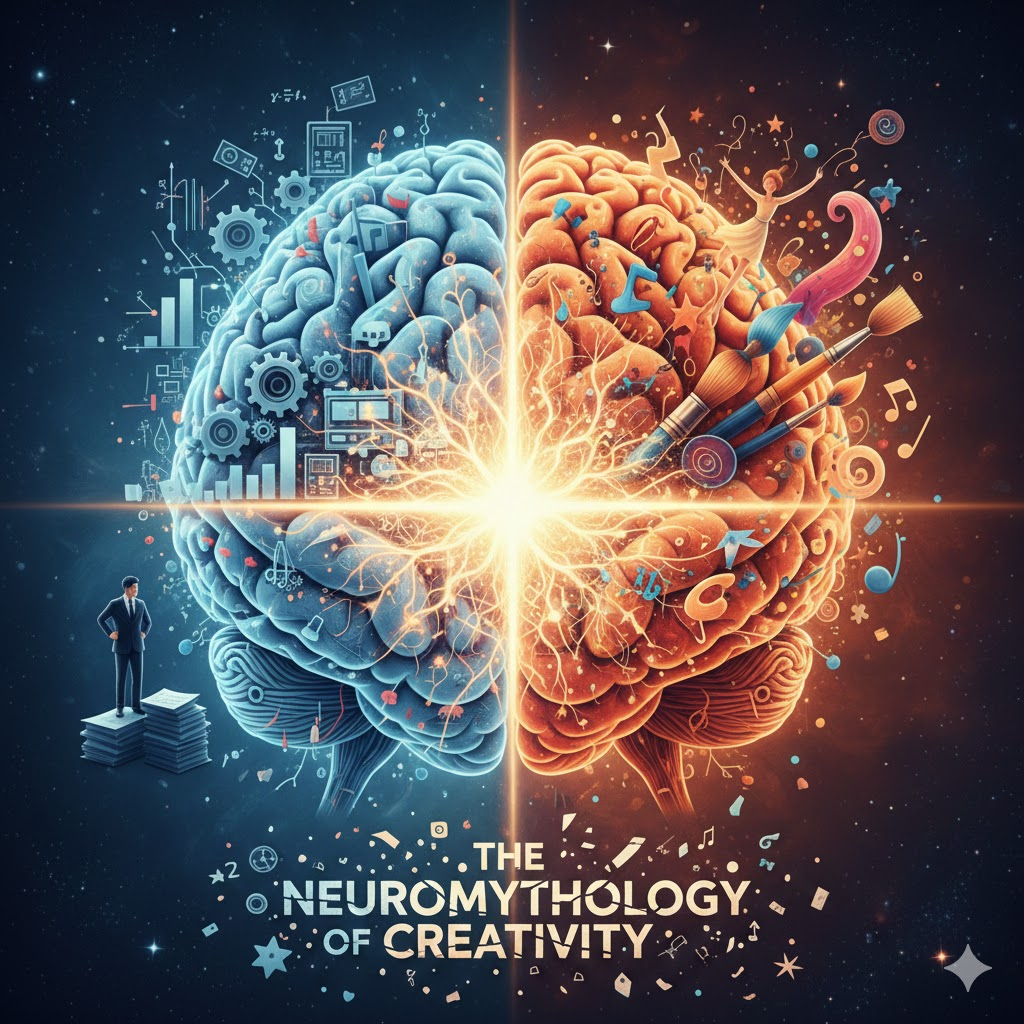
We live in a culture obsessed with labeling everything. You’re introverted or extroverted. You’re visual or auditory. And, of course, the reigning label of the corporate and artistic world: you’re “left-brained” (logical, analytical, boring) or “right-brained” (creative, emotional, free).
We love this duality because it’s simple. It’s romantic. It gives us permission to say, “I’m not good with numbers, I’m creative,” or “I have no imagination, I’m logical.” But in Chapter 2 of Creativity: The Human Brain in the Age of Innovation, Elkhonon Goldberg drops a nuclear bomb on this popular idea.
Under the title The Neuromythology of Creativity, Goldberg doesn’t just correct a scientific error; he invites us to look at the machinery of our minds through a far more sophisticated lens. If you want to understand how to truly innovate in your work or in your life, you first have to stop believing in neurological fairy tales.
1. From Neuro-Orphans to Neuro-Fads
Why do we persist in believing myths about the brain that science discarded decades ago? Goldberg opens the chapter with a fascinating reflection on how certain scientific concepts become cultural “rock stars,” while others—far more important ones—are left as “neuro-orphans.”
The idea of the “creative right brain” was born from an oversimplification of Roger Sperry’s split-brain research in the 1960s. Popular culture hijacked the finding. It was too attractive a narrative to pass up: the dualism of Dr. Jekyll and Mr. Hyde, reason versus passion, Apollo versus Dionysus—all conveniently mapped onto our cranial anatomy.
However, Goldberg argues that this “neuro-fad” has obscured the true function of the hemispheres. The real distinction is not Logic vs. Creativity, but Routine vs. Novelty.
Your right hemisphere is not the home of the artistic muses; it is the structure responsible for processing new, ambiguous information for which you have no prior strategies.
Your left hemisphere is not a bitter accountant; it is the repository of learned patterns and efficient routines.
True creativity does not occur when you “turn off” the left side to unleash the right. It happens thanks to an intense collaboration between both: the right exploring the unknown and the left providing the structures to make sense of it. Believing creativity resides in only one side is like believing music lives only on the black keys of a piano.
2. “Bad and Useless”
To understand the weight of creativity today, Goldberg takes us on a journey through time under the subheading “Bad and Useless.” Today, the word innovation is spoken with reverence in Silicon Valley boardrooms. It is the holy grail of modern capitalism. But this is a historical anomaly.
For most of human history, innovation was viewed with suspicion, fear, and even contempt. In Roman law, for example, the term novitas (novelty) often carried negative connotations, associated with social instability or sedition. A new idea was literally “bad and useless” for the established order.
Our brains evolved in that context of extreme conservatism. Biologically, we are machines designed to minimize risk and maximize prediction (routine). Creativity is, in evolutionary terms, a dangerous and costly activity. It disrupts the status quo.
This explains why, although we all claim to want to be innovative, at a subconscious level we feel a visceral resistance to real change. Innovation hurts. Innovation consumes massive amounts of metabolic energy because it forces the brain to abandon the efficient highway of routine (left hemisphere) and venture into the uncharted jungle (right hemisphere). Understanding this history helps us be more compassionate with our creative blocks: you’re not lazy—you’re fighting against millennia of evolutionary programming screaming, “Stick with what you know!”
3. Deconstructing Innovation and Creativity
If creativity is not a magical lightning bolt striking your right hemisphere, what is it? Goldberg proceeds to deconstruct the phenomenon. He asks us to stop seeing creativity as a monolithic noun and start seeing it as a verb composed of multiple executive processes.
Creativity is, in fact, a function of the frontal lobes (the brain’s executive director) orchestrating resources from across the cortex. It includes working memory, the ability to hold multiple ideas in mind at once and play with them; inhibition, the ability to suppress the obvious, automatic response (“this is how we’ve always done it”) to make room for a new one; and cognitive flexibility, the ability to shift perspectives without breaking.
Goldberg demystifies the process: innovation is the ability to identify a new pattern (right hemisphere) and quickly encode it into a usable system (left hemisphere). It is a constant cycle of novelty followed by routinization.
The creative genius is not the one who lives in perpetual chaos, but the one whose frontal lobes are robust enough to move between chaos and order at will. Innovation requires both the madness of the new idea and the discipline of logical execution. Without the latter, the former is just noise.
4. Multiple Creativities
Finally, the chapter addresses the concept of “multiple creativities.” We have made the mistake of restricting the label creative to the arts: painting, music, writing. If you’re an accountant, engineer, or logistics manager, it’s assumed you’re not creative.
Goldberg shatters this barrier. Since creativity is a process of solving new problems, it manifests in any domain where complexity exists.
There is artistic creativity, which deals with emotional and aesthetic patterns. There is scientific creativity, which deals with logical and natural patterns. There is social creativity, which allows us to navigate complex hierarchies and relationships.
What’s fascinating is that, neurologically, the underlying mechanisms are similar. A great business strategist designing a new supply chain is using the same novelty circuits and executive functions as a composer creating a symphony. By recognizing that multiple creativities exist, we democratize talent. You stop waiting for the muses to visit you and start seeing every difficult problem at work as an opportunity to exercise your innovation machinery.
The lesson of Chapter 2 is empowering: creativity is not a mystical gift reserved for a few chosen ones with a “dominant right brain.” It is a distributed, trainable neurobiological capacity that depends on your ability to manage novelty, challenge historical routine, and use your frontal lobes to conduct the orchestra of your mind.
To practice that “executive creativity” Goldberg describes—and to allow your frontal lobes to orchestrate innovation instead of drowning in administrative noise—you need tools that take on the burden of routine. GGyess WorkSuite acts as the structural support for your creative processes; by automating operational management and centralizing information, it frees your brain from working-memory fatigue, allowing you to move fluidly between novelty and order, exactly as the true neuroscience of innovation requires.