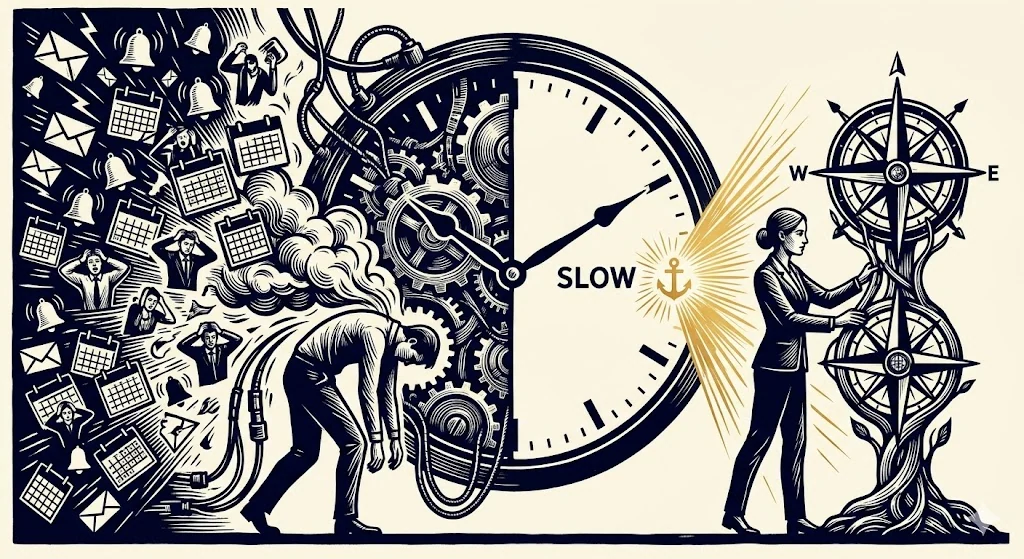

In the modern professional landscape, we are surrounded by dashboards. From the moment we wake up, wearable devices track our sleep cycles and heart rates. When we sit down at our desks, software monitors our screen time, counts the number of emails we send, tallies the tasks we cross off, and calculates the exact efficiency of our workdays. We live in an era defined by quantification, driven by the famous business adage: “If you cannot measure it, you cannot manage it.”
However, an insidious problem arises when we apply this rigid, data-obsessed philosophy to complex knowledge work. We begin to conflate the act of measuring with the act of doing. We obsess over the metrics themselves, treating them as the ultimate goal rather than a simple compass. This hyper-fixation creates a toxic cycle of anxiety, where a day only feels “successful” if the charts are green and the numbers are high. Ultimately, obsessing over daily metrics leads to profound professional burnout and a severe misalignment of our true goals.
To build a sustainable, impactful career—especially for the driven lower-middle-class professionals, emerging entrepreneurs, and creative teams who must maximize their limited resources without sacrificing their well-being—we need a new paradigm. We must learn how to measure our true productivity without becoming slaves to the very metrics designed to help us. This comprehensive guide will explore the psychological trap of vanity metrics, redefine what professional success actually looks like, and provide a holistic framework for assessing your value, momentum, and impact.
The Trap of Vanity Metrics in the Workplace
To understand why our current obsession with metrics is flawed, we must look at where these measurement systems originated. The traditional concept of productivity was born on the factory floors of the industrial revolution. In a manufacturing context, productivity is purely quantitative and entirely linear: if you produce fifty widgets in an hour, you are objectively more productive than someone who produces thirty widgets in the same timeframe.
When the economy shifted toward knowledge work—designing marketing strategies, writing code, consulting with clients, and managing complex projects—we lacked a new, nuanced way to measure success. Consequently, we defaulted to the outdated industrial metrics of volume and speed. We began measuring hours logged at a desk, lines of code written, slides generated, and emails answered.
These are what we call vanity metrics. They look incredibly impressive on a performance review or a daily dashboard, but they frequently have absolutely no correlation with the actual value generated for the business. You can spend eight exhausting hours furiously replying to non-essential emails and attending poorly planned meetings. Your metrics will suggest you were highly productive, but your actual impact on your core objectives will be zero.
When you obsess over vanity metrics, you subconsciously gamify your workday. You start chasing the quick dopamine hit of checking off minor, insignificant tasks just to make your numbers look better, while indefinitely procrastinating on the deep, challenging, and meaningful work that truly moves the needle. This is the illusion of motion masquerading as progress.
Shifting the Focus: From Outputs to Outcomes
The first step in breaking free from metric obsession is changing your professional vocabulary. You must transition your focus from outputs to outcomes.
An output is simply the tangible thing you produced: a 10-page report, a newly designed logo, a published landing page, or a scheduled meeting.
An outcome is the actual, real-world impact that output had: the report secured a new round of funding, the logo increased brand recognition by 15%, the landing page converted 50 new clients, or the meeting resolved a critical bottleneck that was delaying a launch.
Outputs are easy to measure, which is exactly why micromanagers and anxious professionals obsess over them. Outcomes, on the other hand, are much harder to quantify immediately, but they are the only things that genuinely matter.
To measure your productivity without losing your mind, you must start evaluating your days based on strategic alignment rather than sheer volume. Ask yourself: Did my actions today contribute directly to a high-level outcome? If you spent four uninterrupted hours wrestling with a complex structural problem for a client’s business model and finally found the solution, you only completed “one” task. By the standard of vanity metrics, it was a low-productivity day. By the standard of outcomes, it was a massively successful and highly productive day.
Qualitative Indicators of True Productivity
If we step away from counting tasks and tracking every minute of our time, how do we actually know if we are doing a good job? The secret lies in embracing qualitative indicators. These are highly subjective, internal metrics that tell you far more about the sustainability and effectiveness of your work than any pie chart ever could.
Here are the primary qualitative indicators you should begin to monitor:
1. The Presence of Flow
Flow is a psychological state of deep, effortless concentration where you become completely immersed in a challenging task. Time distorts, external distractions fade away, and your execution peaks. You cannot force yourself into a flow state while frantically multitasking or obsessing over a ticking clock. If you are experiencing regular periods of flow throughout your week, it is the highest possible indicator that you are engaging in meaningful, highly productive deep work.
2. Energy Management vs. Time Management
Obsessive metric tracking assumes that every hour of the day is biologically equal. It assumes that you can produce the exact same quality of work at 4:00 PM on a Friday as you can at 9:00 AM on a Tuesday. True productivity requires respecting your natural biological rhythms. A highly productive professional manages their energy, not just their time. If you reach the end of the week feeling a sense of deep satisfaction and healthy fatigue—rather than completely hollowed out, anxious, and depleted—you are operating at a sustainable, highly productive pace.
3. Strategic Clarity
When you are genuinely productive, you have absolute clarity on your priorities. You know exactly what you are doing, why you are doing it, and how it connects to your long-term vision. Conversely, when you are obsessing over metrics, you often feel scattered, confused, and reactive, constantly putting out fires instead of building the foundation. If your mind feels clear and your daily actions feel intentional, your productivity is exactly where it needs to be.
A Healthier Framework for Measurement
Letting go of metric obsession does not mean abandoning accountability entirely. You still need a framework to ensure you are moving forward. The goal is to build a measurement system that serves you, rather than a system that enslaves you.
Establish Weekly Intentions, Not Daily Quotas:
Daily task quotas are rigid and unforgiving. They do not account for sudden emergencies, creative blocks, or the unpredictable nature of knowledge work. Instead, set three to five major intentions for the entire week. As long as those core, high-impact tasks are accomplished by Friday afternoon, the exact day or hour they were completed is entirely irrelevant.
Keep a “Done” List:
To-do lists are inherently anxiety-inducing because they exclusively highlight what you have failed to do so far. To balance your psychological state, keep a “done” list. At the end of every day, write down the most meaningful things you accomplished. This practice rewires your brain to focus on your progress and value, rather than fixating on the never-ending backlog of pending tasks.
Conduct an Honest Friday Review:
At the end of your work week, before you shut your computer down, conduct a simple, qualitative review. Ask yourself three questions:
- What was the most impactful outcome I achieved this week?
- What systemic bottlenecks or distractions slowed me down?
- How can I adjust my environment next week to facilitate more deep work?This holistic, reflective approach provides vastly more insight into your performance than tracking your keystrokes or analyzing your exact time-in-app.
Redefining Your Workflow with GGyess
To truly shift your focus from obsessive metrics to meaningful outcomes, you must operate within a digital environment that supports clarity, intentionality, and focus. A cluttered workspace filled with unnecessary tracking tools only exacerbates anxiety. This is precisely why we have completely evolved GGyess.
We understand that true productivity is about seamless execution, not vanity metrics. To reflect this, GGyess is no longer fragmented into separate Social and Master suites. We have intentionally stripped away the noise to provide one singular, uncompromising productivity powerhouse: the ultimate GGyess workspace. It is everything you need to plan, organize, and deliver your most important work, without switching between a dozen different apps.
At the core of this transformation is WorkHub (formerly Planily), your central command center. WorkHub is designed to give you absolute control over your projects without micromanaging your every click. Effortlessly manage your tasks with an intuitive and fast system, creating custom views of any project—whether you prefer Gantt, Kanban, Calendar, or Table formats—with your own filters, groups, and sorts. You can track progress in these versatile views to always know exactly where you are and what the next strategic move is.
To ensure your work system is truly all-in-one and deeply collaborative, GGyess has been significantly upgraded with powerful new features designed for outcome-based teams:
- Native Video Calls: Say goodbye to endless context switching. You can now launch high-quality video calls directly within your workspace to discuss strategies, review creative assets, and align your team in real-time.
- Smart Appointments: Coordinate seamlessly with clients and team members. Our integrated appointment system ensures that your schedule is respected and your collaborative blocks are perfectly timed.
- Automated Reminders: Offload the cognitive burden of tracking deadlines. GGyess provides intelligent, customizable reminders to keep your momentum going without requiring you to constantly check a dashboard.
Furthermore, GGyess handles the heavy lifting of project setup so you can focus on the work only you can do. You can use the built-in AI assistant to instantly turn your ideas or project briefs into prioritized, detailed, and actionable tasks. The AI automatically breaks down requirements, suggests deadlines, and even auto-assigns tasks based on your team’s custom roles and current workload.
Productivity is not a high score you achieve on a screen; it is the tangible value you bring to your projects, your clients, and your team. Stop obsessing over the metrics that drain your energy, and start focusing on the outcomes that define your success. Start for free today, and let GGyess turn your chaos into profound, measurable clarity.
Put your next project in motion.
Explore GGyess and find a place to organize the work with your team.
Explore GGyess ↗