In our hyper-connected, always-on modern economy, burnout has transitioned from a rare occupational hazard to a widespread systemic crisis. The World Health Organization now officially classifies burnout as an occupational phenomenon resulting from chronic workplace stress that has not been successfully managed. It is characterized by three distinct dimensions: profound feelings of energy depletion or exhaustion, increased mental distance or cynicism related to one’s job, and a noticeable reduction in professional efficacy.
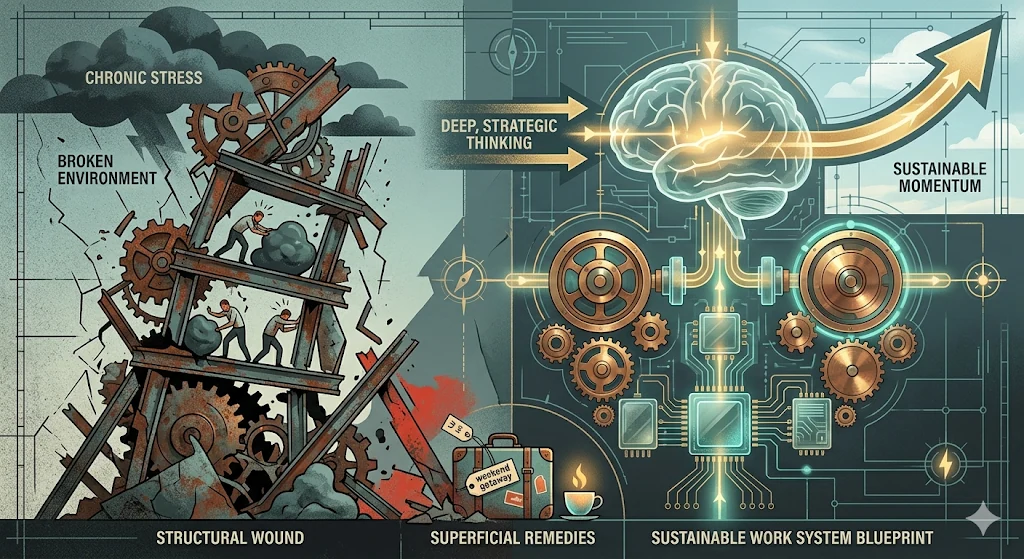
Many professionals attempt to cure burnout with superficial remedies: a weekend getaway, a new meditation app, or an extra cup of coffee. However, these are temporary bandages applied to a structural wound. You cannot “vacation” your way out of burnout if the environment you return to on Monday morning is fundamentally broken. The true, lasting antidote to burnout is not finding better ways to recover from exhaustion; it is engineering a sustainable system of work that prevents that exhaustion from occurring in the first place.
Building a sustainable work system requires a paradigm shift. It demands that we stop treating our minds as hard drives with infinite storage and start treating them as processors optimized for deep, creative, and strategic thinking. In this guide, we will explore the structural causes of burnout and lay out a comprehensive blueprint for designing a professional life that thrives on steady, sustainable momentum rather than frantic, anxiety-driven sprints.
The Anatomy of Modern Burnout
To build an effective antidote, we must first understand the poison. Modern burnout is rarely the result of a single, catastrophic deadline. Instead, it is the death by a thousand cuts. It is the steady accumulation of open cognitive loops, undefined expectations, and the relentless friction of navigating a chaotic digital workspace.
One of the primary drivers of burnout is cognitive overload. The human brain is a remarkable engine for generating ideas, solving complex problems, and designing innovative solutions. It is, however, a terrible office assistant. When you use your working memory to store your daily to-do list, remember follow-up emails, and track project deadlines, you consume an enormous amount of mental energy. This “background processing” drains your cognitive battery long before you even attempt to do meaningful work.
Another massive contributor is context switching. The modern knowledge worker spends their day jumping between an inbox, a team chat, a project management board, and their actual work. Every time you switch contexts, your brain incurs a “switching penalty”—a loss of time and focus as it recalibrates to the new environment. Research shows that it can take up to 23 minutes to fully regain deep focus after a single interruption. When your entire day consists of interruptions, it is no wonder you feel exhausted while simultaneously feeling like you accomplished nothing.
Finally, burnout is fueled by a lack of boundaries. When our offices live inside our smartphones, the physical boundary between “work” and “life” evaporates. Without intentional, hard boundaries, work expands to fill every available hour of the day, leaving no time for the deep rest required to sustain high-level performance.
Pillar 1: Total Cognitive Offloading
The foundation of a sustainable work system is total cognitive offloading. You must ruthlessly extract every single task, idea, deadline, and commitment out of your head and place it into a secure, reliable external system.
If your brain trusts that the external system is capturing everything, it will finally let go. The anxiety of “forgetting something important” dissipates, freeing up massive amounts of mental bandwidth for actual execution.
- Capture Everything: Create a habit of immediate capture. Whether it is a brilliant strategic insight or a reminder to buy printer paper, put it into your system the moment it crosses your mind.
- Clarify and Organize: A captured task is useless if it is vague. Process your captured items regularly. Turn vague ideas like “Launch new campaign” into actionable, distinct steps with clear deadlines and assigned owners.
- Review Regularly: A system is only as good as the trust you place in it. Conduct a thorough weekly review to clean up your tasks, recalibrate your priorities, and prepare for the week ahead.
Pillar 2: Frictionless Delegation and Collaboration
No sustainable system can be built in a silo. Burnout disproportionately affects leaders and managers who attempt to carry the entire weight of a project on their own shoulders.
Effective, sustainable work requires relying on the collective strengths of your colleagues. However, the way you collaborate dictates whether your team is a source of leverage or a source of stress. When delegating multifaceted creative tasks to a team—whether you are coordinating with colleagues like Josué, Keila, Martín, or Brandon—relying on fragmented text messages and endless email threads is a guaranteed recipe for leadership burnout.
A sustainable system demands centralized, transparent communication. Every task must have a single source of truth: one place where the brief, the files, the deadlines, and the discussions live. When team members can independently find the information they need and understand how their specific task fits into the larger puzzle, the friction of management drops to near zero.
Pillar 3: Designing Hard Boundaries
A sustainable engine cannot run at maximum RPM indefinitely. It requires structured periods of cooling and maintenance. In the context of a work system, this means establishing and fiercely protecting hard boundaries.
- Temporal Boundaries: Define strict working hours. If your workday ends at 6:00 PM, let that be a hard stop. Communicate these hours clearly to your clients and your team, and hold yourself accountable to them.
- Digital Boundaries: Disable non-essential notifications on your devices. You do not need to be alerted every time someone “likes” a message or uploads a file. Reclaim control of your attention by checking your communications on your schedule, not the algorithm’s.
- The Shutdown Ritual: Create a psychological bridge between your workday and your personal life. At the end of the day, spend ten minutes reviewing what you accomplished, planning your top priorities for tomorrow, and explicitly telling your brain that work is over.
Executing the Sustainable System with GGyess
The greatest barrier to building a sustainable work system is often the very software designed to help us. Juggling a half-dozen different applications for chatting, task tracking, file storage, and video conferencing creates the exact context-switching friction that leads directly to burnout.
To truly cure burnout, you need a unified, quiet, and hyper-efficient environment. That is the exact philosophy behind the newly evolved GGyess.
We have fundamentally re-engineered our platform to eliminate the noise. GGyess is no longer divided into fragmented suites; we have completely removed the SocialSuite and MasterSuite to provide one singular, uncompromising productivity workspace. It is everything you need to plan, organize, and deliver, all in one place, without the exhausting distraction of social media metrics or fragmented toolsets.
At the very core of this streamlined experience is WorkHub (the powerful, redesigned successor to Planily). WorkHub is your ultimate command center. It allows you to visualize your projects exactly how your brain processes them best, seamlessly switching between Kanban, Gantt, Calendar, or Table views.
To build a truly frictionless and sustainable system, GGyess now features powerful new native integrations designed to keep you in the flow:
- Integrated Video Calls: Connect with your team face-to-face instantly without ever leaving your workspace. No more hunting for third-party links or switching apps.
- Smart Appointments: Manage your calendar, protect your deep work blocks, and schedule critical team syncs directly within the platform.
- Automated Reminders: Offload the anxiety of remembering deadlines completely. GGyess will proactively alert you and your team to upcoming milestones, ensuring nothing falls through the cracks.
Furthermore, GGyess continues to leverage its built-in AI assistant to eliminate manual administrative overhead. You can simply write what you need done in plain language, and the AI will instantly break it down into detailed, actionable tasks with deadlines, priorities, and assigned owners.
Burnout is not inevitable. By replacing the chaos of scattered tools with a single, highly structured, and deeply intuitive workspace, you can protect your energy and reclaim your focus. Start for free today, and let GGyess be the foundation of your sustainable success.
Put your next project in motion.
Explore GGyess and find a place to organize the work with your team.
Explore GGyess ↗