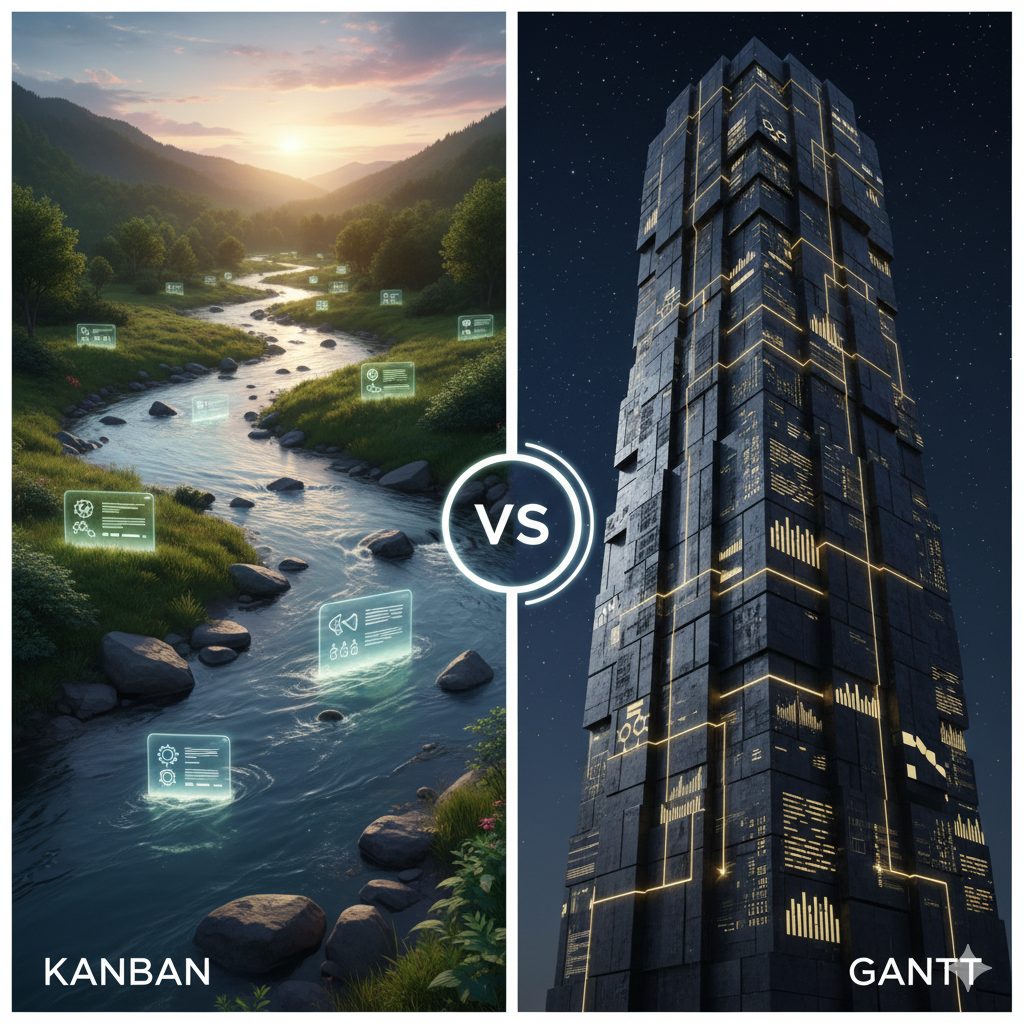
In today’s business ecosystem, where speed is the primary currency and project complexity grows exponentially, choosing the right framework is not a trivial decision; it is a strategic one. The eternal battle between Kanban and Gantt is not simply about choosing a tool, but about adopting a philosophy on how time, effort, and resources should interact to generate value.
Does your team need the flexibility of a flowing river or the structure of a well-founded building? To answer this, we must break down both concepts from their foundations.
1. Kanban: The Philosophy of Continuous Flow
Born on the Toyota assembly lines in the 1940s, the Kanban system (which in Japanese means “visual card”) revolutionized manufacturing before conquering the worlds of software development and marketing.
The Pillars of Kanban
Kanban is based on work visualization and flow optimization. Unlike other methods, it does not prescribe fixed roles or meetings; it adapts to what you already have and seeks incremental improvement.
- Work Visualization: The Kanban board is the heart of the system. Each task is a card that travels through columns (typically: To Do, In Progress, Review, and Done).
- Work in Progress (WIP) Limits: This is the critical differentiator. Kanban limits how many tasks can be in a specific column at the same time. This prevents bottlenecks and ensures the team finishes what they start before taking on something new.
- Flow Management: The goal is not just to “work,” but for work to move constantly and predictably.
Note: Kanban is ideal for environments where priorities change frequently and work arrives unpredictably.
2. Gantt Charts: The Architecture of Time
If Kanban is the flow, the Gantt Chart is the map. Popularized by Henry Gantt in the early 20th century, this method became the gold standard for large-scale engineering and construction projects.
The Pillars of Gantt
A Gantt chart is a visual representation of a project schedule. It uses horizontal bars to show the duration of each task along a timeline.
- Task Dependencies: Gantt excels at showing which tasks depend on others. For example, “I cannot paint the wall (Task B) until I finish building it (Task A).”
- Milestones: Critical checkpoints that mark the end of a major phase.
- Critical Path: It allows for the identification of the sequence of tasks that determines the total duration of the project. If a task on the critical path is delayed, the entire project is delayed.
3. Comparison: Flexibility vs. Structure
To decide which is better for your team, it is useful to observe how they handle the main variables of project management:
| Feature | Kanban | Gantt |
| Primary Focus | Workflow and continuous delivery. | Schedules and dependencies. |
| Flexibility | High. Tasks can be easily reordered. | Low. Changing one date can affect the entire plan. |
| Visualization | Column board (vertical). | Timeline (horizontal). |
| Ideal for… | Maintenance, support, agile teams. | Product launches, construction, events. |
| Roles | Does not require specific roles. | Often requires a dedicated Project Manager. |
4. When to Choose Kanban?
Kanban shines in teams that value agility. It is the winning choice if:
- The work is repetitive or continuous: Technical support teams or content creation where the task flow is constant.
- Priorities change rapidly: If your client tends to change their mind every week, Kanban allows you to pivot without destroying an entire schedule.
- You seek to reduce team stress: By limiting WIP, you protect collaborators from workload saturation.
5. When to Choose Gantt?
The Gantt Chart is indispensable when predictability is the key factor. Choose it if:
- You have immovable deadlines: For example, organizing a trade fair that occurs on a specific date.
- There are complex dependencies: Projects where multiple teams must coordinate chronologically (design first, then development, then QA).
- You need to manage long-term resources and budgets: Gantt allows you to visualize how long resources will be occupied before the project even begins.
6. The Problem with the “Perfect Tool”
Often, teams make the mistake of choosing a methodology and then forcing their processes to fit into a complicated tool. This generates what we call “operational friction”: spending more time updating the tool than doing the actual work.
Many current project management systems are too heavy. They have thousands of features you will never use and end up becoming a labyrinth of clicks. This is where simplicity becomes a competitive advantage.
7. Evolution: From Chaos to Clarity with GGyess
After analyzing the structure of Gantt and the fluidity of Kanban, you realize that what your team truly needs is results, not more digital bureaucracy. This is where a solution that eliminates the noise comes into play: GGyess.
GGyess is born from the need to simplify project management. While other tools force you to sit through hours of tutorials, GGyess focuses on allowing your team to start producing from minute one.
Why is GGyess the natural transition?
If you have tried to implement Kanban or Gantt in spreadsheets or complex software, you have noticed that information tends to scatter. GGyess centralizes communication and execution without unnecessary complications.
- Intuitive Implementation: GGyess takes the best of task visualization so that any team member, regardless of their technical level, knows what to do next.
- Focus on Execution: Unlike traditional Gantt charts that can become obsolete two days after being created, GGyess allows planning to live and breathe with the team.
- Elimination of Analysis Paralysis: GGyess is designed for teams that prefer doing over over-planning. It provides an environment where clarity of objectives is the priority.
At the end of the day, the debate between Kanban and Gantt is secondary to the question: Does my team have what it needs to finish its tasks? GGyess answers this with a clean interface and an architecture designed for real productivity.
Conclusion
There is no “one size fits all” answer for every team. The best methodology is the one your team actually uses and that doesn’t add mental burden. You can start with a Gantt structure to define your major milestones and use the agility of a Kanban for the day-to-day.
However, if you are tired of tools that promise a lot but only deliver more administrative work, it is time to simplify. The transition to GGyess represents a commitment to pure efficiency, allowing you to manage your team’s workflow with an ease that traditional tools simply cannot offer.