
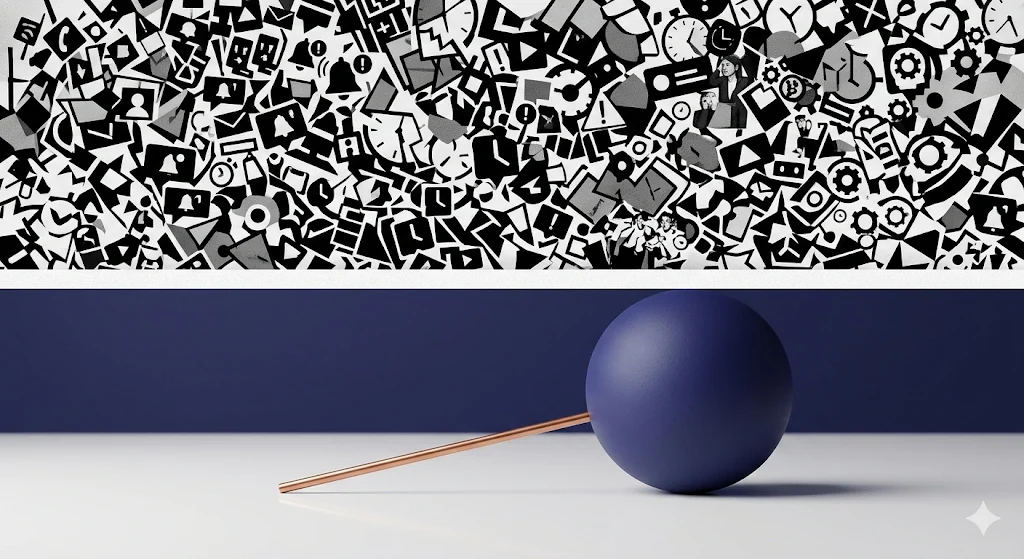
Welcome to the age of relentless accumulation. In our modern professional landscape, there is a pervasive and deeply ingrained belief that more is inherently better. We are constantly pressured to take on more projects, attend more meetings, download more applications, and cram more tasks into our already overflowing schedules. This culture of constant busyness equates sheer volume with value, leading professionals to believe that exhaustion is simply the price of success. However, this toxic mindset inevitably leads to a state of chronic overwhelm, profound burnout, and a paradoxical decrease in actual, meaningful output. When your attention is scattered across a hundred different directions, you are effectively moving nowhere.
The antidote to this modern epidemic is a radical paradigm shift: Minimalist Productivity. Minimalist productivity is not about doing less because you are lazy or unmotivated; it is about doing less so that you can achieve exponentially more. It is the intentional and ruthless elimination of the non-essential, allowing you to focus your finite time, energy, and cognitive resources on the vital few tasks that truly move the needle. In this comprehensive guide, we will explore the core philosophies of minimalist productivity, the psychological toll of digital clutter, and actionable strategies to simplify your workflow and reclaim your professional life.
The Philosophy of Essentialism
At the very core of minimalist productivity lies the concept of essentialism. Essentialism is not merely a time-management strategy; it is a systematic discipline for identifying what is absolutely necessary and eliminating everything else. This philosophy is deeply rooted in the Pareto Principle, commonly known as the 80/20 rule. In almost every professional scenario, roughly 80 percent of your desired outcomes are generated by a mere 20 percent of your inputs or efforts.
The vast majority of the tasks on your to-do list—the endless email chains, the recurring status update meetings, the administrative busywork—fall into the trivial 80 percent that yields minimal real-world value. The minimalist worker recognizes this asymmetry and fundamentally rejects the idea that all tasks are created equal. Instead of trying to optimize their workflow to fit more trivial tasks into the day, they focus all their optimization efforts on identifying their vital 20 percent.
Once these high-leverage activities are identified, the minimalist directs intense, unbroken focus toward them. They understand that creating one exceptional piece of strategic work is infinitely more valuable than rushing through twenty mediocre administrative chores. By obsessing over the essential, you stop operating in a state of constant, panicked reaction and begin operating from a place of calm, strategic intention.
The Cognitive Cost of Multitasking
One of the greatest enemies of minimalist productivity is the persistent myth of multitasking. For decades, the corporate world has glorified the ability to juggle multiple tasks simultaneously as a highly desirable skill. However, modern neuroscience has definitively proven that the human brain is physically incapable of true multitasking when it comes to complex cognitive processes. What we perceive as multitasking is actually rapid context switching—our brains frantically darting back and forth between different points of focus.
Every single time you switch your attention from a deep strategic report to a quick instant message, and then back again, you incur a severe cognitive penalty known as “attention residue.” A fragment of your brain’s processing power remains stuck on the previous task, severely degrading your cognitive capacity, creativity, and accuracy for the current task.
This continuous fragmentation of attention is exhausting. It is the primary reason you can spend nine hours sitting at a desk, feel entirely depleted by the end of the day, yet feel as though you accomplished absolutely nothing of substance. Minimalist productivity demands a return to single-tasking. It requires the discipline to choose one single, vital objective, close every other browser tab, silence your phone, and dive into a state of deep, uninterrupted work until the task is absolutely complete.
Digital Minimalism in the Workspace
You cannot cultivate a clear, focused mind if your digital environment is a chaotic, cluttered mess. The modern knowledge worker is burdened by an overwhelming sprawl of software. Teams routinely use one application for messaging, another for email, a third for project management, a fourth for video conferencing, and a fifth for document storage.
This fragmented digital ecosystem creates a massive amount of “work about work”—the meta-work required just to coordinate and manage the actual work. You spend hours searching for lost files across different platforms, trying to remember where a specific conversation took place, and dealing with an endless barrage of notifications from a dozen different sources.
Digital minimalism requires you to ruthlessly audit your digital toolstack. Just as you would declutter a physical desk, you must declutter your digital workspace. Eliminate redundant applications, turn off all non-essential push notifications, and strive to consolidate your workflow into as few platforms as possible. A minimalist digital environment is quiet, intentional, and structured. It operates in the background, quietly supporting your deep work rather than constantly demanding your immediate attention.
The Power of the Positive ‘No’
The most powerful tool in the minimalist productivity arsenal is not a sophisticated application or a complex scheduling matrix; it is the simple, two-letter word: “No.” Every time you say “yes” to a non-essential request, a low-priority project, or a meeting that lacks a clear agenda, you are simultaneously saying “no” to your most important priorities.
Your time and energy are finite, zero-sum resources. You cannot magically create more hours in the day, which means every new commitment actively steals resources from your existing ones. Minimalist productivity requires you to become fiercely protective of your boundaries. You must develop the courage to decline requests that do not align with your core objectives.
This is often uncomfortable, as we are socially conditioned to please others and demonstrate our value through constant availability. However, a respectful, well-reasoned “no” is the ultimate act of professional integrity. It demonstrates that you respect your own time and that you are deeply committed to delivering excellence on your primary responsibilities. When you filter out the noise of constant requests, you create the vast, empty blocks of time necessary to engage in transformative deep work.
The Psychological Benefits of Doing Less
The psychological toll of the “more is more” mentality cannot be overstated. When you are perpetually drowning in tasks, your brain remains in a constant state of low-grade fight-or-flight arousal. This chronic stress elevates cortisol levels, leading to anxiety, sleep disruption, and eventually, total professional burnout.
Minimalist productivity acts as a powerful psychological intervention. By consciously choosing to engage with fewer tasks, you regain a profound sense of agency and control over your professional life. You transform from a passive victim of your inbox into an active architect of your career. This shift in your locus of control is incredibly empowering and drastically reduces daily anxiety.
Furthermore, minimalist productivity allows for the genuine cultivation of craftsmanship. When you are not rushing frantically to meet fifty arbitrary deadlines, you have the necessary breathing room to obsess over the quality and details of your work. You can take absolute pride in your output, knowing that it represents the absolute best of your abilities rather than a rushed, frantic compromise. This return to craftsmanship fosters a deep sense of professional fulfillment and intrinsic motivation that superficial vanity metrics can never provide.
Designing a Minimalist Daily Routine
Translating the philosophy of minimalism into daily execution requires structured, intentional habits. The first step is to abandon the traditional, endless to-do list. A list of thirty tasks is not a productivity tool; it is a recipe for anxiety and paralysis.
Instead, adopt the “Rule of Three.” At the beginning of each workday, before you open your email or check your messages, identify the three most important outcomes for the day. If you accomplished nothing else besides these three tasks, would you consider the day a success? Write them down and pursue them relentlessly.
Second, implement strict time-blocking. Divide your day into distinct blocks of time dedicated to specific types of work. Create rigid boundaries around your “deep work” blocks, treating them with the same unshakeable respect you would afford a high-stakes meeting with your most important client. During these blocks, disconnect completely from the digital world.
Finally, embrace the weekly purge. At the end of each week, review your outstanding commitments. If a task has been lingering on your list for weeks without any progress, confront it honestly. Does it actually need to be done? If not, delete it permanently and free your mind from the heavy burden of unfulfilled, trivial obligations.
GGyess: The Ultimate Minimalist Workspace
To successfully implement minimalist productivity, you need a digital environment that inherently supports focus, simplicity, and consolidation. A cluttered workspace filled with disconnected tools is the absolute antithesis of deep work. This is precisely why GGyess has evolved into the ultimate, streamlined productivity platform.
We understand that true productivity is about doing the essential work without friction. Therefore, we have undergone a massive update to align perfectly with minimalist principles. GGyess no longer features the fragmented SocialSuite or MasterSuite; we have eliminated the excess to bring you a singular, highly focused platform known simply as GGyess. It is everything you need to manage your projects, your tasks, and your teams, with absolutely none of the noise.
At the core of this minimalist ecosystem is WorkHub (formerly known as Planily), your unified command center. WorkHub allows you to visualize your projects cleanly through your choice of Kanban, Gantt, Calendar, or Table views, ensuring you only see what is strategically necessary at any given moment. In the spirit of doing less to achieve more, we have deliberately removed complex, overly rigid features—including the old One-Thing mode—to keep your workflow beautifully fluid and intuitive.
To prevent the severe cognitive drain of context switching and tool sprawl, GGyess now natively incorporates high-quality video calls directly within the platform. This allows you to collaborate face-to-face and resolve complex issues without ever leaving your workspace. We have also introduced a powerful appointments system and fully automated reminders to carry the administrative burden of scheduling and tracking deadlines entirely for you.
Furthermore, GGyess continues to leverage its powerful built-in AI assistant to handle the busywork: simply describe your project in plain language, and the AI will instantly break it down into actionable tasks, set realistic deadlines, and assign roles based on team workload, freeing you to focus entirely on high-level execution. By consolidating your entire operational workflow into one quiet, efficient space, GGyess officially replaces the chaos of scattered tools and becomes the silent engine of your minimalist success. Start doing less to achieve more today with GGyess.
Put your next project in motion.
Explore GGyess and find a place to organize the work with your team.
Explore GGyess ↗