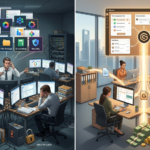
Picture the following sports scene. You’re in the Olympic final of the eight-person rowing event with a coxswain. In your boat, you have the eight strongest, most disciplined, and most motivated athletes in the world. Their muscles are tense, they’re ready to give everything, and when the starting gun fires, they begin rowing with tremendous force.
But there’s one small problem: the rower at the bow is trying to go north, the one at the stern thinks the finish line is south, three of them are rowing at a frantic pace of 60 strokes per minute, and the other three are moving at a calm pace of 30.
What happens to the boat?
Despite the immense effort, the sweat, and the undeniable ability of the athletes, the boat doesn’t move toward the finish line. It stays in the middle of the lake, spinning violently in circles until the rowers collapse from exhaustion without advancing even a hundred meters.
In the business world, we don’t call this a “runaway boat”; we call it lack of team alignment.
It’s one of the most painful paradoxes of collaborative work: you can have the most talented people in the industry working ten hours a day, delivering tasks nonstop, and feeling exhausted by the end of the week—but when you look at the company’s quarterly results, the needle hasn’t moved. There’s a lot of motion, but zero progress.
Today we’re going to step into the boat, understand why teams end up rowing in opposite directions, and discover how to synchronize efforts so work flows across the water at unstoppable speed.
The Illusion of Alignment: Why We End Up Spinning in Circles
Most business leaders assume that because they held a planning meeting in January and presented a PowerPoint with the “Goals of the Year,” the entire team is magically aligned. This is the illusion of alignment.
In reality, that presentation is forgotten the next day when inboxes fill with urgent emails and clients start calling. The team switches into survival mode, and the bigger vision fragments.
These are the three main reasons your boat starts spinning in circles:
1. The Silo Syndrome (Rowing Blindfolded)
The marketing department has the goal of “Getting 10,000 new leads.” The sales department has the goal of “Closing high-value corporate deals.” Marketing launches massive low-cost campaigns to inflate their numbers (achieving their objective), but they deliver to Sales a list of prospects with no budget to buy (ruining Sales’ objective).
Both teams rowed hard, but because they lacked visibility into how their work affected the person next to them, the effort canceled itself out.
2. The Trap of “Personal Efficiency” vs. “Team Efficiency”
We have a toxic obsession with checking items off our individual to-do lists. If a programmer finishes their 10 tasks for the day, they go home feeling like a champion. But if those 10 tasks were not the critical priority the design team was waiting for in order to move forward, that programmer’s “productivity” actually delayed the overall project.
The sum of unsynchronized individual efficiencies does not create an efficient team.
3. The Missing Voice of the Coxswain (Changing Priorities)
In a rowing boat, the only person who doesn’t row is the coxswain. Their job is to look ahead, set the rhythm by shouting “One, two, one, two!”, and ensure the direction.
In many companies, the project leader changes direction every day based on the latest email they received. On Monday they ask everyone to row toward launching Product A; on Wednesday they panic and tell everyone to shift toward Campaign B. The team, dizzy and unsure what the real “North” is, simply stops rowing with conviction.
Synchronization: The Difference Between Chaos and Flow
In rowing, just like in business, success is not about brute force—it’s about synchronization. And synchronization has two non-negotiable components: Direction (where we’re going) and Rhythm (the pace at which we connect our efforts).
If you want your team to stop spinning in circles and start winning races, you must implement a system that aligns both components with the daily work of every collaborator. Here is the roadmap to achieve it.
Step 1: Translate the Big Goal into Daily Tasks (The Line of Sight)
The problem with big corporate goals (e.g., “Increase customer retention by 20%”) is that they’re too abstract for the average employee. When a designer sits down to create a banner on Tuesday morning, they don’t know how that banner connects to the 20% retention goal.
To align your team, you must create an unbreakable line of sight. Every task, no matter how small, must be anchored to a larger objective. The designer is not just “making a banner”; they are “creating the visual asset for the loyalty campaign that will help us retain our best customers.”
When people understand the why behind their daily work, operational decisions automatically align with strategic goals.
Step 2: One Boat, One Board (Visual Centralization)
If the development team organizes their work in a complex tool that only they understand, the design team uses sticky notes on the wall, and leadership relies on a static Excel file, the boat is split into three pieces.
True collaborative alignment requires a Single Source of Truth. A central space where any member of the company—from intern to CEO—can enter and see the complete map.
If everyone sees the same board, it becomes impossible for someone to start rowing in the wrong direction without the rest of the team noticing and correcting it in time.
Step 3: Connect the Oars (Clear Dependencies)
A team’s cadence breaks when information handoffs fail. If rower number two lifts their oar before rower number one finishes their stroke, they will collide.
In the office, this means the order of tasks must be public and transparent. No one should begin working based on assumptions. Dependencies must be mapped: “Carlos’ Task B cannot start until Sofía’s Task A is finished and approved.”
This creates a natural rhythm. Carlos doesn’t stress trying to move ahead without information, and Sofía knows exactly who is waiting for her delivery—strengthening her sense of responsibility.
Step 4: Set the Rhythm with Milestones
Trying to row 10 kilometers at full speed without stopping is impossible. Teams burn out when projects feel endless and there are no checkpoints.
To maintain rhythm and motivation, leaders must divide the journey into milestones. These are small flags along the lake. “By this Friday, all texts must be approved.”
When the team reaches a milestone, they lift their heads, verify they’re still heading in the right direction, celebrate the small victory, adjust the rhythm if necessary, and then push their oars into the water again for the next stretch.
Step 5: Radical Transparency in Workload
If three people in your boat are rowing until their hands bleed while five others are barely touching the water with their oars, the boat will drift—and resentment will destroy your company culture.
Aligning a team also means distributing the weight fairly. You need real-time visibility into how many responsibilities each person has at this stage of the project. If someone is overloaded, the entire team must have the flexibility to redistribute tasks to keep the boat balanced.
Why Traditional Tools Fail (The Dark Lake)
Knowing how to synchronize your team is useless if you force them to row on a lake in complete darkness where they can’t see each other’s faces or hear the coxswain’s instructions.
This is exactly what happens when you try to manage company objectives through endless email threads and scattered chats.
Email is the number one enemy of alignment. It’s a closed and fragmented medium. If the CEO sends a key instruction to the project manager and the manager forgets to forward it to the operational team, suddenly half the boat changed direction without the other half knowing.
Spreadsheets aren’t the solution either. An Excel file is a static photograph of the past, not a living organism that sets the rhythm for a team that breathes, changes, and adapts every day.
To achieve perfect alignment, you need technology that acts as your coxswain, your compass, and your map at the same time.
GGyess: Perfect Synchronization on a Single Board
We designed GGyess precisely to solve the problem of runaway boats. We understood that real productivity isn’t about your people working harder—it’s about them working together.
In GGyess, we eliminate the barriers that create departmental silos. When you start an important project, the entire vision, files, dates, and critical instructions live on a centralized and transparent board. There are no more “V2_Final” versions lost in someone’s chat; the information exists in one place and is accessible to everyone in the boat.
Remember the importance of the line of sight? In GGyess, context is king. Each task card is not just a digital sticky note—it’s a space where the why is documented. When you assign a task to a collaborator, they can see in real time which milestone their work belongs to, understanding its direct impact on the company’s success.
To set the rhythm, GGyess allows you to switch project views with a single click. If you need to ensure your team’s timelines won’t collide, the Gantt view shows the exact sequence of dependencies. If you need to know who should row harder today, the Calendar or Workload view shows exactly which team members are overloaded and who can help lighten the load.
But the most impressive part of GGyess is how our integrated Artificial Intelligence assumes the role of the perfect analytical coxswain.
If you know where you want to take the company but aren’t sure how to coordinate the oars to get there, simply describe your main objective to the AI. Within seconds, the platform will break that goal into logical phases, suggest the necessary tasks for each department, connect dependencies, and propose realistic deadlines. It delivers a perfectly orchestrated plan so your team only needs to sit down and start rowing in sync.
Additionally, the “handoffs” and communication happen exactly where the work is being done. When one department finishes its part, the next one is automatically notified, maintaining a steady, asynchronous, and frictionless rhythm. No unnecessary status meetings asking “Where are we?”—everyone already knows where the boat is and how fast it’s moving.
Teamwork shouldn’t feel like a constant struggle to push everyone in the same direction. When priorities are clear, tasks are connected, and communication is centralized, frustration disappears and true speed emerges.
Stop spinning in circles. Get your entire team into the same boat, set an unstoppable rhythm, and cross the finish line together with GGyess.