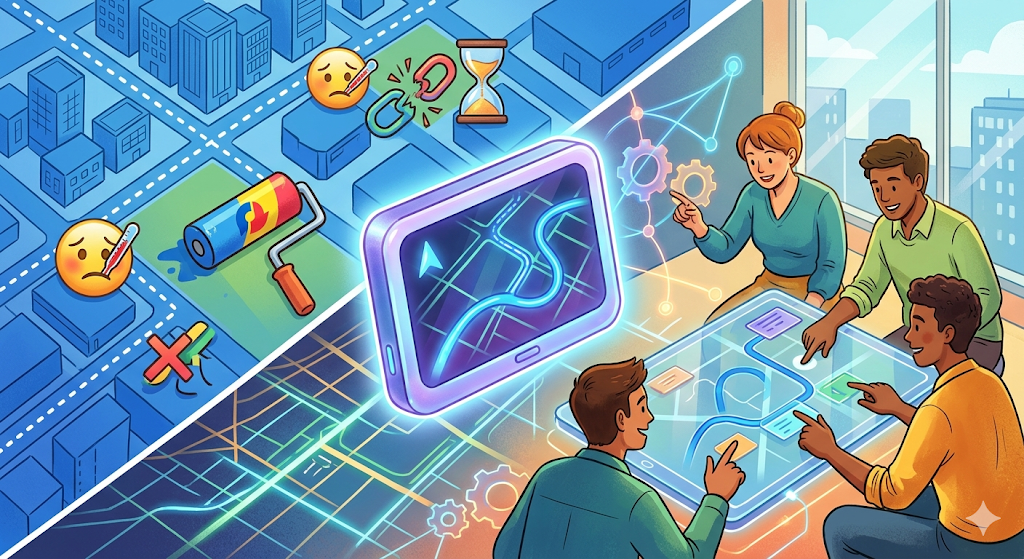
It’s day one of a new project. The team is gathered, there’s contagious optimism in the air, and the leader projects a spotless timeline on the screen. Every task is perfectly aligned, deadlines fit together like a puzzle, and the launch date shines proudly at the end of the calendar. Everything looks perfect.
But then day four arrives.
The lead designer gets sick. The client decides that, on second thought, they want to change the brand’s main color. The technology provider announces that their integration will take three days longer than expected. Suddenly, that beautiful day-one timeline becomes an obsolete document that no one looks at again, and the team enters the dreaded “survival mode”, putting out daily fires and working overtime.
Sound familiar? This is the reality of collaborative work. No matter how brilliant your team members are, projects never, ever move in a straight line.
The problem isn’t that unexpected things happen; the problem is that we keep planning our projects as if we were still using paper maps in the age of artificial intelligence. It’s time to stop getting frustrated by traffic and start building chaos-proof planning. It’s time to learn how to recalculate the route.
The Paper Map vs. the Smart GPS
Think back and remember what it was like driving to an unknown destination twenty years ago. You kept a printed map in the glove compartment or instructions written on a piece of paper: “Drive 10 kilometers, turn right at the traffic light, take the main highway.”
It was a rigid plan. If you reached the main road and discovered it was closed for repairs, panic would take over the car. You didn’t know where you were, which detour to take, or worst of all, how much extra time it would take to arrive.
That’s exactly how most companies operate today. They plan their projects in static spreadsheets or text documents. When a task is delayed (the road closes), the entire system collapses because the document doesn’t know how to react. The project manager must manually reschedule fifty Excel cells while the team waits in confusion.
Now think about how you drive today using a GPS on your phone.
You tell it where you want to go and it draws a route. If you miss an exit, or if an accident blocks the main road, the voice on your phone doesn’t yell at you, blame you, or panic. It simply says: “Recalculating…” In milliseconds it analyzes alternate roads, adjusts your arrival time, and gives you a new instruction.
In modern project management, your goal is not to avoid surprises (that’s impossible). Your goal is to build a work system capable of saying “Recalculating” automatically, transparently, and without stress for the team.
The Four Horsemen of Project Chaos (And How to Avoid Them)
For your planning to be as flexible and resilient as a GPS, we first need to understand what creates “heavy traffic” in collaborative work.
1. The Optimistic Planning Fallacy
Humans are terribly optimistic when estimating how long something will take. If a task usually takes five days, in the planning meeting we say: “If everything goes well, I can do it in three.” But everything never goes perfectly.
The GPS solution:
Just as navigation apps add extra minutes during rush hour, a good project leader always includes buffers (time margins). Never plan at 100% of your team’s capacity. Plan at 80% to leave space for inevitable chaos.
2. The Scope Creep Syndrome
The team starts building a bicycle, and halfway through the project someone suggests it would be great if it could also fly and shoot laser beams. Adding small requirements along the way destroys any schedule.
The GPS solution:
If you decide to stop for two hours at a restaurant during a trip, the GPS updates your arrival time. Work should function the same way. If the client requests a change, the answer isn’t “No.” The answer is: “Sure, but let’s see how this moves the final delivery date.” Making the impact visible discourages impulsive requests.
3. Invisible Dependencies
Juan can’t upload the article to the blog because María hasn’t sent the images yet, but María doesn’t know Juan is waiting. Tasks don’t exist in a vacuum—they’re connected.
The GPS solution:
A GPS understands that you can’t drive down Street B if you haven’t crossed Street A. In your projects, tasks must be linked. If Task A is delayed by two days, Task B (and the person responsible for it) should automatically move two days forward on the calendar without anyone sending an email.
4. Human Bottlenecks
Everything flows perfectly until work reaches the director’s inbox for “final approval”… and then it sits there for a week because the director is traveling.
The GPS solution:
A GPS warns you about traffic before you enter it. Your work system should visually show where tasks are piling up. If you see that one person has 15 cards in “Review” while the rest of the team has zero, it’s time to redistribute the workload before the entire project stops.
How to Build Your Organizational GPS: The Art of Recalculating
If you want your team to stop feeling anxious every time a plan changes, you must implement a culture and system of dynamic planning.
Step 1: Fix the Destination, But Flex the Route (Agility)
A GPS has one non-negotiable element: the destination. Everything else (which streets to take, what speed to drive) can change.
In your team, the final goal should be set in stone, but the way to reach it should be written in pencil.
If the objective is “Launch the campaign on November 15,” empower your team to propose shortcuts if they see the original route is blocked. Micromanagement—forcing everyone to follow the exact path you chose—is the enemy of speed.
Step 2: Abandon Static Tools
You can’t recalculate quickly if your tools are slow.
If you use emails to update status, scattered chats to share files, and spreadsheets to track time, your team is essentially blind.
You need a centralized platform where, if you change the date of a milestone, the entire schedule automatically shifts forward. Dependency automation is the difference between a calm Friday afternoon and a crisis-filled one.
Step 3: Remove the Blame from “Recalculating”
This may be the most important lesson.
When you miss an exit on the highway, the GPS doesn’t say: “You’re useless! How did you miss the sign? Now we’ll be late because of you.” It simply adjusts the plan neutrally.
In high-performance teams, delays should be treated as data, not crimes. If a developer runs into a complex bug that will take two extra days, they must feel the psychological safety to report it immediately on the project board.
If blame dominates the culture, people will hide problems until the last minute—making it impossible to recalculate the route in time.
Step 4: Visualize the Impact in Real Time
To recalculate, you must see the entire map.
Visual tools like Kanban boards show the instant status of each task, but timeline views (like Gantt charts) allow you to see the future.
By seeing how time bars overlap, you can think like a strategist: “If I move this task to next week, Carlos is free today to help us unblock this problem.”
GGyess: The Ultimate Navigation System for Your Team
We’ve established that chaos will happen. Deadlines will change, requirements will expand, and life will simply happen. Pretending otherwise is a recipe for burnout. What separates companies that fail in chaos from those that thrive in it is the technology they use to respond.
This is where your paper map goes in the trash and GGyess takes the wheel.
GGyess was designed precisely because project planning often feels like a straitjacket. Teams need a tool that breathes, moves, and adapts with them in real time.
Think of GGyess as your company’s smart GPS. When you start a project, our integrated AI acts like the best navigation system: you tell it your objective, and the AI instantly generates the optimal route, breaking the project into tasks, assigning responsibilities based on workload, and setting logical deadlines.
But the real magic happens when day four arrives and things change.
Did a supplier delay by a week? No problem. In GGyess’s timeline view you simply drag that task a few days forward. Automatically, all dependent tasks adjust. Team members receive a quiet, intelligent update in their own calendars. No one panics, no emergency two-hour meeting is needed. The system simply says: Recalculating.
GGyess also gives you satellite-level visibility into your company’s most valuable resource: your people’s energy. With interactive boards you can see when a team member is about to hit a task “traffic jam.” Before that person collapses under pressure, you can redistribute tasks with a simple drag-and-drop.
We’ve left behind the era where collaborative work meant endless email chains and lost files. In GGyess, each task is an exact coordinate containing all conversations, files, and instructions needed to move forward. The entire team looks at the same map, in real time, all the time.
Chaos out there isn’t going to stop. Clients will keep changing their minds and markets will keep moving at dizzying speed. You can’t control the traffic of the working world, but with the right tool you can help your team navigate it with total confidence.
Stop fighting the paper map. Embrace flexibility, empower your team, and make your planning chaos-proof.
Drive your projects toward success with GGyess.