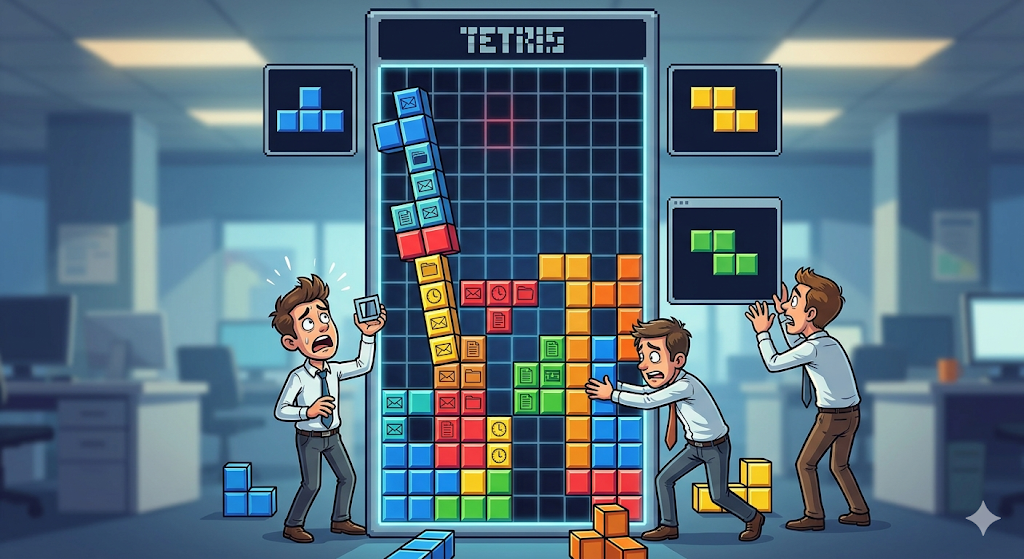
If you grew up in the past few decades, it’s almost impossible that you haven’t played Tetris. You know the feeling perfectly: at the beginning, the game is relaxing. The pieces (tetrominoes) fall slowly. You have plenty of time to analyze their shape, rotate them, and place them exactly in the perfect spot. The music is cheerful, your mind is clear, and you feel like you have absolute control over the universe.
But then, you level up.
The music speeds up. The pieces start falling faster. Suddenly, you make a small mistake and leave an empty gap. To try to fix it, you stack another piece on top. Without realizing it, you’ve created a tower in a single column. Panic takes over. You desperately look at the box that tells you what the “next piece” will be, hoping it’s the long straight bar that will save your game. But it isn’t. It’s a square. You drop it on the tower, the pile touches the top of the screen, and the music stops with a tragic sound. Game Over.
This experience—the one that made our palms sweat in front of a Game Boy or an old phone—is the perfect metaphor for what happens every day in thousands of offices around the world.
In team management, the falling pieces are tasks, requests, and urgent emails. The columns where those pieces land are the members of your team. And when all the pieces start falling on the same person at a dizzying speed, you’re not playing productivity—you’re playing a game of seeing when that person will collapse (burnout) and when your entire project will reach Game Over.
Today we’re going to learn how to play this game like professionals. We’ll discover why our screen fills with chaotic blocks and how to design a system that distributes workload so your team always keeps the board clean and under control.
Why the Board Collapses: The Classic Distribution Mistakes
Before we can clear the screen, we need to understand why the pieces pile up. Rarely does a team leader intentionally overload an employee. Imbalance in collaborative work is usually the result of psychological and managerial “traps” we all fall into without noticing.
1. Punishing Efficiency (The Star Employee Curse)
Imagine you have an excellent player on your team—let’s call her Laura. Laura is fast, never complains, and always delivers high-quality work. When a difficult piece appears (an urgent task or an upset client), your leader brain thinks: “I don’t have time to explain this to the new employee, I’ll just give it to Laura.”
The next day another complex task appears. “Give it to Laura.”
Without realizing it, you’re dropping all the heavy blocks into Laura’s column while the columns of the rest of the team remain almost empty. In the corporate world, hard work is often “rewarded” with more hard work—until your best talent collapses from stress and quits.
2. Invisible Pieces (Ghost Work)
In Tetris, you can see every block that falls. In the modern office, much of the work is invisible. Carlos might only have three “official” tasks assigned for this week’s project, so you assume his column is empty. What you don’t see is that Carlos is answering 50 customer support emails per day, helping a coworker with a technical issue, and attending three meetings daily that lead nowhere.
When you assign him one more “small” task, Carlos explodes. You’re surprised—but that’s because you just dropped a block into a column that was invisibly already touching the ceiling.
3. The Avalanche Effect (Poor Time Planning)
Sometimes the problem isn’t who does the work, but when it falls. If you plan for the design team to create five graphics, the writing team to produce five texts, and the programmer to assemble everything… guess what will happen at the end of the month.
For the first three weeks, the designer and writer work at a normal pace. During the last week, the programmer receives all ten pieces at the same time—like an unstoppable avalanche that fills their screen in two seconds.
How to Play to Win: Strategies to Balance the Board
To avoid collapse, you must stop reacting to falling pieces and start controlling the board. Here are the golden rules to distribute workload in a humane, efficient, and sustainable way.
Rule 1: Turn On the Board Lights (Total Visibility)
You cannot balance a workload you cannot see. If task assignments in your company happen through random WhatsApp requests, hallway conversations, or email threads, you are playing Tetris blindfolded.
You need to centralize all assignments in one place. The entire team should have a visual board where it’s obvious how many tasks each person has. If you open your project manager and see one person’s avatar appearing in 25 active cards while another appears in only 3, you’ve just identified a tower about to collapse. Visibility is the first step toward managerial empathy.
Rule 2: Measure the Weight of the Pieces, Not Just the Quantity
In the game, a square block takes up more space than a small one. At work, tasks are not equal.
If you measure workload by saying “Maria has 5 tasks and Juan has 5 tasks, so we’re balanced,” you could be making a fatal mistake. Maria’s five tasks might be “Send follow-up emails” (15 minutes each), while one of Juan’s tasks might be “Write the code for the new payment portal” (40 hours of work).
When assigning work, you must estimate the effort or time required for each block. Workload is balanced by measuring hours and energy—not by counting cards.
Rule 3: Use the “Pause” Button (Limit Work in Progress)
One of the most counterintuitive productivity rules is that for work to flow faster, people must do fewer things at the same time.
If someone’s board is filling up, stop dropping pieces on it. Implement Work in Progress (WIP) limits. Agree with your team that no one can have more than three tasks in the “In Progress” state at the same time. If someone receives a fourth urgent task, they must pause one of the previous ones or ask for help finishing it. This prevents analysis paralysis and ensures rows are “cleared” (completed) before more work piles on top.
Rule 4: Learn to Rotate Pieces (Cross-Training)
What do you do when a piece needs to fit on the right side of the board, but the only gap is on the left? In the game, you move it. In the office, this means flexibility.
If only Laura knows how to use the design software, every graphic piece will inevitably fall into her column. The long-term solution to avoid bottlenecks is cross-training. If you teach Carlos how to make basic design edits, you’ve just created a new column where graphic pieces can fall. The more shared skills your team has, the easier it becomes to move blocks from a saturated column to an empty one.
Rule 5: Watch the “Next Piece” Box (Future Planning)
The secret of world-class Tetris champions isn’t watching the piece falling right now—their eyes are always on the small corner that shows the next piece that will appear.
As a leader, your job isn’t just distributing today’s work—it’s anticipating tomorrow’s work. If you know a major campaign will launch next week, you should start clearing your team’s columns today. Use calendars and timelines to identify future workload peaks and adjust resources before the game speed overwhelms you.
GGyess: Your Ultimate “Cheat Code” for Team Management
The theory of maintaining perfect balance sounds great, but in practice, when day-to-day pressure increases, it’s incredibly difficult to mentally calculate who has time and who is about to collapse emotionally. Moving tasks around in static spreadsheets is as frustrating as playing with an unresponsive controller.
You need a console designed for flow. You need GGyess.
GGyess completely transforms the way you distribute human effort. We built a platform that eliminates guesswork and makes workload balancing as intuitive as simple drag-and-drop.
Imagine opening GGyess on a Monday morning. Instead of reading endless email threads to guess who’s busy, you simply open the Workload view for your team. Instantly, the platform shows you a crystal-clear visual map. You see the “column” of every team member. You see who has a calm week and—most importantly—GGyess highlights in red if someone’s task volume exceeds their available working hours. You’ve turned the board lights on.
Did you find someone whose screen is about to collapse? This is where GGyess feels like magic. You don’t need to call a meeting or send apologetic emails to reassign work. You simply click one of the tasks from the overloaded employee and drag it gently into the column of a teammate with availability. With that simple movement, the system instantly updates responsibilities, quietly notifies the people involved, and transfers all the context (files, deadlines, and instructions) to the new owner. Problem solved in three seconds.
But what if you didn’t even have to reach that stressful point?
With the integrated Artificial Intelligence inside GGyess, the game changes from level one. When you’re planning a new project, you don’t have to guess who should do what. You describe your idea to our AI, and it not only breaks the project into tasks—it also distributes the weight of each block intelligently and fairly based on your team’s availability and assigned roles. The AI ensures no one starts the project with an overwhelming disadvantage.
And we know there are invisible pieces. That’s why GGyess centralizes all communication and files inside the same platform. There’s no more “ghost work” hidden in external apps. Every effort from your team becomes measurable, visible, and therefore manageable.
When you need to look ahead, our Calendar and Gantt views act as the perfect predictive tool. You can see how tasks from different people connect across weeks and months, ensuring you never create an end-of-month “avalanche” for any team member.
Work shouldn’t be a survival game where the reward for efficiency is being punished with stress until collapse. A truly productive team moves forward at a steady, sustainable, and balanced pace.
Stop playing Tetris blindly with the mental health and productivity of your talent. Take control, balance the board, and let everyone win with GGyess.