

This guide focuses on communicating a change, its evidence and the decision the receiver needs. The worked example follows three units: “workshop question”, “decision activity” and “agreed action”.
Reference input: workshop question and prework. Expected output: decisions converted into actions. Before assigning work, confirm the current input version and who will review the result.
Communicate what changed and what it enables
A status update for the remote planning workshop facilitation should show the change since the last check, its evidence and the next action. “We are still working” does not explain whether someone needs to intervene. For workshop question, identify the new version or fact. For decision activity, explain the effect on the commitment. For agreed action, name the action and owner. Avoid copying the project's entire history into every update. Include enough context to interpret the change without reconstructing discussions that no longer affect the current decision. The message should reduce uncertainty for a specific reader.
Support the state with an observation
An on-track state needs evidence of real progress. A blockage needs a missing input and someone able to resolve it. A decision request needs options and a useful response time. Keep workshop question and prework as the shared reference and check that the record makes decisions converted into actions findable. In this process, avoid ending a workshop with extensive notes and no owned action. The proposed check is to ask the group to confirm the action, owner and next check. Sending a message differs from obtaining a resolution. When the next stage depends on an answer, keep the question open until a usable decision arrives or the commitment is renegotiated with affected people.
Worked example
The fictional workshop chooses between two initiatives. Prework describes constraints and the session should produce actions. Facilitation retains the decision, executor and unresolved question so closure is more than a collection of notes.
The example involves Sofia, Valeria and Camila. Names, situations and numbers are illustrative and do not represent customer results. The three units let you test the proposed approach before extending it to other work.
| Situation | Operational message | Next-action owner | Closure |
|---|---|---|---|
| workshop question | Progress with version and evidence | Valeria | Review decision |
| decision activity | Blocked with missing input | Sofia | Usable confirmation |
| agreed action | Decision with options and impact | Camila | Selected option and updated plan |
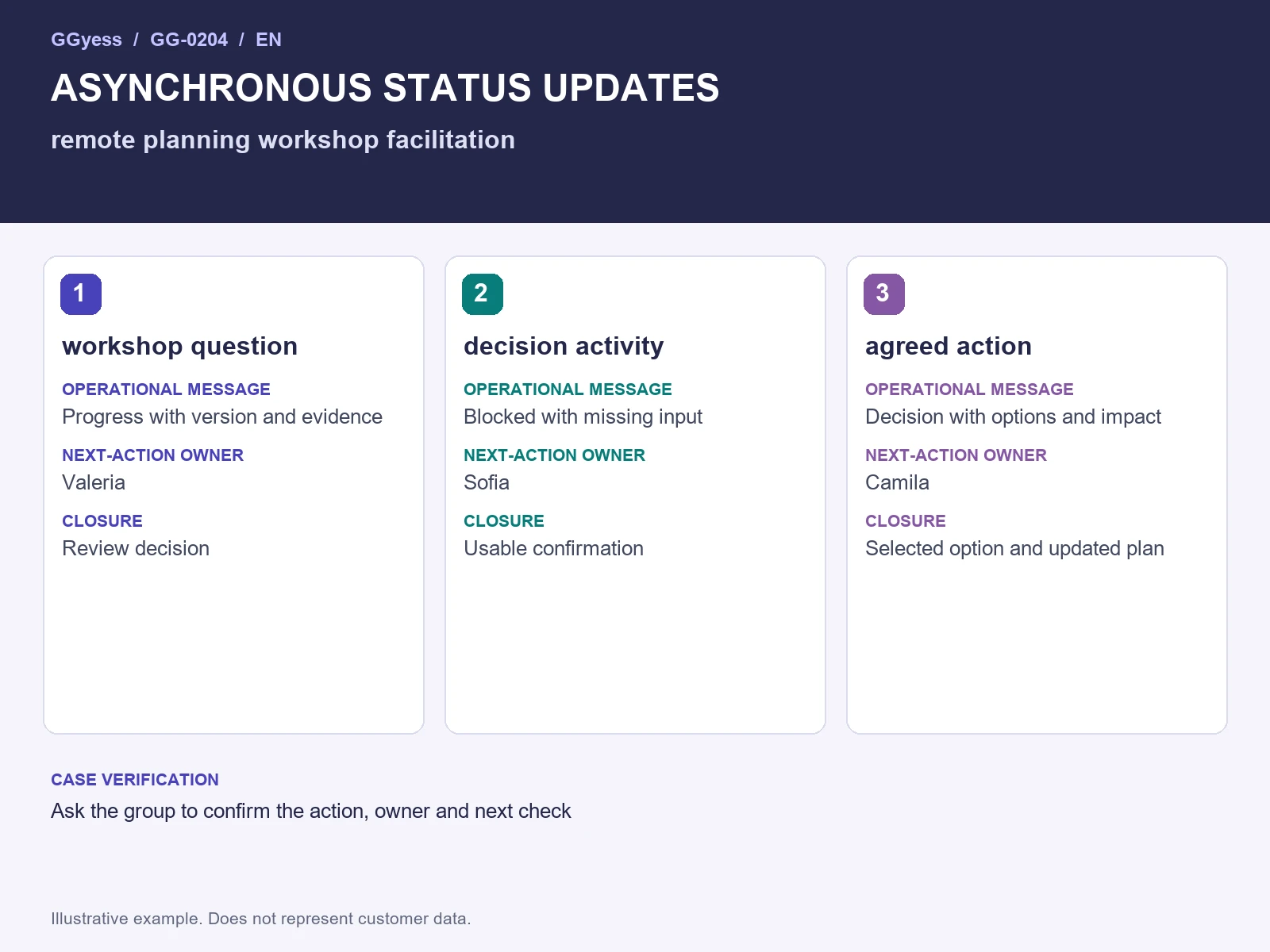
Use three messages that lead to action
Progress message: “The current version of workshop question is ready for review; evidence is beside the task and the reviewer confirms the next step.” Blocked message: “We cannot close decision activity because the identified input is missing; its owner needs to confirm availability before the next check.” Decision message: “For agreed action, two alternatives affect capacity and date differently; the approver needs to select one and record the reason.” These are illustrative examples to adapt. Replace general references with confirmed versions, people and decision times before sending them as operational messages.
Change the channel when the decision requires it
A structured message can be sufficient when options and authority are clear. When incompatible interpretations or dependent decisions appear, bring together the people needed to resolve them. Define the required outcome and record the conclusion beside the work. A meeting without a documented decision recreates the same uncertainty. At closure, update the commitment and notify whoever receives the result. An update's value comes from turning an observed change into coordinated action, rather than its frequency or length. Choose the communication method that helps the necessary decision happen while preserving its practical context.
What to check before closure
The risk to control in this case is ending a workshop with extensive notes and no owned action. A completed label needs a supporting observation. Keep the following beside the decision so the receiver can establish what was checked:
- Input and version used: workshop question and prework.
- Case check: ask the group to confirm the action, owner and next check.
- Outcome under review: decisions converted into actions.