

This guide focuses on comparing scope, sequence and capacity to agree on a feasible commitment. The worked example follows three units: “current request”, “duplicate request” and “context-free request”.
Reference input: open requests with minimum context. Expected output: a cleaned backlog with decision reasons. Before assigning work, confirm the current input version and who will review the result.
Establish the actual effect of the delay
To recover the marketing request backlog cleanup, compare the accepted commitment with what remains executable. Identify the delayed unit, missing input and dependent delivery. Do not automatically move every date. Independent tasks may still proceed, while a review window may need to be reserved again. Use open requests with minimum context to verify the situation and distinguish facts from estimates. The recovery plan should explain which commitment became infeasible and which outcome remains useful to its receiver. Without that distinction, a revised date changes the calendar without resolving the operational problem or clarifying what the team can now deliver.
Compare scope, sequence and capacity options
Present three options: reduce an optional element, reorganize genuinely independent work or add competent available capacity. Explain what each option sacrifices. Adding someone may require context and review, so it does not automatically shorten delivery. For current request, confirm the minimum requirement. For duplicate request, check whether existing input supports partial progress. For context-free request, establish who can review the result. Do not propose hours the team cannot provide or remove the control that prevents a material defect to make recovery appear faster. A credible comparison includes the cost of each option's new dependencies.
Worked example
The fictional backlog contains a current need, a duplicate and another with insufficient context. Cleanup retains a reason for each decision and an owner for questions. It does not mean deleting old requests solely because of their arrival date.
The example involves Sofia, Valeria and Camila. Names, situations and numbers are illustrative and do not represent customer results. The three units let you test the proposed approach before extending it to other work.
| Recovery option | Condition | Effect | Verification |
|---|---|---|---|
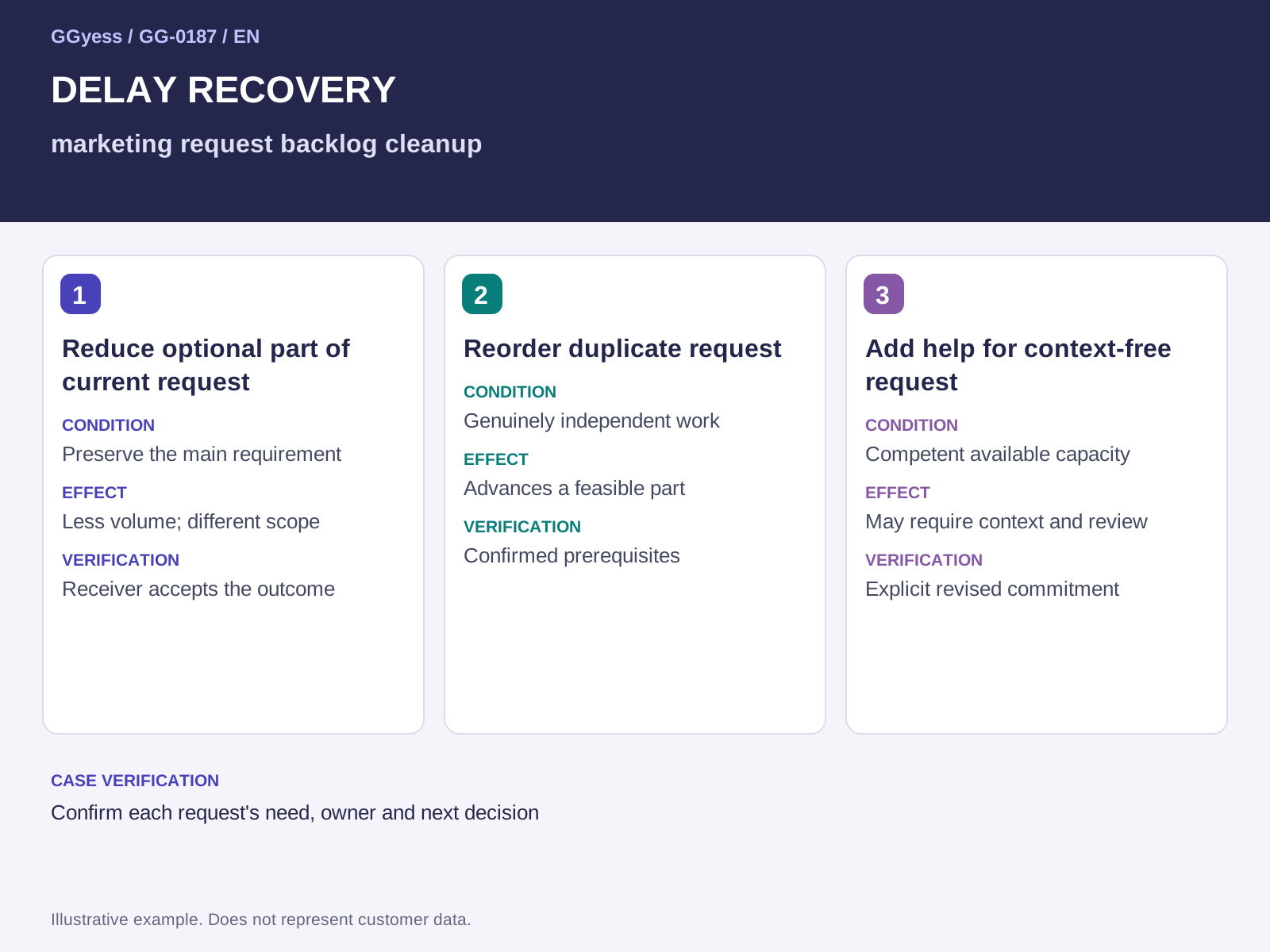
| Reduce optional part of current request | Preserve the main requirement | Less volume; different scope | Receiver accepts the outcome |
| Reorder duplicate request | Genuinely independent work | Advances a feasible part | Confirmed prerequisites |
| Add help for context-free request | Competent available capacity | May require context and review | Explicit revised commitment |
Agree on a revised commitment
In this illustrative example, the team preserves the main requirement, defers an optional improvement and retains a review before delivery. The owner communicates revised scope, conditions for meeting it and the next check. The receiver confirms whether that outcome still solves their need. Avoid retaining historical priorities as if still approved; the proposed check is to confirm each request's need, owner and next decision. Preserve the previous commitment and explain the reason for change without turning the record into a personal accusation. Useful recovery assigns clear actions to the people able to resolve the situation and makes the decision behind the revised outcome visible.
Verify recovery through evidence
Moving a task to a new date does not prove recovery. Verify the critical input, completed production and acceptance of a cleaned backlog with decision reasons. If risk remains, retain a check near the last useful intervention point. Do not declare recovery simply because an overdue marker disappeared from the board. At closure, record which adjustment worked and under what conditions. That information can improve subsequent planning. Separate later learning from immediate recovery: first restore a feasible commitment, then decide whether a recurring cause justifies changing the process. The same evidence can support both discussions without confusing their different purposes.
What to check before closure
The risk to control in this case is retaining historical priorities as if still approved. A completed label needs a supporting observation. Keep the following beside the decision so the receiver can establish what was checked:
- Input and version used: open requests with minimum context.
- Case check: confirm each request's need, owner and next decision.
- Outcome under review: a cleaned backlog with decision reasons.