

This guide focuses on identifying what prevents progress and what evidence establishes a usable input. The worked example follows three units: “agreed publication”, “draft review” and “publication evidence”.
Reference input: delivery agreements and evidence links. Expected output: a committed-publication matrix. Before assigning work, confirm the current input version and who will review the result.
Identify what actually prevents a start
In the influencer deliverable tracking, a dependency exists when a piece of work requires an earlier input or decision. Start with agreed publication: what fact, permission, material or validation must be available to execute it? Separate a real prerequisite from a preference about work order. If two tasks can proceed using independent inputs, do not chain them merely out of habit. For every dependency, record what is missing and which outcome it enables. This explains the blockage without requiring everyone to reread full conversations or assume the whole project stopped because one asset remains unresolved.
Connect the input, owner and availability evidence
The initial reference is delivery agreements and evidence links. Assign an owner to each pending input, including those provided by another team. Ownership may mean coordinating receipt rather than personally producing it. Agree on observable availability evidence: an accessible file, recorded decision or completed test. A promised date establishes an expectation; it does not establish that the input is already usable. Before starting draft review, check the agreed evidence and record the version. If that input later changes, identify which tasks used the earlier version before deciding what needs to be revisited.
Worked example
The example's operational agreement includes one post and one story per participant. The approved draft and published link are recorded separately. If content changes after review, the team needs to identify which version ultimately became visible.
The example involves Camila, Nora and Sofia. Names, situations and numbers are illustrative and do not represent customer results. The three units let you test the proposed approach before extending it to other work.
| Unit | Prerequisite to verify | Evidence | Action when missing |
|---|---|---|---|
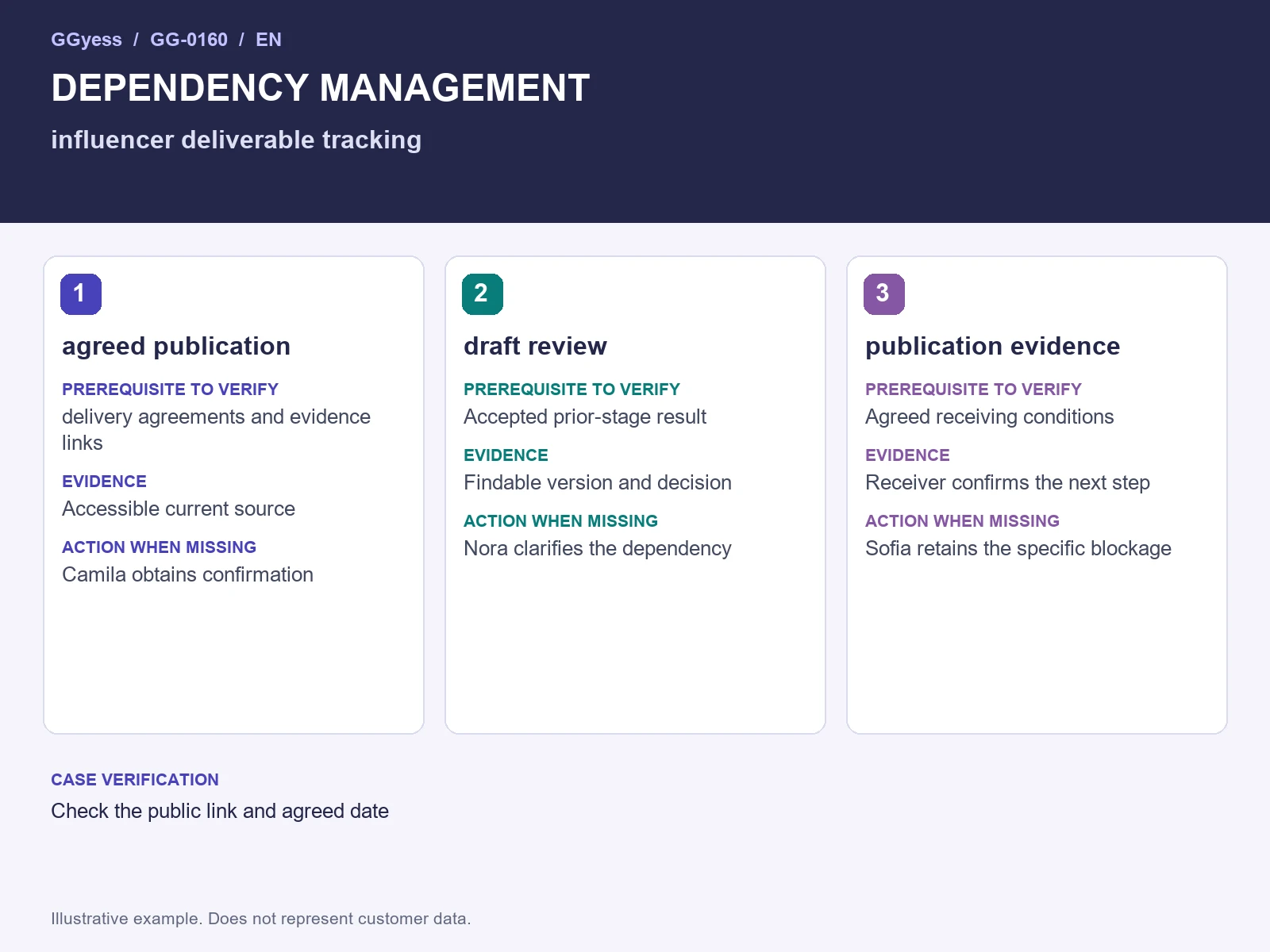
| agreed publication | delivery agreements and evidence links | Accessible current source | Camila obtains confirmation |
| draft review | Accepted prior-stage result | Findable version and decision | Nora clarifies the dependency |
| publication evidence | Agreed receiving conditions | Receiver confirms the next step | Sofia retains the specific blockage |
Escalate with a concrete decision request
A useful blockage notice identifies the affected task, missing input, person able to resolve it and latest useful decision time. Offer options with consequences: wait, advance an independent part or reduce the agreed outcome. Do not mark every task blocked if some retain a valid execution path. When changing the sequence, check that the new order does not create a circular dependency. Escalation helps when someone can choose a path and see which commitment must change if no answer arrives. Merely repeating that a task is blocked adds little decision value.
Verify that unblocking evidence is usable
Receiving a file does not necessarily resolve a blockage. In this workflow, guard against treating an approved draft as a published asset. The proposed check is to check the public link and agreed date. Ask the next-stage executor to confirm that the input supports work, and record any remaining restriction. The dependency chain should produce a committed-publication matrix, rather than accumulate administrative confirmations. When a dependency closes, update affected tasks and their next actions. If evidence proves insufficient, retain the reason for reopening it so the same unresolved condition does not circulate repeatedly as though it were a new problem.
What to check before closure
The risk to control in this case is treating an approved draft as a published asset. A completed label needs a supporting observation. Keep the following beside the decision so the receiver can establish what was checked:
- Input and version used: delivery agreements and evidence links.
- Case check: check the public link and agreed date.
- Outcome under review: a committed-publication matrix.