

This guide focuses on separating execution, review and authority to resolve a disagreement. The worked example follows three units: “agreed publication”, “draft review” and “publication evidence”.
Reference input: delivery agreements and evidence links. Expected output: a committed-publication matrix. Before assigning work, confirm the current input version and who will review the result.
Give each outcome one accountable owner
In the influencer deliverable tracking, the task owner coordinates progress and is accountable for the next action. That does not mean personally performing every contribution. For agreed publication, name someone who can explain the state, obtain missing inputs and request a decision. Avoid assigning accountability to “marketing” or “the client”: groups can collaborate, but an individual needs to collect the decision and maintain the record. When several people contribute, distinguish their contributions from ownership of closure. Otherwise everyone may interpret shared responsibility differently, leaving the practical next step unowned despite an apparently complete assignment list.
Separate execution, review and decision authority
The person producing draft review may need specialist support while someone else decides whether the outcome meets the agreement. Record those roles separately. An approver needs a criterion and a review window as well as a name in a table. Confirm review availability before promising delivery. Someone who is consulted provides information; consultation does not automatically create a permanent veto. Explain which decisions require input and which the owner can resolve without reopening the whole project. This reduces avoidable waiting while preserving the controls that materially protect the outcome.
Worked example
The example's operational agreement includes one post and one story per participant. The approved draft and published link are recorded separately. If content changes after review, the team needs to identify which version ultimately became visible.
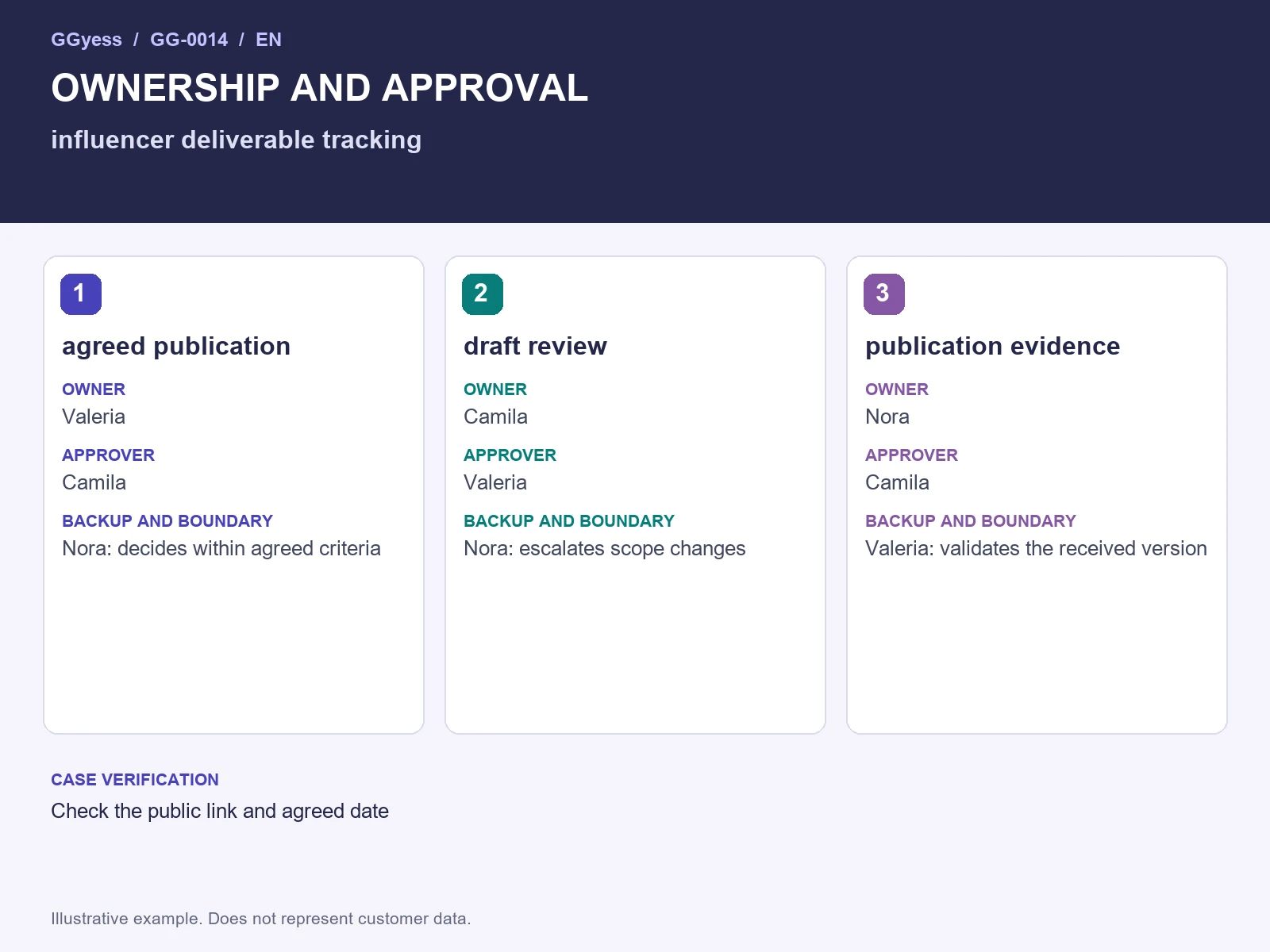
The example involves Valeria, Camila and Nora. Names, situations and numbers are illustrative and do not represent customer results. The three units let you test the proposed approach before extending it to other work.
| Unit | Owner | Approver | Backup and boundary |
|---|---|---|---|
| agreed publication | Valeria | Camila | Nora: decides within agreed criteria |
| draft review | Camila | Valeria | Nora: escalates scope changes |
| publication evidence | Nora | Camila | Valeria: validates the received version |
Resolve incompatible instructions explicitly
Suppose two reviewers request conflicting changes to publication evidence. The executor should not choose intuitively or prepare two full versions merely to avoid the conflict. Record the alternatives, affected criterion and person authorized to decide. Request a resolution that identifies the accepted version and explains the reason. If the disagreement changes the agreed result, treat it as a scope change and revisit the commitment. Retaining every comment is different from resolving comments: the record needs to establish which instruction remains valid and who closed the contradiction.
Test backup coverage before it is needed
A backup is useful when they understand the context and can act within clear authority. Before an absence, ask them to locate delivery agreements and evidence links, identify the working version and explain how to verify a committed-publication matrix. Watch the risk of treating an approved draft as a published asset. The proposed practical check is to check the public link and agreed date. Resolve missing permissions or additional approvals before the handover. Define what must be escalated and to whom. Validate the ownership matrix through a reproducible decision, rather than considering it complete simply because every cell contains a person's name.
What to check before closure
The risk to control in this case is treating an approved draft as a published asset. A completed label needs a supporting observation. Keep the following beside the decision so the receiver can establish what was checked:
- Input and version used: delivery agreements and evidence links.
- Case check: check the public link and agreed date.
- Outcome under review: a committed-publication matrix.