

This guide focuses on agreeing on an acceptable outcome before production begins. The worked example follows three units: “agreed publication”, “draft review” and “publication evidence”.
Reference input: delivery agreements and evidence links. Expected output: a committed-publication matrix. Before assigning work, confirm the current input version and who will review the result.
Write requirements that can be observed
An acceptance criterion for the influencer deliverable tracking describes a checkable property of the outcome. “Make it professional” expresses an expectation but does not resolve a review. For agreed publication, specify required content, reference version, destination and evidence of compliance. When a criterion involves editorial judgment, define who applies it and show a commented example. Agreeing before production exposes different interpretations while they are still inexpensive to resolve. Do not introduce new criteria at the end without recognizing their effect on the work already committed. A usable criterion supports a decision rather than simply expressing a preference.
Show a passing example and a failing example
Compare two versions of draft review. One retains the required information, uses current material and supports the next stage. The other may look finished but leaves an important condition unchecked. In this process, watch the failure of treating an approved draft as a published asset. Document the specific difference instead of applying a broad quality label. A useful comparison explains which observation would change the decision. If no evidence can resolve the disagreement, the criterion still needs refinement or an authorized person to interpret the case. The comparison should reveal an actionable difference, not just a subjective ranking.
Worked example
The example's operational agreement includes one post and one story per participant. The approved draft and published link are recorded separately. If content changes after review, the team needs to identify which version ultimately became visible.
The example involves Diego, Alex and Mateo. Names, situations and numbers are illustrative and do not represent customer results. The three units let you test the proposed approach before extending it to other work.
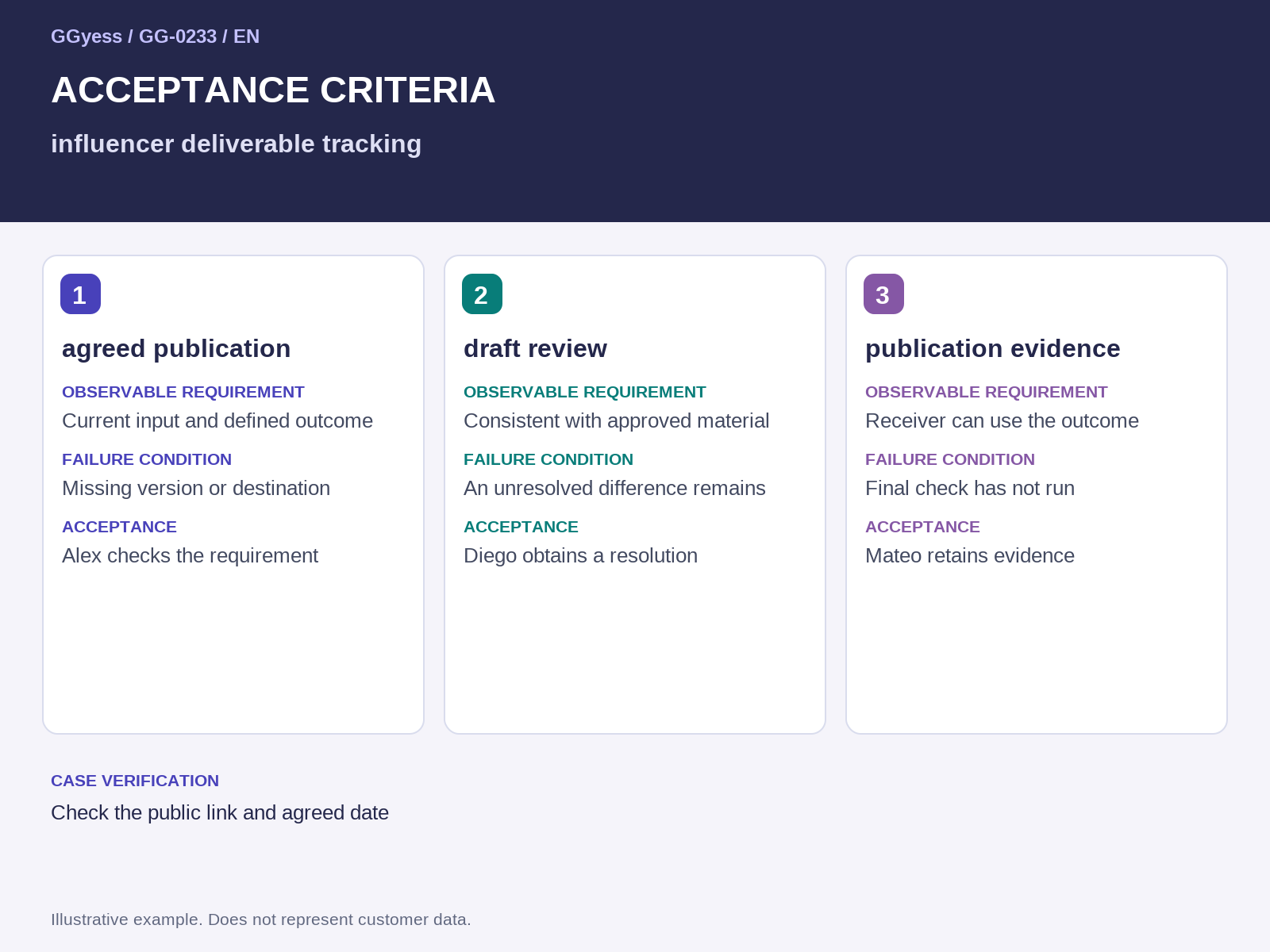
| Unit | Observable requirement | Failure condition | Acceptance |
|---|---|---|---|
| agreed publication | Current input and defined outcome | Missing version or destination | Alex checks the requirement |
| draft review | Consistent with approved material | An unresolved difference remains | Diego obtains a resolution |
| publication evidence | Receiver can use the outcome | Final check has not run | Mateo retains evidence |
Define who accepts and what evidence remains
The person accepting publication evidence needs the criteria, access to the reviewed version and time to decide. Record acceptance, return or conditional acceptance with reasons. Conditional acceptance needs an explicit outstanding item and clear boundary; it must not be mistaken for full closure. Retain evidence another reviewer would need to understand the decision. Comment volume does not determine acceptance. A traceable decision about the correct version and agreed requirements does. This distinction helps teams avoid reopening finished work merely because someone discovers an old discussion after the delivery has moved on.
Resolve ambiguity before closure
To validate a committed-publication matrix, the proposed check is to check the public link and agreed date. If applying a criterion to a real case exposes ambiguity, record it and resolve it with the approver. Distinguish clarifying an unclear instruction from changing the requested outcome. The first explains how to check the existing agreement; the second may require capacity and a new decision. Check whether the defect affects other units as well. At closure, leave an identified version and enough explanation that the next review does not need to renegotiate from the beginning what compliance means.
What to check before closure
The risk to control in this case is treating an approved draft as a published asset. A completed label needs a supporting observation. Keep the following beside the decision so the receiver can establish what was checked:
- Input and version used: delivery agreements and evidence links.
- Case check: check the public link and agreed date.
- Outcome under review: a committed-publication matrix.