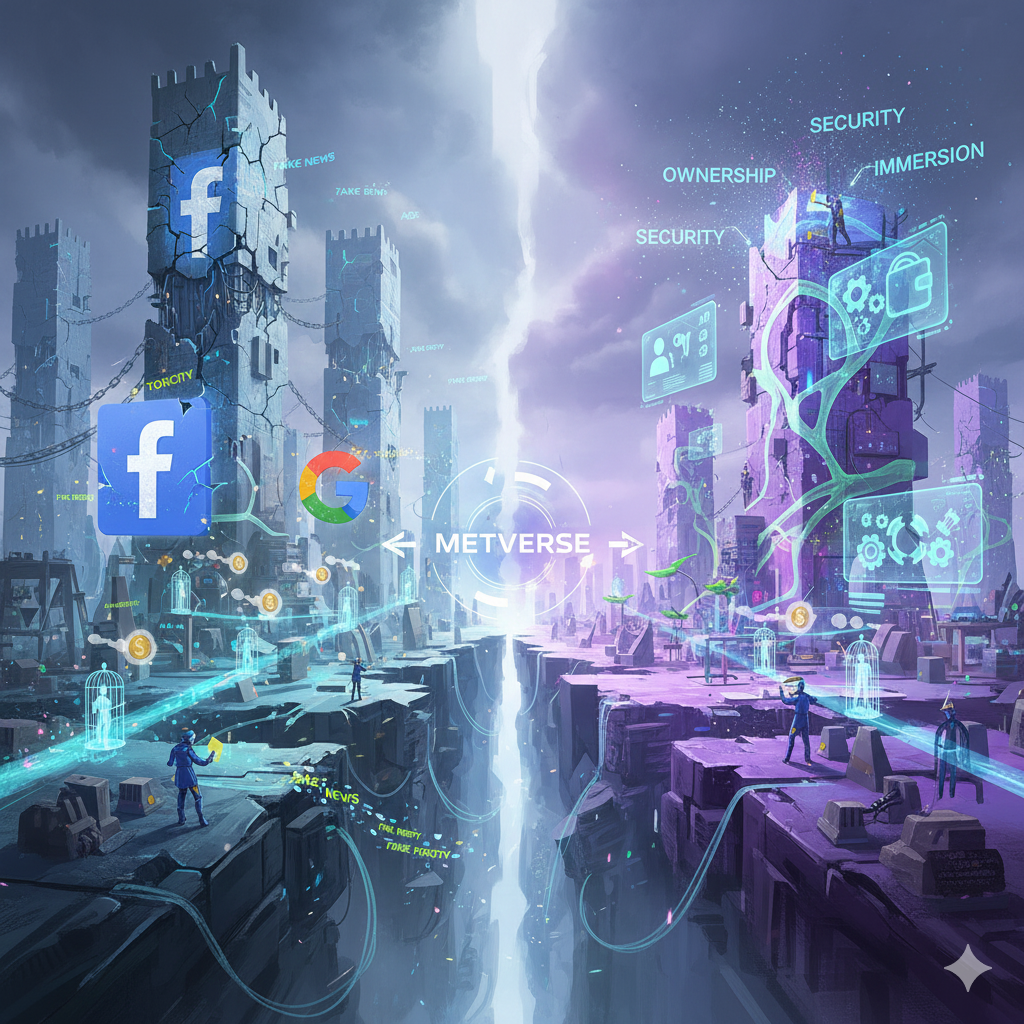
Let’s be honest: social media, as we know it, is broken. It was born with the utopian promise of connecting friends. But twenty years later, it has turned into a mass-media system saturated with ads, polluted by fake news, toxicity, and bots. Users no longer feel like owners of their content; they feel like products sold to the highest advertising bidder.
Chapter 7 of Marketing 6.0 puts forward a provocative thesis: the Web2 era—the age of centralized platforms like Facebook or Google—is showing structural cracks. People are looking for security, ownership, and real immersion.
The answer to this crisis is the Metaverse. But don’t think of the Metaverse as just a video game with VR headsets. Think of it as Web3: the next iteration of the internet, where users go from being tenants to being owners.
If you want to understand where your customers will be in 2030—or where your Generation Alpha customers already are—you need to understand the architecture of this new world.
1. The Inevitable Evolution: From Reading to Owning
To understand the Metaverse, we first need to understand the history of the internet in three acts.
Web1 (1989–2004): The Read Era
We could only consume information. It was static. A digital brochure.
Web2 (2004–Present): The Read/Write Era
Social networks emerged. We could create content, share photos, and express opinions. But we don’t own that content—the platform does. If Instagram shuts down your account tomorrow, you lose everything.
Web3 (The Future): The Read/Write/Own Era
This is where the decentralized Metaverse comes in. Thanks to blockchain technology, users can create content, own it, and take it wherever they want. Intermediaries disappear.
The Metaverse is the visual interface of Web3. It’s an attempt to return power to users by enabling real economies where creators—not just platforms—earn the value.
2. The Two Flavors of the Metaverse: Dictatorship or Democracy?
Not all metaverses are the same. Right now, two models are competing for the future.
A. Centralized Metaverses (Web2)
Virtual worlds controlled by a single company.
Examples: Roblox, Fortnite, Minecraft.
Reality: They are massively popular (Roblox has over 200 million active users). They are the playground of Generation Alpha.
The problem: They are still “walled gardens.” If you buy a skin in Fortnite, you can’t use it in Roblox. The company sets the rules.
B. Decentralized Metaverses (Web3)
Worlds governed by the community through blockchain.
Examples: The Sandbox, Decentraland.
The promise: You own your virtual land and assets (NFTs). If the platform changes, the community votes through DAOs.
The problem: They are still complex to use, graphically inferior, and have fewer active users than gaming giants.
For brands, the dilemma is clear: do you go where the people are today (centralized) or invest in the ideology of the future (decentralized)? The smart answer is usually to start with the former while experimenting with the latter.
3. The Anatomy of a Virtual World: The 5 Essential Components
If your brand decides to enter the Metaverse, slapping a logo on a virtual wall is not enough. You must understand the five pillars that make these worlds work.
1. Virtual Assets (The New Property)
In the physical world, brands sell clothes or cars. In the Metaverse, they sell code. From virtual land (Adidas bought land in The Sandbox) to immersive stores (Gucci Vault), brands are creating digital twins of their products.
The key: assets aren’t just decoration; they’re status. Owning a limited-edition virtual pair of Nike sneakers can be as valuable to an avatar as the real ones are to a human.
2. Avatars (The New Identity)
An avatar is more than a game character; it’s a projection of the user’s ideal self. Brands like Maybelline or L’Oréal already offer makeup for avatars. There are even virtual influencers like Lil Miquela or FN Meka—computer-generated personalities with multimillion-dollar contracts.
The brand question is simple: how do you help your customer express themselves digitally?
3. User Experience (Gamification)
The Metaverse is boring if there’s nothing to do. Experiences must be interactive, social, and consistent.
Example: Marshmello’s concert in Fortnite. Millions attended, but the system split them into rooms of 100 people to keep the experience intimate and fluid.
Strategy: don’t build a static showroom. Create games, missions, and rewards.
4. Creator Economy (Play-to-Earn)
This is the economic revolution. In the Metaverse, users don’t just play; they work and create. Thanks to NFTs and crypto, a 16-year-old designer can create a virtual jacket, sell it to other users, and earn lifetime royalties.
Opportunity: brands can collaborate with native creators instead of forcing corporate designs. Nike bought RTFKT—a digital sneaker studio—precisely to dominate this new economy.
5. Governance (DAOs)
In decentralized worlds, there is no CEO. There is a DAO (Decentralized Autonomous Organization), essentially a digital cooperative. If you hold platform tokens, you have voting rights.
Example: NYX (L’Oréal) created a DAO for 3D makeup artists, allowing the community to decide the brand’s creative direction in the Metaverse. This builds extreme loyalty.
4. The Smart Strategy: The “Web 2.5” Path
The book acknowledges an uncomfortable truth: pure Web3—crypto wallets, private keys, tokens—is still too complex and intimidating for the average user.
That’s why the winning strategy is Web 2.5: the middle ground. You deliver the benefits of ownership and decentralization with the usability of Web2.
The perfect case study is Starbucks Odyssey. Starbucks wanted a blockchain-based loyalty program but knew customers didn’t want technical complexity.
They didn’t call them NFTs; they called them “Journey Stamps.”
They didn’t force crypto payments; customers could use credit cards.
The result was an immersive, modern experience built on futuristic technology—but accessible to someone who just wants a coffee.
The Metaverse Is Not Optional for Generation Alpha
The 2021 hype may have cooled, but the underlying trend is an unstoppable tsunami. For Generation Alpha, a world where they can’t interact, create, and own digital assets is a broken world. They don’t see the Metaverse as an escape; they see it as their natural place to socialize.
Today’s social networks are becoming the cable TV of their generation—something their parents use. The Metaverse is their internet.
The question for your brand is simple: will you wait until Web3 is perfect to enter, or will you start building your land in Web 2.5 today—learning the rules of the new economy before it’s too late?
Strategic Implementation Note with GGyess
Entering the Metaverse means managing digital assets, collaborating with external creators, understanding new governance models, and coordinating technology and marketing teams. It’s a new and chaotic ecosystem.
GGyess WorkSuite is ideal for managing this transition. You can organize digital assets, manage workflows with decentralized creators, and maintain brand consistency while experimenting across multiple platforms (Roblox, The Sandbox, and more). GGyess provides real-world operational order so you can innovate safely in the virtual one.