Over the past decade, boardrooms and marketing departments have lived under the dictatorship of a single word: Omnichannel.
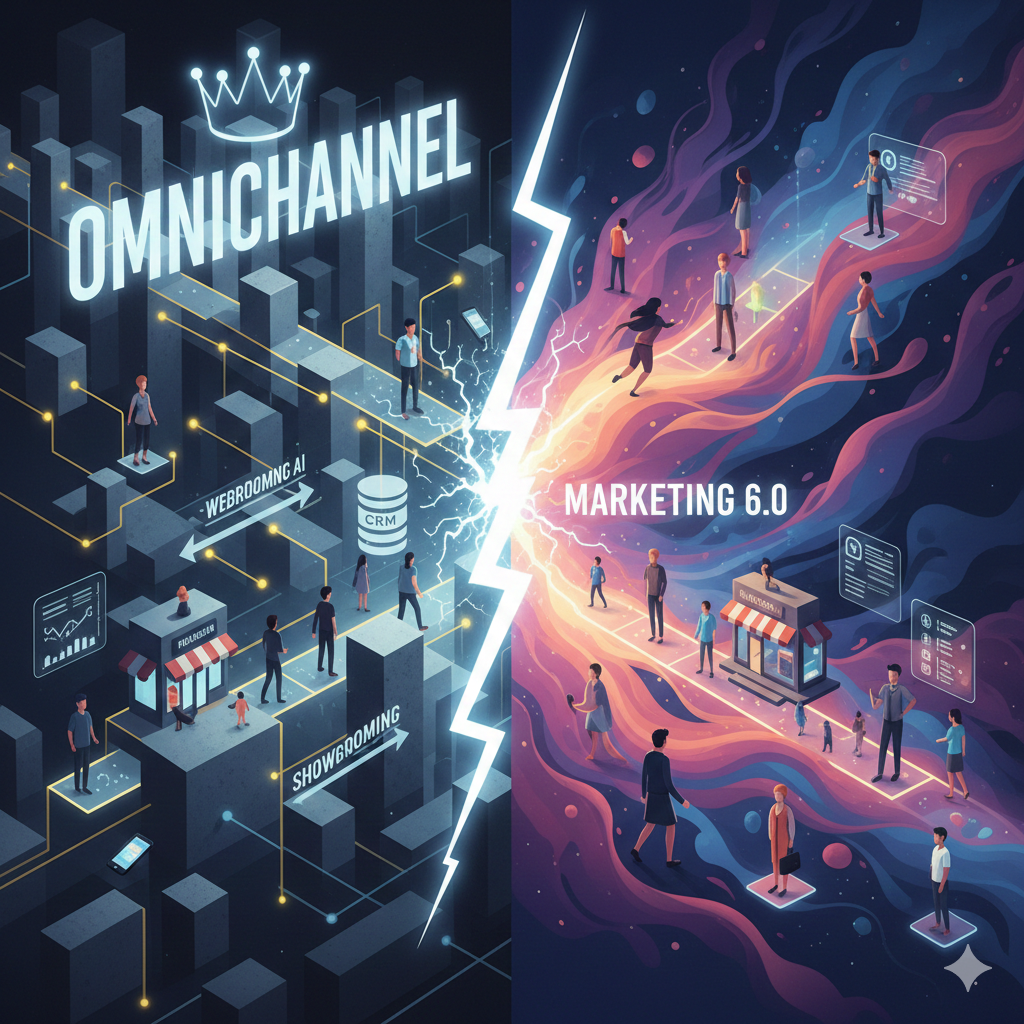
The promise was seductive and logical. If the customer had a smartphone in their hand and feet on the ground, our mission was to connect both worlds. We obsessed over terms like webrooming (research online, buy in-store) and showrooming (browse in-store, buy online). We invested millions in CRMs to unify databases and in logistics systems that allowed online purchases to be picked up in physical stores.
And just when we thought we had control—when physical and digital stores finally began speaking the same language—the customer changed planets.
That’s not an exaggeration. The arrival of generative Artificial Intelligence and the demographic rise of Generation Z and Generation Alpha have triggered a seismic shift that renders omnichannel obsolete. We are no longer in an era of connected “channels.” We are entering the era of Marketing 6.0, where the boundary between physical and digital is not crossed—it dissolves.
If your 2025 strategy is still based on “optimizing the online channel,” you’re preparing for a war that ended yesterday. The future is immersive, and here’s why.
The Evolution of Commercial Consciousness: From Selling to Purpose, and from Purpose to Immersion
To understand the magnitude of the change proposed by Marketing 6.0, we need to look in the rearview mirror. The history of modern marketing is not a straight line, but an upward spiral of complexity and humanity.
Just fifteen years ago, we lived in the era of Marketing 3.0. This was when we realized that the consumer was not a wallet with legs, but a human being with a soul. Brands stopped talking only about features and began talking about values, sustainability, and purpose. It was the era of “making the world a better place.”
Then technology ran us over. Marketing 4.0 arrived, forcing us to digitize that purpose. We learned to use content marketing and social media to accompany the customer along their journey. And almost without catching our breath, we entered Marketing 5.0, the era of “technology for humanity,” where pioneers like PepsiCo used algorithms to predict which flavors we would want before we knew it ourselves, or where Google used AI to democratize access to information.
But Marketing 6.0 is a fundamentally different leap. It’s not just about using technology to analyze the customer. It’s about using technology to create the customer’s reality.
The core difference lies in immersion. Up until 5.0, technology was an external tool: a screen we looked at, a keyboard we touched. In 6.0, technology becomes environmental. It disappears. It surrounds us. The screen—which for 20 years was our window into the digital world—has become a barrier that must be broken.
The New Concept: From Omnichannel to Metamarketing
Here, precision in language matters, because words create realities.
The omnichannel model is built on the assumption that two separate worlds exist: the physical (atoms) and the digital (bits). Omnichannel strategy is about building efficient bridges between those two islands. It’s logistical and communicative management: “If you message us on Twitter, the store should know who you are.” Useful—but reactive.
Marketing 6.0 introduces the concept of Metamarketing. The Greek prefix meta means “beyond” or “to transcend.” Metamarketing doesn’t aim to build bridges; it aims to drain the ocean separating the islands and create a single continent.
In a metamarketing strategy, the customer perceives no transition. There is no moment of “going online.” The internet is deployed over physical reality as an invisible but interactive layer.
Omnichannel example: You search for sneakers on Nike’s website, go to the store, try them on, and buy them.
Metamarketing example: You walk into a Nike store. Your phone vibrates because IoT sensors recognize you. A smart mirror shows how the sneakers look on you without you needing to untie the laces (Augmented Reality). When you buy them, you automatically receive a digital twin (NFT) of those sneakers so your avatar can wear them in Roblox that same afternoon.
In the second scenario, physical, digital, and virtual happen simultaneously. There are no channels. There is a single, unified experience.
Architects of Reality: The Three Layers of Marketing 6.0
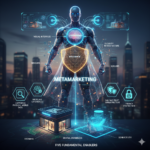
This new world isn’t built with good intentions—it’s built with heavy engineering. The framework outlines a three-layer architecture that any technology or marketing leader must begin assembling to avoid falling behind.
1. The Activation Layer: The Invisible Nervous System
At the base of the pyramid, hidden beneath the surface, are the technologies that make the magic possible. Without them, immersion is just smoke.
Internet of Things (IoT): The eyes and ears of the business. Sensors that capture physical behavior in real time. Imagine shelves that know when a product is picked up and when it’s put back.
Artificial Intelligence (AI): The brain. It processes millions of IoT data points to make decisions in milliseconds. AI is no longer for monthly reports—it personalizes music, lighting, or offers in a store the exact moment a specific customer walks in.
Spatial Computing: The ability of machines to understand 3D space. It’s what allows autonomous cars to avoid crashes or virtual fitting rooms to adapt clothing to your moving body.
Blockchain: The trust layer. In a digital world, how do you prove ownership? Blockchain enables decentralized ownership of digital assets—critical for the virtual economies to come.
2. The Environment Layer: The New Commerce Scenarios
Where will commerce happen in 2030? The answer: in places that today feel like science fiction.
Extended Realities: Physical stores won’t die—but “dumb” physical stores will. The future is augmented physical space. Walls that are screens, products that display information when touched, holographic guides.
The Metaverse: Forget the caricature of legless Facebook avatars. The real metaverse is immersive social platforms where Generation Alpha already lives: Roblox, Fortnite, Minecraft. These are not games; they are the new shopping malls. Public squares where kids hang out—and incidentally, play. If your brand doesn’t exist there, it doesn’t exist for them.
3. The Experience Layer: What the Customer Feels
At the top is what we actually deliver. Marketing 6.0 proposes three types of experiences to combat Zoom fatigue and digital boredom.
Multisensory Marketing: Sight and sound are saturated. The future is reclaiming touch (haptic technology that lets you “feel” digital textures), smell, and taste. Brands must design digital aromas and tactile experiences.
Spatial Marketing: Seamless integration between human and machine. The gold standard is Amazon Go’s Just Walk Out technology. The store becomes a living organism that senses you, gives you what you need, and charges you without pulling out a wallet. Zero friction.
Metaverse Marketing: Creating purely virtual goods and events. Luxury brands like Gucci and Balenciaga already sell digital bags that cost more than physical ones. Absurd? Not to a generation that values digital identity as much as—or more than—physical identity.
The Human Factor: Generation Z and Alpha Take Control
Why now? Why can’t we continue with comfortable digital marketing?
Because the customer has mutated. Generation Z (born mid-1990s to 2010) and Generation Alpha (born after 2010) are different species. For Boomers or Millennials, the internet was a discovery—something that arrived in our lives. We “logged on.” For an Alpha, the internet is like electricity or oxygen. They don’t connect—they simply exist within it.
They have radical intolerance for friction. They don’t understand waiting. They don’t understand why a store doesn’t know what they bought yesterday. They don’t understand why they can’t try on clothes virtually. Marketing 6.0 is, at its core, the business response to the impatience and technological expectations of these generations. They see no difference between atoms and bits—and demand that brands see no difference either.
The Technology Paradox: Becoming Human Again
There’s a final irony here. Marketing 6.0 might sound like a cold, robotic world of VR headsets and sensors. But the ultimate goal is the opposite.
The goal of Metamarketing is to make technology so advanced that it becomes invisible. To eliminate screens, keyboards, and checkout lines so that what remains is pure interaction. To let AI handle boring logistics so store associates can smile and advise instead of scanning barcodes. Marketing 6.0 uses machines to restore the humanity lost in 20th-century industrial processes.
Are You Ready to Break the Screen?
The shift from Omnichannel to Metamarketing is not a software update—it’s a mindset transplant. It requires companies to stop viewing departments (IT, Marketing, Sales, Retail) as silos and start seeing them as a single nervous system.
The question this paradigm places on your executive table is brutally honest: In a world where your competitor can take customers to an immersive virtual store, serve them with empathetic AI, and deliver products before they ask—does your “I have a website and a store” model still hold?
The future doesn’t belong to those with the best technology, but to those who make technology disappear in favor of pure experience. Welcome to Marketing 6.0.
Strategic Implementation Note
Jumping into Marketing 6.0 presents a massive operational challenge. You can’t manage IoT strategies, augmented reality, and metaverse presence with scattered emails and spreadsheets. Coordinating physical and digital teams requires a central operational brain.
This is where platforms like GGyess WorkSuite stop being a luxury and become critical infrastructure. To execute a metamarketing strategy, you need a system that centralizes complex project management, automates repetitive workflows, and enables real-time collaboration as fluid as the experiences you aim to deliver. GGyess provides the structural clarity and operational order your team needs to stop fighting administrative chaos and focus on building the immersive experiences that will define the next decade.