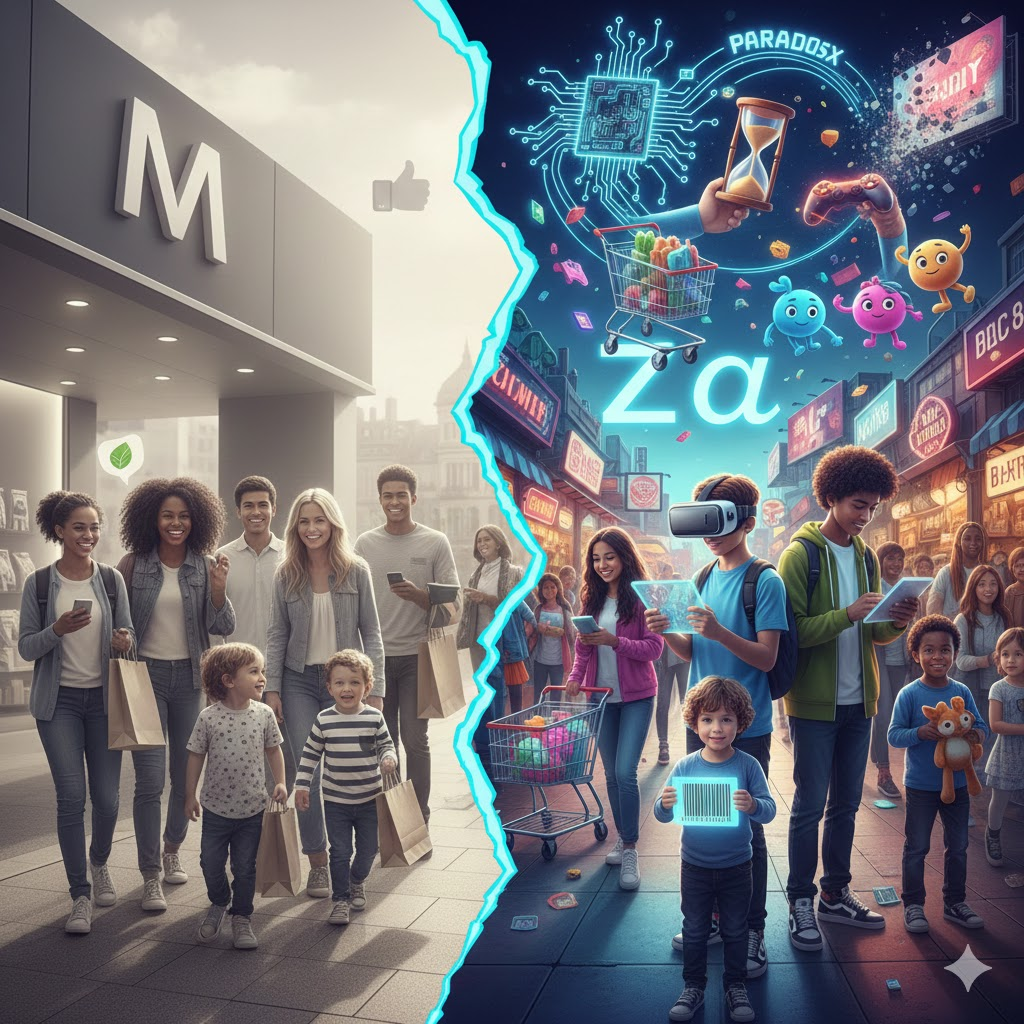
Over the past decade, brands have enjoyed a comfortable romance with Millennials (Generation Y). We got used to them. We knew they wanted eco-friendly products, that they shopped online but valued well-designed physical stores, and that we could persuade them with a solid Instagram influencer campaign.
But that golden age of predictability is over.
Millennials are no longer the rebellious kids; they are now parents and managers. Consumer power has shifted to two demographic groups that are radically different from anything we’ve seen before: Generation Z (born between the mid-1990s and 2010) and Generation Alpha (born after 2010).
Together, they represent more than 4 billion people. And they bring with them a paradox that is driving traditional CMOs crazy: they are addicted to technology yet prefer shopping in physical stores; they have 8-second attention spans but can stay focused on a video game for 5 hours; and they hate advertising but love brands that behave like real people.
In this second chapter of the new marketing era, we decode the DNA of these Phygital Natives and explain why your current “digital marketing” strategy probably feels irrelevant to them.
1. Phygital: When the Boundary No Longer Exists
The first thing we must understand is that for a 16-year-old Gen Z teen or a 10-year-old Alpha child, the distinction between “online” and “offline” is as absurd as the difference between “air inside the house” and “air outside.” For them, it’s all air. It’s all life.
Unlike Millennials—who witnessed the birth of the internet and treated it as a tool (“I log in to do something”)—Gen Z and Alpha live immersed in it. That’s why we call them Phygital Natives (Physical + Digital).
They’re having dinner with friends (physical) while chatting with others on Discord (digital) and buying a Fortnite skin (virtual). Everything happens at the same time.
This fluidity creates a fascinating paradox: they love physical stores. Studies from McKinsey and A.S. Watson show that Gen Z shops in physical stores more than Millennials. Why? Because for them, the store is not a logistics point (that’s what Amazon is for); the store is a social stage. They go to touch, try on, film TikToks in fitting rooms, and socialize.
They expect a fully phygital experience: walk in, scan a code to see reviews, pay with their phone without lining up, and leave. If your physical store is “dumb” (no digital integration), to them it’s a boring museum.
2. The KGOY Phenomenon: Growing Up at the Speed of Light
Another factor that makes these consumers especially hard to fool: they are premature adults.
The phenomenon is called KGOY (Kids Getting Older Younger). Due to unlimited access to information from birth and exposure to global crises (recessions, pandemics, climate change), these generations have matured at a breathtaking pace.
Traditionally, life followed clear stages: learn, explore, settle down, retire. Gen Z is doing the “learning,” “exploring,” and “settling” stages simultaneously. At 20, many are already worried about retirement, investing in crypto or fractional stocks, and prioritizing job stability over “idealistic dreams.”
They are radical pragmatists. While Millennials were idealists spending on “experiences” and avocado toast, Gen Z is financially realistic. They grew up watching their parents suffer through the 2008 crisis. They know what things cost.
They don’t buy brands for the logo; they buy for functional value and durability.
They don’t fall for emotional TV ads; they research five Reddit threads before pulling out their card.
3. The Anatomy of Attention: ADHD or Extreme Selectivity?
The most widespread myth is that Gen Z can’t pay attention. False. What they actually have is an extremely sophisticated garbage filter.
They grew up bombarded by thousands of ads per day. To survive, their brains developed selective blindness. They have an 8-second radar to decide whether something is relevant.
If your TikTok doesn’t hook them in second one: scroll.
If your website takes more than 3 seconds to load: gone.
But if content passes the filter (it’s authentic, entertaining, or useful), their capacity for immersion is infinite. They can binge-watch series or spend hours in the metaverse. The lesson for brands is brutal: interruptive advertising is dead. You can no longer buy attention; you must earn it by becoming part of their entertainment or their utility.
That’s why they prefer short, visual, direct formats (TikTok, Reels, Shorts) over long texts or 30-second ads.
4. The Tyranny of Authenticity: Why They Hate Perfection
If you want to kill your brand with Gen Z, do this: post a perfect studio photo with perfect models, perfect lighting, and an inspirational corporate slogan.
Gen Z smells fake from miles away. They grew up with Instagram filters and know perfection is a lie. That’s why they’re migrating from “posing” networks (Instagram) to “community and chaos” networks (TikTok, Discord, Reddit, Twitch).
Real Values: It’s not enough to say you’re sustainable. They want receipts. If you claim diversity and inclusion but your board is homogeneous, they will cancel you.
Raw Content (UGC): They’d rather see a real person—with acne and bad lighting—honestly reviewing a product on TikTok than a million-dollar TV commercial. User-Generated Content is the only trust currency they accept.
5. Liquid Identity: Being Yourself (Across Five Platforms)
Finally, we must understand how they manage identity. For Boomers, “being yourself” meant having a solid, consistent personality. For Gen Z and Alpha, identity is fluid and digital.
They invest real time and real money in building their digital persona.
They pay for Fortnite skins.
They curate their aesthetic on social platforms.
They use avatars to express themselves in the metaverse.
But unlike Millennials—who often had one face for LinkedIn and another for Instagram—Gen Z seeks cross-platform coherence. They value individuality and radical self-expression. They want to be themselves everywhere, and they expect brands to give them tools for that self-expression, not impose a uniform.
The Marketing 6.0 Challenge
Selling to Phygital Natives requires humility. We must accept that old “push message” tactics no longer work. We must accept that we don’t control the conversation—they do, in their Discord servers and Reddit communities.
To win in this new era, your brand must:
Be Phygital: Integrate technology into physical stores to eliminate friction, not to “decorate.”
Be Pragmatic: Offer real, functional, clear value. Drop the empty poetry.
Be Imperfect: Show behind the scenes. Speak like a person, not a corporation.
Be Immersive: Enter their worlds (games, metaverse) by respecting their rules—not as an advertising invader, but as an experience enabler.
The future doesn’t belong to the brands that shout the loudest, but to those that can whisper something authentic into the ear of a generation that has learned to ignore noise.
Strategic Implementation Note
Adapting to Phygital Natives requires operational speed that email threads and traditional meetings simply can’t provide. Managing UGC campaigns, coordinating IoT-enabled physical experiences, and maintaining authentic presence across decentralized platforms (Discord, TikTok) is logistical chaos.
To maintain coherence in this storm, you need a centralized operating system. GGyess WorkSuite allows you to orchestrate these multidisciplinary projects with precision. By automating task management and centralizing communication between creative and technical teams, GGyess ensures your brand moves at Gen Z speed—without breaking its internal structure in the process.