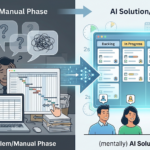
Elena stared at her computer screen with a mixture of pride and terror. Seven months had passed since she had “the big idea.” Seven months of twelve-hour days, of polishing every pixel, of debating every comma in the user manual, and of configuring a technological architecture that, according to her, would support millions of users. She felt like an architect building a cathedral. However, on launch day, the silence was deafening. A thousand visits, zero sales. Ten thousand dollars in advertising, two sign-ups. The market was sending her a message that her brain refused to process: she had built something that nobody wanted.
What Elena had just suffered is the silent nightmare of thousands of entrepreneurs and executives worldwide. She didn’t fail due to a lack of effort, but because of an excess of “operational waste.” In the information age, the most expensive resource isn’t money; it is your brain’s learning cycle. And if that cycle is blocked by inefficient processes, you are dead before you even begin.
The Neuroscience of Failure: The sunk cost bias
Why do we push forward with projects that aren’t working? Why did Elena spend seven months building something without validating it? The answer lies in our biology. The human brain hates to lose. When we invest time and energy into something, our neural architecture creates an emotional bond with the project. Dopamine activates when we imagine success, but when environmental signals tell us we are on the wrong track, our amygdala—the fear center—kicks in.
To avoid the pain of admitting a mistake, the brain resorts to “sunk cost bias.” We tell ourselves: “I’ve invested so much that I can’t quit now.” This biological mechanism is what keeps us tied to tools that don’t work, slow processes, and obsolete ideas. In the context of The Lean Startup by Eric Ries, this is the biggest obstacle to innovation. Efficiency is not about doing more things; it is about eliminating everything that does not add value to validated learning.
Muda: The poison of waste in the digital age
Eric Ries took the concept of muda (waste) from the Toyota Production System and applied it to the modern world of entrepreneurship. In a factory, waste is easy to see: defective parts, piled-up inventory, unnecessary movements. But in knowledge work, waste is invisible. It is a cognitive gas leak that suffocates your productivity.
Waste today is disguised as “being busy.” It is that two-hour meeting that could have been a message. It is the time you lose searching for a file that someone forgot to label. It is the energy you spend jumping between five different platforms to understand the status of a single project. Every minute you spend managing chaos instead of creating value is muda. And from a neuro-writing perspective, we know that this chaos generates cortisol. The chronic stress of not finding information or feeling that processes are slower than your ideas eventually burns out your team’s creative capacity.
The Loop that changes everything: Build, Measure, Learn
The foundation of operational efficiency according to Ries is the fundamental feedback loop: Build-Measure-Learn. The goal is not to finish a project, but to complete this loop as quickly as possible. If it takes you six months to learn that your client prefers Option B over Option A, you have wasted five and a half months.
Neurobiologically, this loop is a blessing for high performance. When we receive quick feedback, our brain enters a state of “directed plasticity.” We learn what works and what doesn’t, which reduces uncertainty and, therefore, anxiety. Agility isn’t about running faster; it’s about having the capacity to change direction without breaking your bones. To achieve this, you need an operational structure that is liquid. If your way of working is rigid, if your data is scattered, and your processes are bureaucratic, the learning loop stops. And a business that doesn’t learn is a business that is dying.
Vanity Metrics vs. Actionable Metrics: The cheap dopamine trap
One of the most critical points of The Lean Startup is the distinction between vanity metrics and actionable metrics. Vanity metrics are those that make you feel good but tell you nothing about the real health of your business: social media followers, number of free downloads, or “likes” on a post.
Your brain loves these metrics. They generate a quick dopamine spike. They make you feel like you are winning. But they are dangerous because they are not linked to operational efficiency or real growth. Actionable metrics, on the contrary, are those that force you to make decisions: conversion rate, customer acquisition cost, real retention. These metrics are often harder to look at, but they are the only ones that allow you to pivot successfully. Real operational efficiency is reached when you stop looking at the noise and start looking at the signal.
The Moment of Truth: Pivot or Persevere
A point comes in every project where the data clashes with the original vision. It is the moment of truth: Do we pivot or persevere? To persevere is to follow the current path. To pivot is a change in strategy designed to test a new hypothesis about the product, the business model, or the growth engine.
Pivoting requires courage, but above all, it requires clarity. You cannot pivot quickly if your information is fragmented. If you have to request three reports from three different departments and wait a week to understand what is happening, your capacity to pivot is zero. Neuroscience tells us that clarity reduces “cognitive load.” When information is transparent and centralized, the brain can make bold decisions with less stress. Operational agility is, ultimately, a matter of information availability.
Eliminating friction: The path toward the fluid startup
Friction is the silent killer of execution. It is the resistance you find when trying to move an idea from conception to market. In an inefficient organization, friction is everywhere: in a lack of communication, in the use of incompatible tools, and in time wasted on manual administrative tasks.
To eliminate wasted time, you need an infrastructure that favors flow. Flow is that state where work seems to happen effortlessly. For the brain, flow is the state of maximum efficiency. It is achieved when goals are clear, feedback is immediate, and distractions are minimal. Efficient operations act as an invisible operating system, allowing talent to focus on innovation rather than managing chaos.
GGyess: Your engine for validated learning and total efficiency
This is the point where Eric Ries’s theory meets the tool that makes it all possible. In a world where wasted time is the standard, GGyess stands as the ecosystem specifically designed to eliminate digital muda and boost your capacity to pivot.
We understood that you cannot apply the Lean method if your processes are scattered across ten different applications that don’t talk to each other. That is why GGyess has consolidated everything your company needs in one place. By centralizing project management, team communication, AI planning, and file storage, GGyess reduces operational friction to zero. No more time wasted jumping from tab to tab; no more attention residue burning your neurons.
With GGyess, the Build-Measure-Learn loop accelerates dramatically. Our integrated Artificial Intelligence allows you to break down ideas into action plans in seconds, meaning you can move from hypothesis to execution at a speed that was previously impossible. If the data tells you it’s time to pivot, GGyess gives you the agility to reorganize your entire game board in a click, ensuring your whole team is aligned with the new direction instantly.
By using GGyess, you are eliminating vanity metrics from your daily management and focusing on what truly moves the needle. Our platform gives you back control over your most valuable resource: your team’s focus time. It is the perfect ally to leave waste behind and become a high-performance organization that learns, evolves, and dominates its market.
Don’t allow your vision to sink due to slow and fragmented operations. Make efficiency your greatest competitive advantage. Visit ggyess.com today and discover how our unified ecosystem can transform your chaos into an unstoppable growth engine. It is time to stop wasting time and start doing wonders with GGyess. Your ability to pivot toward success is just one platform away.