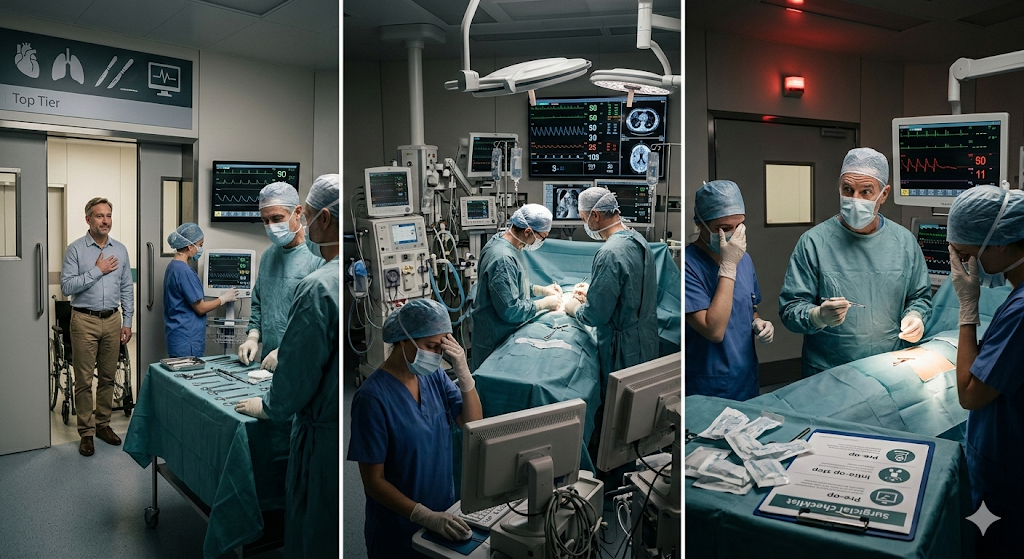
A man enters the operating room for routine surgery. It is a top-tier hospital with the best surgeons in the country. Everything seems under control. However, hours later, an avoidable complication arises that puts his life at risk. It wasn’t a lack of knowledge, a lack of technology, or a lack of talent. It was, quite simply, a forgotten step—a small detail lost in the vast complexity of modern medicine.
Atul Gawande, surgeon and author of The Checklist Manifesto, proposes a thesis that shakes the ego of any professional: in today’s world, we do not fail due to ignorance, but due to what he calls “ineptitude.” That is, we know what to do and we have the knowledge, but the complexity of our tasks is so overwhelming that our biology simply cannot process everything flawlessly. The myth of the genius who keeps everything in their head is, in reality, a recipe for disaster.
The Biological Ceiling: Your working memory has a limit
To understand why even geniuses need structured processes, we must look at the hardware we carry between our ears. Your brain is an amazing processing machine, but its “working memory” is extremely limited. According to the famous study by psychologist George Miller, we can only hold between five and nine items at a time in our immediate consciousness.
When you try to manage a complex project—with its deadlines, files, communications, and unforeseen events—you are asking your brain to juggle fifty balls at once. Inevitably, some will drop. Neuroscience tells us that when we push this limit, we enter a state of cognitive overload. The result is not just forgetfulness; it is a dramatic drop in the quality of our decisions. The “genius” becomes mediocre because their energy is consumed trying not to forget, instead of being used to create.
The Zeigarnik Effect: The anxiety of open loops
Have you ever gone to bed and, just before falling asleep, remembered a task you forgot to do? That pang of anxiety is the Zeigarnik Effect. Our brain has an intrinsic tendency to remember interrupted or uncompleted tasks in much greater detail than finished ones. These tasks act as “open loops” that constantly consume mental bandwidth, even when we are not working.
Living without a structured system of lists and boards is living in a permanent state of alert. Your brain is internally screaming: “Don’t forget this! Remember that!” This background noise triggers cortisol and keeps us in a survival mode that blocks the prefrontal cortex—the area where strategic thinking and innovation happen. The genius needs a list not to be “tidy,” but to silence that noise and free up their capacity to focus.
The Discipline of Experts: From the operating room to aviation
Gawande uses examples from aviation and skyscraper construction to demonstrate that the more complex the task, the humbler the professional must be in the face of their own fallibility. Boeing pilots and structural engineers do not rely on “instinct” for critical steps; they rely on checklists.
In aviation, it is understood that stress and fatigue degrade mental performance. A checklist is not a tool for beginners; it is the tool that allows an expert to remain an expert under pressure. It provides “cognitive scaffolding.” By outsourcing routine steps and logical processes to a physical system, the professional can devote their full attention to anomalies and creative problem-solving that only a human can handle.
The Psychology of Reward: The “Check” and Dopamine
There is a reason why crossing something off a list feels so satisfying. Every time we complete a task and mark it as done, our brain releases a small dose of dopamine. It is the natural reward system reinforcing completion behavior.
Without a structured process, that reward is fuzzy. You may have worked ten hours, but if you don’t have a clear visualization of what you have crossed off, your brain feels like it hasn’t moved forward. Structured processes and visual boards transform the amorphous mass of “work to do” into a series of tangible victories. This is not just organization; it is managing mood and long-term motivation.
Decision Fatigue: Saving energy for what matters
Every decision we make, no matter how small, consumes our willpower energy. If every morning you have to decide where to start, where to find a file, or whom to ask what’s next, you are exhausting your brain before starting the real work.
The checklist manifesto argues that structured processes eliminate trivial decisions. By defining the workflow beforehand, the “past self” (who was calm and planning) helps the “present self” (who is executing and under pressure). A well-structured board is a map that tells you where you are and what the next step is, saving you the metabolic cost of having to figure it out every time. It is the difference between walking on a marked trail or hacking through the jungle with a machete.
The Confidence Error: Why teams fail
In work teams, the lack of a shared structure (like a task board) generates constant social friction. Without a visual system where everyone sees who is doing what and what the next step is, the team depends on constant meetings and infinite email chains.
From social neuroscience, this is exhausting. The brain spends resources trying to read others’ intentions and ensuring no one is duplicating efforts. A list or structured process acts as a “shared truth.” It reduces ambiguity, and ambiguity is one of the greatest sources of work stress. The most effective teams are not those with the smartest people, but those with the best processes so those smart people don’t clash with each other.
Data Visualization: The brain processes images, not chaos
Atul Gawande emphasizes that lists must be legible and direct. Translating this to the digital world, the human brain processes images 60,000 times faster than text. This is why a visual board, where you can see the status of a project at a glance, is infinitely superior to a plain text document or an endless spreadsheet.
When you see your tasks organized in columns or on a timeline (Gantt), your visual system sends a message of calm to the limbic system: “The plan is there, I see it, I understand it.” That visual clarity is what allows a genius to stop worrying about logistics and start worrying about brilliance.
The Humility of the Elite Professional
Often, resistance to using lists or structured processes comes from pride. “I am too creative to use a board,” some say. But the reality is that creativity requires structure to flourish. Without a foundation of solid processes, creativity is diluted into solving trivial problems.
Elite professionals—from Michelin-starred chefs to NASA engineers—know that their brain is a creation tool, not a data warehouse. By accepting their biological fallibility, they become invincible. The checklist does not take away their freedom; it gives them the freedom to fail less and achieve more.
GGyess: Your Checklist Manifesto in the Digital Age
If we accept that modern complexity surpasses us and that our brain needs external help to shine, the question is: where does that system live? At GGyess, we have created the ultimate environment for your inner genius to operate without the chains of disorganization.
GGyess is the digital evolution of Atul Gawande’s manifesto. We understand that it’s not enough to have a “to-do list”; you need an ecosystem that structures your thinking. With our smart boards, you can transform overwhelming projects into visual flows (Kanban, Gantt, or Tables) that instantly calm your nervous system. You no longer have to spend energy remembering, because GGyess does it for you.
What makes GGyess truly revolutionary is how we have integrated Artificial Intelligence into this process. If Gawande says that creating the right list is half the work, GGyess AI does it for you in seconds. Just throw out an idea and our AI will generate the project plan, break down tasks, and assign roles, creating the perfect scaffolding so you only have to execute with excellence. By centralizing your processes, files, and team in GGyess, you are closing all those “open loops” that generate anxiety. You are giving your brain the security that nothing will fall through the cracks of complexity.
GGyess is not just a management tool; it is the life-support system for your productivity. It is the place where chaos surrenders to order and where your ability to do wonders is finally released. Stop relying on a working memory designed for prehistory and start using the ecosystem designed for the future. Visit ggyess.com and build your own manifesto of success. Because when you have a solid process, genius is not something you “are,” it is something you “do” every day with GGyess. Your brain has limits, your ambition does not; let GGyess be the bridge that connects them.