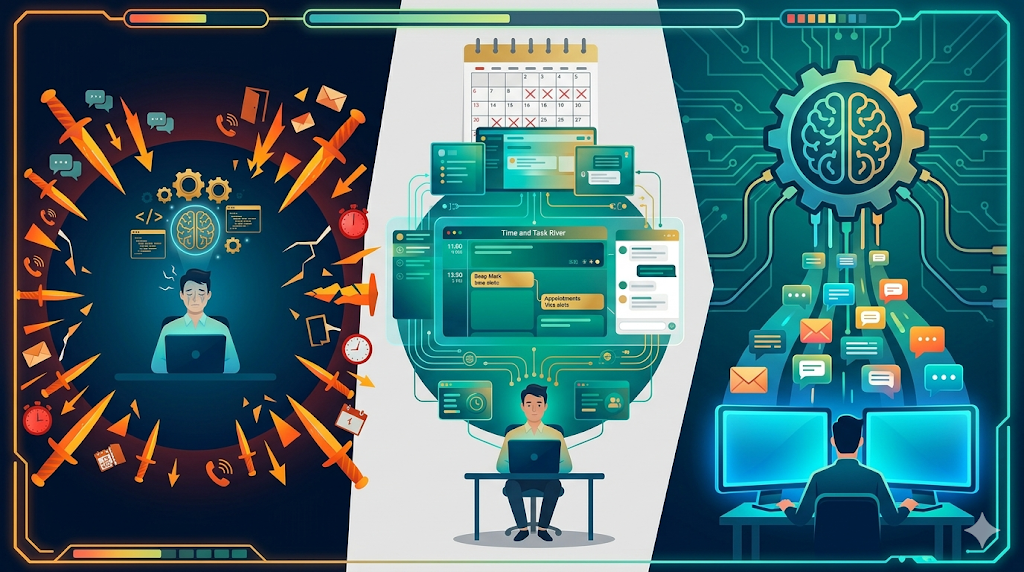
In the modern digital economy, a company’s most valuable asset is not its software stack, its office space, or even its client list. The ultimate currency of a high-growth organization is uninterrupted human focus.
Yet, we have inadvertently designed workplaces that treat focus as a limitless, easily replaceable resource. We applaud the “open-door policy” and celebrate hyper-availability, equating rapid response times with dedication. But for creative professionals, developers, strategists, and founders, this culture of constant connectivity comes at a staggering cost. It systematically destroys the capacity for “Deep Work”—the state of distraction-free concentration required to push your cognitive capabilities to their limits and produce truly elite results.
The primary culprit behind this destruction of deep work? The fragmented, standalone calendar.
We have normalized a workflow where scheduling, task management, and communication live in completely different digital universes. This separation forces teams into a perpetual state of reactive chaos. To build a sustainable, high-performance culture, we must rethink how we manage time. We must stop treating appointments as isolated events and start treating them as native components of our operational workflow.
The Illusion of the “Empty” Calendar
To understand the friction in modern scheduling, we have to examine the paradox of the “dumb calendar.”
In a traditional setup, your project management tool holds your actual deliverables, while a third-party booking app dictates your availability. When a client, a vendor, or a colleague looks at your calendar link, they see blank space. They see that you only have two hours of video calls scheduled for Tuesday, which leads them to assume you have six hours of “free” time.
But that calendar is entirely blind to your actual workload.
It does not know that you have a massive product launch on Wednesday. It does not know that an AI assistant just helped you instantly generate a complete task structure with pressing deadlines assigned to you. It does not account for the four hours of intense, focused problem-solving you need to complete a critical milestone. Because the calendar only tracks meetings and not tasks, it allows anyone with a link to cannibalize your most productive hours.
You become a victim of your own accessibility. Your days are carved into disjointed 30-minute blocks, leaving you with fragmented slivers of time that are entirely insufficient for complex, cognitively demanding execution.
The Cognitive Cost of Context Switching
The damage caused by scattered appointments goes far beyond the minutes spent on the calls themselves. The true cost lies in the cognitive transitions required to navigate them.
Psychologists refer to the “resumption time”—the period it takes for a human brain to return to a state of deep focus after an interruption. Studies consistently show that it takes an average of 23 minutes to fully recover your concentration after shifting your attention away from a complex task.
Consider a typical scenario in a fragmented tech stack:
- You are deeply immersed in a strategic project board, making critical decisions.
- A standalone reminder app abruptly pulls your attention away to notify you of an impending meeting.
- You abandon your workspace, open your email, and hunt for an external video conferencing link.
- You join the call, completely severing your mental connection to the project you were just working on.
- After the call, you must close the video app, reopen your project manager, re-orient yourself to the interface, and try to remember your exact train of thought.
When this cycle happens three or four times a day, your creative bandwidth is annihilated. The sheer mental effort of transitioning between the interface of your tasks, the interface of your calendar, and the interface of your video calls induces decision fatigue before the day is even half over.
The Paradigm Shift: Merging Appointments into the WorkHub
The solution is not to stop meeting with clients or collaborating with teams. The solution is architectural. To democratize deep work and protect your team’s bandwidth, the scheduling mechanism must be intimately fused with the task execution engine.
Enter the unified WorkHub.
When you eliminate the boundaries between what you are doing and when you are doing it, the entire operational dynamic changes. An integrated workspace connects every part of your workflow—tasks, projects, teams, and files—without switching between a dozen apps. This consolidation allows for a radical new approach to time management: Contextual Scheduling.
1. Capacity-Aware Availability
Imagine a booking system that actually understands your workload. By bringing appointment scheduling directly into the WorkHub, your availability is no longer just a reflection of your empty meeting slots; it is a reflection of your true operational capacity.
If you are assigned to a critical project phase, you can seamlessly block out “Deep Work” sprints on the exact same platform that manages the project. Because the tasks and the schedule live in the same ecosystem, you can transition smoothly between visualizing your deliverables in a Kanban board or a Gantt chart, and seeing how they map onto your Calendar view. This empowers teams to construct realistic timelines that honor both collaborative meetings and intense, solitary focus.
2. Frictionless Video Integration
The era of the external video link is ending. When appointments are natively integrated into the workspace, the meeting itself happens where the work happens.
If a client books a discovery call or a team lead schedules a sprint review, the event acts as an anchor inside the WorkHub. When it is time to meet, there is no app-switching. The video call opens directly within the platform. You can discuss the strategy face-to-face while simultaneously co-editing documents, reviewing shared files, and dragging task cards across a board. The meeting does not interrupt the workflow; it becomes an active, embedded part of it.
3. Smart, Contextual Reminders
Notification anxiety is a direct result of disjointed systems screaming for your attention at the wrong times. In a unified WorkHub, reminders undergo a massive evolution. They transition from “dumb alarms” to “intelligent, contextual nudges.”
Because the platform houses your appointments, your video calls, and your project deadlines, the reminder architecture can be highly strategic. You are gently notified of an upcoming stakeholder call without being violently pulled out of your task environment. The reminder serves as a bridge, smoothly guiding you from a state of deep work into a collaborative session, and safely depositing you back into your workflow afterward.
Turning Ideas into Action Automatically
One of the most powerful byproducts of this unified architecture is the elimination of administrative “ghost work.” In a traditional setup, after an appointment ends, someone has to spend an hour manually translating the conversation into actionable project steps.
Within an integrated WorkHub powered by artificial intelligence, this friction disappears. You can simply write what you need done in plain language, and the system breaks it into detailed, actionable tasks with deadlines, priorities, and owners. The transition from a booked appointment to an active execution pathway is nearly instantaneous.
You no longer have to worry about whether a promise made on a video call will make it onto the task board. The scaffolding is built right in front of you.
Reclaiming the Digital Workspace
For too long, we have allowed our tools to dictate our work habits. We have surrendered our calendars to the chaos of external booking links and sacrificed our focus to the altar of context-switching.
It is time to take back control of our creative bandwidth.
By demanding an infrastructure that respects the psychology of deep work, leaders can foster an environment where true innovation thrives. When teams are not constantly exhausted by the administrative friction of navigating disparate apps, they can channel their absolute best energy into the work that actually moves the needle.
This philosophy of absolute focus and streamlined execution is the driving force behind GGyess. Moving beyond the limitations of basic project management, GGyess has evolved into a singular, uncompromising productivity engine. By natively integrating your appointments, built-in video calls, intelligent reminders, and AI-powered task generation into one unified WorkHub, GGyess eliminates the noise of the fragmented tech stack. It acts as an impenetrable shield for your team’s time, ensuring that the space where you schedule your work, discuss your work, and execute your work is exactly the same place. Reclaim your focus and accelerate your growth with GGyess.