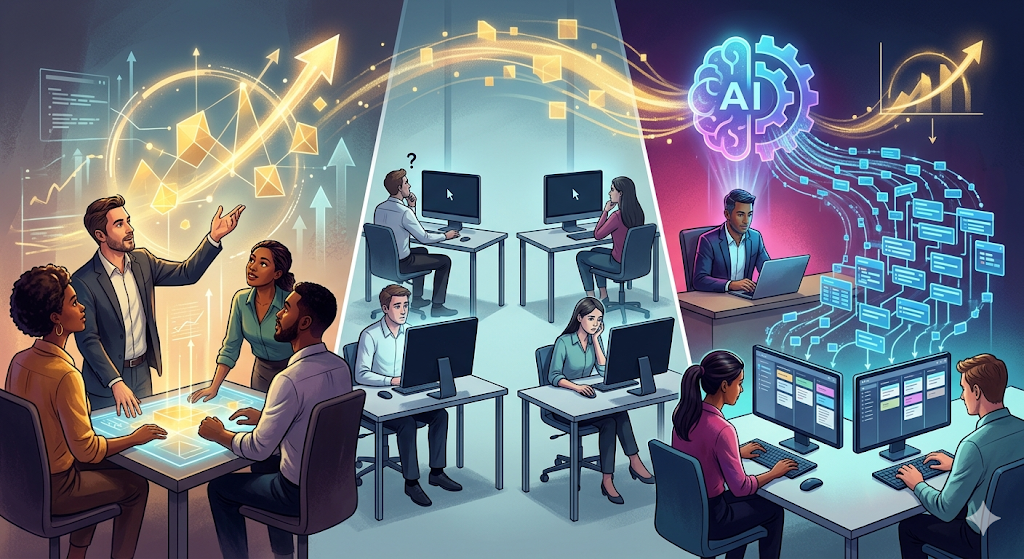
Every visionary leader, startup founder, and agency director is intimately familiar with the “Monday Morning Chasm.”
It happens during the all-hands meeting. The founder delivers a passionate, highly strategic brief about a new product launch, a market expansion, or a massive client pivot. The vision is crystal clear. The team nods enthusiastically, energized by the roadmap. The call ends, the team members open their digital workspaces, and suddenly, the momentum evaporates.
They are staring at a blank screen.
This is the Vision-Execution Gap. Having a brilliant strategic goal is only 10% of the battle; the remaining 90% is the grueling, administrative, and highly cognitive labor of breaking that massive goal down into a linear sequence of micro-tasks. Traditionally, this burden falls on project managers who spend hours meticulously translating a 15-minute speech into hundreds of individual cards, assigning deadlines, calculating workloads, and hunting down the right team members.
But the architecture of digital work has fundamentally shifted. We have entered the era of “AI-Assisted Scaffolding”—a paradigm where artificial intelligence bridges the gap between human ambition and operational execution in a matter of seconds.
The Concept of Organizational Scaffolding
In cognitive psychology and education, “scaffolding” refers to the temporary, structural support provided to a learner to help them achieve a complex goal they could not accomplish on their own. Once the foundation is strong, the scaffolding is removed, and the structure stands independently.
In the context of a high-growth remote or hybrid team, scaffolding is the digital infrastructure of a project. It is the timeline, the task hierarchy, the assigned responsibilities, and the underlying documentation. Without strong scaffolding, teams experience crippling decision paralysis. They waste their highest-energy hours trying to figure out what to do, rather than actually doing it.
For years, building this scaffolding was an entirely manual, friction-heavy process. You had to conceptualize the goal, open a fragmented project management tool, manually type out every individual step, cross-reference your team’s availability on a separate calendar, and individually notify people on a disconnected chat app. It was a tax on mental bandwidth that punished fast-moving organizations.
Today, advanced artificial intelligence has automated the role of the structural architect.
AI as the Ultimate Project Architect
Imagine a workflow where the friction of manual setup is entirely eradicated. Instead of staring at a blank spreadsheet and trying to reverse-engineer a project timeline, you simply type what you need done in plain language.
The intervention of AI in project management is not about writing your marketing copy or generating code; it is about cognitive offloading. You paste a project brief or a simple goal, and the artificial intelligence acts instantly to generate a complete task structure. It comprehends the dependencies of your request, effectively turning a vague mandate like “Launch Q3 Marketing Campaign” into a robust, multi-phase execution pathway.
1. Granular Task Decomposition
The most paralyzing aspect of a new project is its scale. AI scaffolding solves this by taking a macro-level objective and breaking it down into detailed, actionable tasks. It parses the requirements and establishes a logical progression of events. Instead of a single, intimidating milestone, the team is presented with a clear, step-by-step checklist where every item represents a manageable, achievable victory.
2. Intelligent Workload Distribution
A structured project plan is useless if the right people aren’t driving the execution. Modern AI systems have evolved to understand the specific dynamics of your workforce. By analyzing your team, the AI can auto-assign tasks based on role tags and current workload. It knows that a “Wireframe Design” task belongs to the UX tag, and it intelligently assigns tasks to the right team members to prevent bottlenecks and burnout.
3. Automated Deadlines and Priority Sequencing
Setting realistic deadlines requires a nuanced understanding of capacity and task dependencies—a calculus that humans frequently get wrong. AI scaffolding eliminates this guesswork. When it generates the project structure, it simultaneously suggests deadlines and assigns priorities. It sequences the work so that dependencies are respected, ensuring that the development team isn’t waiting on unassigned design assets.
The Synergy of the Unified WorkHub
However, generating an intelligent task list is only half the equation. If those AI-generated tasks are isolated from the environments where your team actually communicates, schedules, and meets, the scaffolding will collapse.
The true power of AI project design is unlocked when it exists within a consolidated, all-in-one ecosystem—a unified WorkHub. When the barriers between planning and collaboration are dissolved, the speed of execution accelerates exponentially.
Seamless Conversational Context
When an AI generates a 40-step product launch, questions will inevitably arise. In a fragmented tech stack, team members would have to copy a task link, jump into a third-party messaging app, and try to explain the context to a colleague.
In a perfectly integrated WorkHub, communication is native to the work. When a complex task requires deep alignment, teams shouldn’t have to scramble for external video conferencing links. Built-in video calls allow stakeholders to launch face-to-face syncs directly from the project board. The conversation happens exactly where the tasks, files, and AI-generated roadmaps live, preserving absolute context and keeping the momentum alive.
Synchronizing Strategy with Appointments
Projects do not exist in a vacuum; they interact with the outside world. Whether it’s a client feedback session, a vendor negotiation, or a stakeholder review, external appointments dictate the rhythm of internal execution.
By unifying your appointment scheduling directly into your WorkHub, external commitments instantly inform internal capacity. When a client books a strategy session, it populates alongside the AI-generated tasks. The system intuitively connects your external calendar obligations with your team’s internal delivery dates, ensuring no one is scheduled for deep-focus execution on a day filled with client-facing appointments.
Eradicating “Ghost Work” with Smart Reminders
Even the most perfectly architected project plan will fail if it relies on human memory to keep it moving. “Ghost work”—the constant, manual checking of statuses, pinging colleagues for updates, and adjusting calendars—is a massive drain on operational efficiency.
This is where automated, intelligent reminders become the final layer of the scaffolding. Instead of managers acting as human alarm clocks, the system takes on the burden of follow-ups. Intelligent reminders keep every assignee tethered to their deadlines without inducing notification fatigue. Because the AI originally structured the timeline, the system organically nudges the right people at the exact right moments, ensuring the execution pathway remains clear and uninterrupted.
From Paralysis to Velocity
The psychological impact of working in an AI-scaffolded environment cannot be overstated. When a team logs in on a Monday morning, they are not met with ambiguity. They do not have to decipher the founder’s vision or spend three hours organizing their to-do lists.
They are presented with absolute clarity.
They can even interact conversationally with their workspace, using built-in AI to answer critical questions like “What’s due this week?” right inside their board. This level of operational transparency empowers teams to operate with deep autonomy. Leadership is no longer bogged down in the minutiae of task delegation, and creative professionals are no longer paralyzed by structural chaos.
When you remove the friction of project setup, you give your team the greatest gift possible: the time and mental bandwidth to actually do the work they were hired to do.
To transform your operational speed, you need an ecosystem that doesn’t just store your tasks, but actively helps you build them. GGyess is the ultimate productivity engine designed for this exact purpose. By fusing AI-assisted task generation with a unified WorkHub, GGyess turns plain-language ideas into structured, assigned, and prioritized roadmaps in seconds. And because GGyess natively integrates your video calls, appointments, and smart reminders directly into your workspace, your team will never have to break focus or switch apps to execute the vision. Stop managing your software, and let GGyess build the scaffolding for your success.