
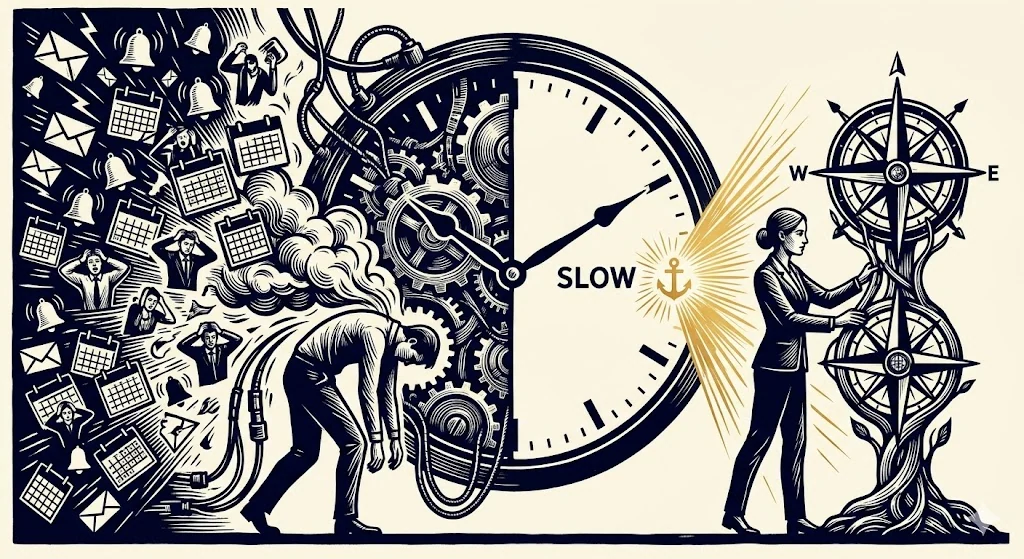
The modern workplace is defined by a paradox: we have more tools, technologies, and methodologies designed to save us time than at any other point in human history, yet professionals feel more overwhelmed, exhausted, and starved for time than ever before. We are constantly connected, rapidly responding to emails, participating in back-to-back virtual meetings, and managing a relentless influx of digital notifications. This frantic pace is often mistaken for actual work.
However, computer science professor and author Cal Newport argues that this frenetic activity is actually “pseudo-productivity.” It is the illusion of accomplishment generated by doing tasks quickly and visibly, rather than doing work that is truly meaningful. In response to this burnout-inducing culture, Newport proposes a radical, yet deeply intuitive alternative: Slow Productivity.
Slow productivity is not an excuse to be lazy or to lower your ambitions. On the contrary, it is a highly strategic manifesto for accomplishing significant, lasting, and high-impact work. It is about shifting your focus away from the volume of tasks you complete and toward the quality of the value you produce.
In this comprehensive guide, we will unpack the core philosophies of Cal Newport’s slow productivity movement, explore why the modern knowledge worker must desperately pivot toward deep work, and provide actionable frameworks for implementing these principles into your daily professional life.
The Trap of Pseudo-Productivity
Before the digital age, productivity was relatively simple to measure. In an industrial, factory-based economy, productivity meant producing more physical widgets in less time. When the global economy shifted toward knowledge work—jobs requiring critical thinking, strategy, design, and complex problem-solving—we lacked a new metric for measuring success.
As a result, we defaulted back to the industrial metric of visible activity. Today, pseudo-productivity is defined by visible busyness. If you are typing quickly, responding to emails within minutes, and filling your calendar with meetings, you appear highly productive to the outside world. But knowledge work does not scale like factory work. A brilliant marketing strategy, a complex piece of software architecture, or a compelling design cannot be mass-produced through sheer speed.
When you prioritize speed and visible busyness, you fragment your attention. Your brain is forced to constantly switch contexts between writing a report, answering a Slack message, and attending a brainstorming session. This constant context-switching leads to profound cognitive fatigue and significantly lowers the quality of your output. Slow productivity demands that we break free from this industrial hangover and respect the true nature of knowledge work.
Principle 1: Do Fewer Things
The foundational pillar of slow productivity is radically reducing the number of projects and commitments you take on at any given time. This directly challenges the modern corporate instinct to say “yes” to every opportunity, side project, or administrative task.
When your plate is overflowing, you spend the vast majority of your day simply managing your obligations rather than executing them. You spend hours organizing your to-do lists, sending status updates, and apologizing for delays. This administrative overhead suffocates your ability to actually do the deep work required to move a project forward.
By doing fewer things, you dramatically reduce this overhead. You reclaim the mental bandwidth necessary to think critically and creatively. For example, when designing accessible digital solutions or targeted marketing campaigns that genuinely serve and empower the lower-middle class, success depends entirely on thoughtful, culturally resonant execution. This demographic requires practical, high-value solutions, which cannot be achieved through a rushed, scattergun approach of mediocre ideas. Doing fewer things allows you to dedicate the intense focus required to create something of undeniable substance.
Actionable Steps:
- Implement a “Pull” System: Instead of constantly having new tasks pushed onto your plate, create a queue of pending projects. Only pull a new project into your active workflow when you have completely finished and delivered an existing one.
- Audit Your Commitments: Regularly review your professional obligations. Identify recurring meetings, committees, or low-impact projects that drain your time. Ruthlessly negotiate your exit from these commitments to free up your schedule for high-impact work.
Principle 2: Work at a Natural Pace
The second principle of slow productivity challenges the expectation of relentless, year-round intensity. Humans are not machines; we operate on biological rhythms. We experience seasons of high energy and creativity, followed naturally by periods requiring rest and reflection.
However, modern hustle culture expects us to operate at 100% capacity, eight hours a day, fifty weeks a year. This unnatural pacing is the primary driver of chronic professional burnout. Slow productivity advocates for embracing variation in your intensity. It means allowing projects to take the time they actually need to mature, rather than forcing them into arbitrary, high-pressure deadlines designed solely to create a false sense of urgency.
Working at a natural pace also means recognizing that a five-year timeline is often much more realistic and less stressful than trying to completely reinvent your career or your business in six months. It is about playing the long game.
Actionable Steps:
- Embrace Seasonality: Structure your year to include periods of intense execution (like a product launch) followed immediately by periods of lighter, more reflective work (like strategic planning or professional development).
- Protect Your “Deep Work” Blocks: Schedule uninterrupted 2-to-3 hour blocks of time on your calendar specifically dedicated to your most complex tasks. Treat these blocks with the exact same respect you would give to a meeting with your most important client.
- Disconnect Completely: When the workday ends, end it completely. Turn off notifications and allow your brain to recover. Rest is not the opposite of productivity; it is the essential fuel that makes deep work possible.
Principle 3: Obsess Over Quality
When you commit to doing fewer things and working at a natural, sustainable pace, you unlock the ability to obsess over the quality of your work. In a world saturated with quickly produced, shallow content and rushed products, true quality is rare and highly valuable.
Obsessing over quality means going beyond the surface level. It means refining your craft, learning new skills, and paying meticulous attention to the details that others ignore. It is the deep satisfaction of knowing you have produced something undeniably good.
Cal Newport famously argues that you should “be so good they can’t ignore you.” You cannot achieve that level of mastery if you are constantly rushing to clear your inbox or check off a dozen minor tasks by 5:00 PM. Mastery requires patience, deliberate practice, and the willingness to engage in difficult, intellectually demanding deep work.
Actionable Steps:
- Define “Quality” in Your Role: Take the time to clearly articulate what a high-quality outcome looks like for your specific profession. What are the metrics of excellence? Use this definition as your ultimate north star.
- Implement Feedback Loops: Obsessing over quality does not mean working in a vacuum. Regularly seek out constructive criticism from trusted peers or mentors to refine your work and catch blind spots you may have missed.
Executing Slow Productivity with GGyess
Transitioning from a chaotic, hustle-driven mindset to a slow, deliberate, and deep work methodology requires discipline. But more importantly, it requires a system that actively supports your focus rather than distracting you from it.
This is exactly where GGyess becomes your ultimate professional ally.
GGyess is built on the philosophy that you do not need more hours in the day; you need a plan you can completely trust. We have evolved and streamlined our platform to strip away the noise. By completely removing the SocialSuite and MasterSuite, we have returned to a singular, focused powerhouse: GGyess. This unified platform is designed to consolidate your workflow, acting as the only tool you need to manage tasks, teams, and projects without the cognitive fatigue of constantly switching between a dozen different apps.
At the heart of GGyess is WorkHub (the evolved, highly optimized successor to Planily). WorkHub is where your deep work is structured and protected. Within WorkHub, you can visualize your project’s trajectory using your preferred method—whether that is a Kanban board, a detailed Gantt chart, a Calendar, or a Table view.
Furthermore, to support the natural pace of your work and ensure seamless collaboration without leaving your deep-work environment, GGyess now includes:
- Integrated Video Calls: Connect face-to-face with your team or clients instantly, directly within the platform, eliminating the need for external conferencing links.
- Smart Appointments: Schedule your deep work blocks and collaborative sessions efficiently, ensuring your time is protected and your natural pace is respected.
- Automated Reminders: Let the system carry the cognitive load of remembering deadlines. Set customized reminders for your critical milestones, freeing your mind to obsess over the quality of the task at hand.
GGyess handles the heavy lifting of organization, utilizing an integrated AI assistant to effortlessly turn your project briefs into detailed, actionable tasks with clear deadlines and priorities. By centralizing your knowledge, your files, and your team’s communication, GGyess provides the ultimate foundation for slow productivity. Start for free today, and reclaim your time for the work that truly matters.
Put your next project in motion.
Explore GGyess and find a place to organize the work with your team.
Explore GGyess ↗