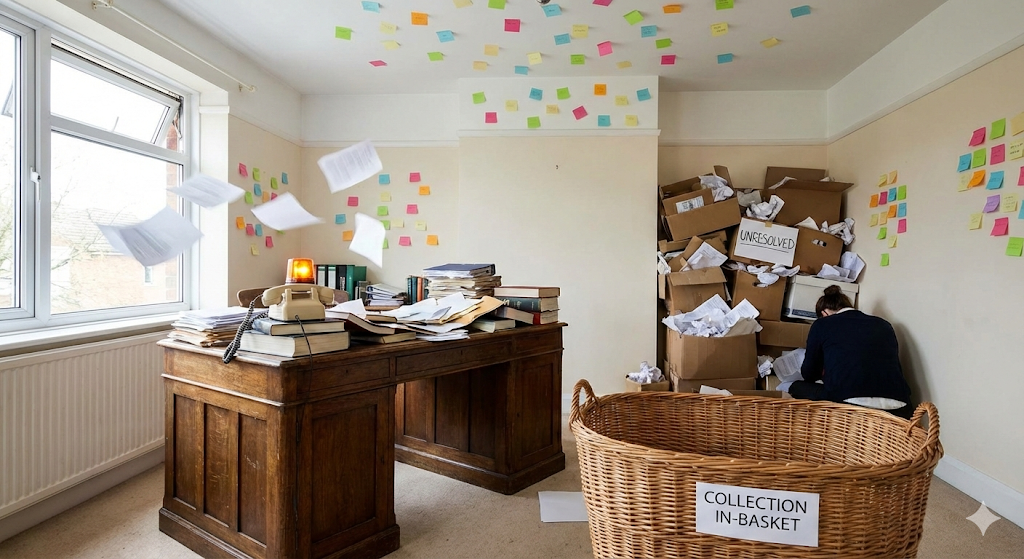
Imagine for a moment that your mind is a room. Right now, that room has windows open where papers are flying in, the phone won’t stop ringing, there are sticky notes glued to the ceiling, and in a corner, a pile of unresolved issues looks at you with disapproval. Trying to work like this is impossible. Trying to relax like this is a pipe dream.
In this fifth chapter, we enter the most cathartic and fundamental phase of the system: Collection.
The goal here is radical and allows for no half-measures. You must gather one hundred percent of the incomplete tasks, fleeting ideas, misplaced objects, and worries orbiting your head, and put them all in a single place. A single container. A master “in-basket.” Only when you have everything captured can your mind drop the ballast and reach that state of “mind like water” we crave so much.
The Golden Rule: Forbidden to Think (For Now)
The most common mistake productivity rookies make is trying to organize while collecting. They start cleaning the desk, find an old bill, and stop to pay it or decide where to file it. Grave error. If you stop to process, you break the flow, and you will never finish capturing.
Collection is a brute activity. It’s like sweeping leaves in the garden in autumn; you don’t stop to look at each leaf and decide if it’s pretty or ugly. You simply sweep them all into a big pile. This process can last between one and six hours, and during that time, your only mission is to move things from “out there” (your mind, your drawers, your car) to “in here” (your in-basket).
The Physical Archaeological Excavation
Start with the tangible. Get up and walk through your physical environment as if you were a stranger looking for anomalies. Your mission is to detect everything that is out of place or represents a pending decision.
But be careful, not everything goes into the basket. There are four categories of things that must stay where they are so as not to collapse your system. Supplies (pens, staples, paper) stay, provided they work. Current reference material (manuals, directories) stays on its shelf. Decoration (that photo of your dog or the corner plant) remains in its place. And, of course, your equipment (computer, phone) does not move.
However, here comes the critical nuance: if the pen doesn’t write, it goes in the basket (or the trash). If the manual is obsolete, it goes in the basket. If the plant is dead, it goes in the basket. If something doesn’t work as it should, it is an “incomplete” and must be captured.
You will encounter logistical problems. What do you do if you find something that doesn’t fit in your physical basket, like a huge painting that has been behind the door for months waiting to be hung? Don’t try to force it in. Write a note that says “Hallway painting” and put the note in the basket. If your basket overflows—and it will—create piles on the floor around it. The temporary mess doesn’t matter; what matters is that everything is gathered in a single focal point.
And remember to resist the temptation to clean. If you open a drawer and it’s a disaster, don’t organize it now. Write a note that says “Organize pan drawer” and put it in the basket. Your goal is to capture the task, not do it.
The Great Mindsweep
Once you have combed your physical environment, from the glove compartment of the car to the last corner of the desk, it’s time for the hardest and most liberating part: cleaning your brain’s RAM.
Your mind is holding onto dozens, perhaps hundreds of “open loops.” Promises you made, business ideas, health worries, or birthdays you fear forgetting. To get them out, you need to do a “Mindsweep.”
Take a stack of paper or notes and start writing. The key here is to use a separate sheet for each thought. “Change car tires” on one sheet. “Call Mom” on another. “New product idea” on another. By separating them, you vastly facilitate later processing. If you make a long list on a single sheet, your brain will tend to view it as a monolithic block impossible to attack.
To help you dig deep into your subconscious, David Allen suggests using a Trigger List. Ask yourself actively: What projects did I start and not finish? Who do I owe money to? Who owes me? Is there anything in the house that needs repair? Do I have pending matters with my bank, my doctor, or my family? Each “yes” is a note that goes into the basket.
The Inventory of Chaos
At the end of this marathon session, you will look at your in-basket and probably feel fear. You will see a mountain of papers, scribbled notes, broken objects, and post-its. To this, you must mentally add all the unread emails on your computer and pending voicemails.
That mountain looks threatening, but it is the best news you’ve had in months. For the first time, the enemy is visible.
There are no longer monsters hiding in the shadows of your mind waiting to attack you with anxiety at three in the morning. Everything you have to do, absolutely everything, is in that pile or in your digital inbox. You have objectified your life. You have turned ethereal worries into physical inventory.
Now you are ready for the next critical phase: Processing. But here a new problem arises. In that pile of notes, you surely have written things like “Launch new web” or “Plan 2025 sales strategy.”
Those notes aren’t simple tasks. They are complex projects. And facing a sheet of paper that says “Create marketing strategy” can be paralyzing because it requires hours of breakdown, planning, and structuring before you can do anything.
From Paper Note to Master Plan in Seconds
This is where classic GTD methodology meets the power of modern Artificial Intelligence to save you hours of work.
Traditionally, you would have to take that note saying “Launch summer campaign,” sit down with a coffee, and start thinking: “What do I need? Designers? Budget? Dates?” That breakdown process is exhausting and is often the reason we procrastinate processing our baskets.
But what if you could take that raw idea you just captured and turn it into an instant battle plan?
With GGyess, that painful intermediate step disappears. Imagine taking the note from your basket that says “Organize launch event.” Instead of freezing up wondering where to start, you simply type that title into the platform.
GGyess Artificial Intelligence takes that simple phrase and, in a matter of seconds, generates a complete project. It doesn’t just create the board for you; it suggests the project phases, breaks down specific tasks and estimates times..
What used to take you an hour of planning and stress in front of a blank sheet now happens in half a minute. You have gone from having an “intimidating scrap of paper” in your basket to having a professional, structured action plan ready to execute.
Collection gives you the peace of having everything captured. GGyess gives you the power of having everything planned instantly.
Don’t let your collection pile become a graveyard of ideas due to a lack of planning time.
Use GGyess AI to generate a complete project plan in 30 seconds and empty your inbox today.